
Summary
A year ago, I sat in a product review where an engineer casually mentioned “we should just fine-tune a small model for this.”
Half the room nodded. I smiled and nodded too, then went home and spent three hours trying to figure out what that sentence actually meant.
That moment is why so many PMs are searching for what are the best AI courses for product managers right now. It’s not about becoming a machine learning engineer. It’s about not being the only person in the room who can’t follow the conversation.
Why AI Is Becoming Essential for Product Managers in 2026
Every product roadmap I’ve reviewed this year has at least one AI-powered feature on it, and most have several.
Recruiters have noticed too — job listings increasingly ask for comfort with generative AI, not just Agile and roadmapping.
That’s driven a wave of interest in AI product management certification 2026 programs, because a certificate is often the fastest way to prove you’ve closed the gap.
Whether you’re evaluating what are the best AI courses for product managers for yourself or your team, the honest answer is: it depends on your starting point, budget, and how hands-on you want to get.
Can Non-Technical PMs Really Learn AI?
Indeed – that’s been the biggest revelation for me personally. To begin with, I thought AI product management entailed some level of programming skills.
Now, having explored all those courses and having spoken to product managers who managed to switch careers and be successful, I’ve found that being good at asking questions to your data scientists and experimenting is way more important than creating machine learning models.
If you’re asking yourself how to become an AI product manager without programming, the answer is simple.
Why Product Managers Need AI Skills in 2026
AI Is Changing Product Discovery
Discovery used to mean user interviews and surveys spread across weeks.
Now, teams use no-code AI tools for product discovery — synthetic user simulations, AI-summarized interview transcripts, and rapid concept testing — to compress that timeline into days.
PMs who understand these tools move faster and waste less engineering time on unvalidated ideas.
AI Is Becoming Part of Every Product Roadmap
It’s rare now to see a roadmap without an AI-assisted feature — smart recommendations, AI copilots, automated summaries.
Even PMs who never touch AI directly need enough fluency to scope these features realistically, set expectations with leadership, and avoid promising things a model can’t reliably do.
Why Coding Is No Longer Mandatory
This is the part that puts most people at ease. The courses that matter most for PMs focus on frameworks — evaluating opportunities, understanding tradeoffs, and communicating with engineers — not writing Python.
That’s why so many of the best AI product management courses for non technical PMs are explicitly built with zero programming prerequisites. If your goal is strategy over syntax, you’re in the right lane.
Quick Comparison Table
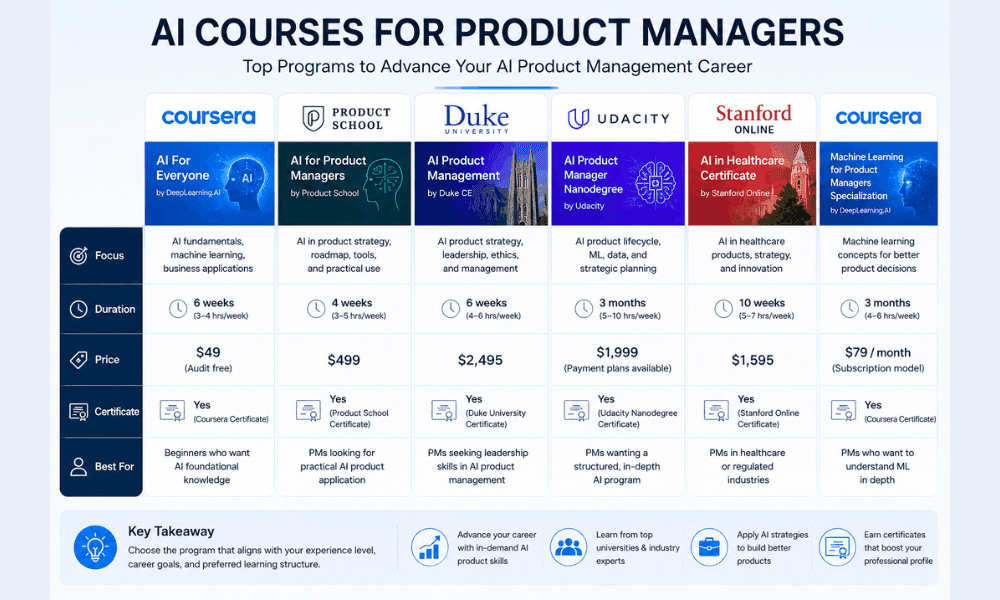
| Course Name | Platform | Duration | Key Focus | Certificate |
|---|---|---|---|---|
| IBM AI Product Manager Professional Certificate | Coursera | ~3 months (self-paced) | GenAI tools, prompt engineering, PM fundamentals | Yes (IBM + ACE/ECTS credit) |
| Product School AI Product Management Certification | Product School (live) | ~1 week intensive cohort | Strategy, AI tool workflows, portfolio project | Yes (industry cert) |
| Duke AI Product Management Specialization | Coursera | 3–6 months (flexible) | ML foundations, ethics, human-centered AI | Yes (Duke, no university credit) |
| Udacity AI Product Manager Nanodegree | Udacity | ~18 hours core content | LLMs, datasets, PRDs for AI features | Yes (Nanodegree) |
| Stanford Mastering Generative AI for Product Innovation | Stanford Online | ~11 hours, short format | GenAI strategy for experienced leaders | Yes (Stanford Certificate) |
Top AI Courses for Product Managers in 2026
IBM AI Product Manager Professional Certificate Review

Summary
When someone asks what the finest AI courses are for product managers, this is one of the most talked-about entries, and it gets the attention.
Layered with generative AI training, it is a 10-course Coursera curriculum specifically designed around the duties, responsibilities, skills, competencies, and knowledge needs for a product manager’s success.
Without requiring any prior PM or technical experience, it is intended to take you from zero to job-ready.
What You Will Learn
- Core PM fundamentals: product concept, vision, project charter, backlog creation, and sprint planning
- Hands-on use of generative AI platforms such as IBM watsonx and Hugging Face
, plus tools like ChatGPT, Gemini, Copilot, and DALL-E for product management tasks - The AI product manager course Coursera track also covers ethical considerations, stakeholder communication, and preparation for the AIPMM Certified Product Manager exam
Pros
- Genuinely beginner-friendly, no prerequisites.
- Backed by a recognizable brand and ACE/ECTS credit recommendation.
- Affordable — roughly $150–$180 total if completed within the 3-month pace.
Cons
- Self-paced format means less accountability than a live cohort.
- Broad rather than deep on advanced GenAI strategy.
Who Is This For? Career switchers, associate PMs, and anyone who wants a structured, budget-friendly on-ramp into AI product work.
Product School AI Product Management Certification
Overview
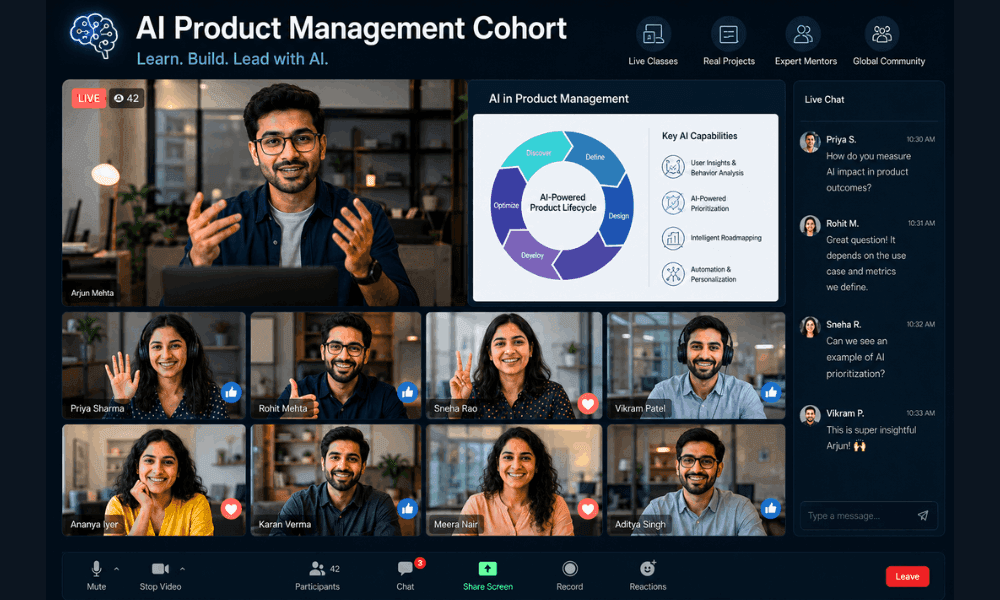
Product School takes the opposite approach from IBM: live, small-cohort, instructor-led sessions rather than self-paced video. It’s part of a broader suite of Top AI product management programs the company now offers under its “AI Builder” umbrella, alongside certifications in AI evals and AI agents.
What You Will Learn
- How to apply AI tools directly inside real product workflows — from PRDs to prototyping.
- Frameworks for evaluating AI opportunities and running experiments.
- A portfolio project built during the course, plus resume and mock-interview support.
Pros
- Instructors come from companies like Google, Meta, Netflix, and Amazon.
- Small cohort sizes mean real feedback, not just recorded lectures.
- Strong alumni network and ongoing community access.
Cons
- Significantly pricier than the self-paced alternatives — a single certification runs about $2,999.
- The intensive, short format demands a real time commitment in a short window.
Who Is This For? Working PMs whose employer is footing the bill, or anyone who learns best through live discussion and peer accountability rather than solo video courses.
Duke University AI Product Management Specialization
Overview
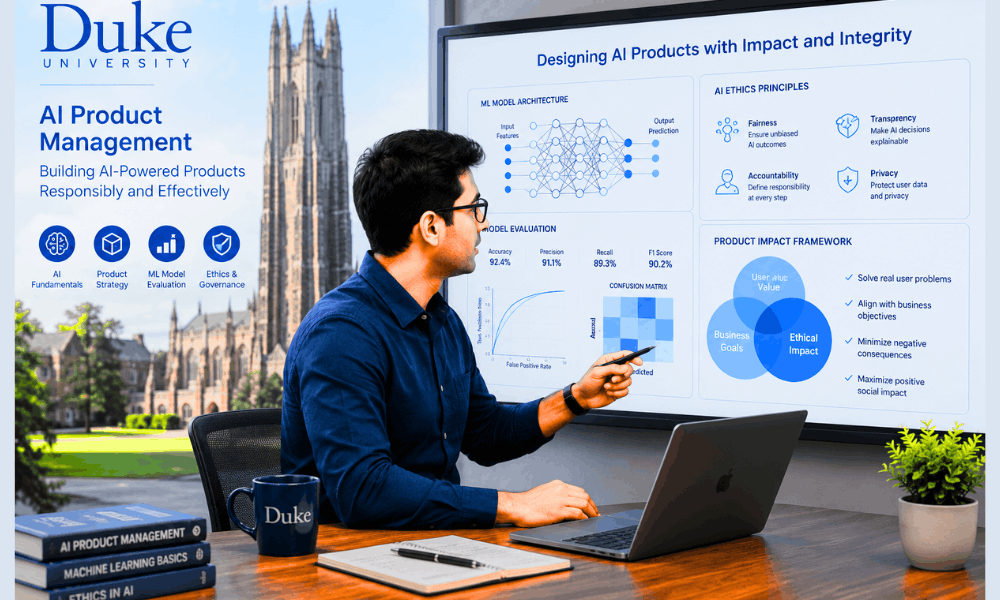
If you want a university name attached to your resume without university-level cost, this is one of the best AI courses for product managers in that budget-conscious category. It’s a three-course specialization from Duke’s Pratt School of Engineering, hosted on Coursera.
What You Will Learn
- A genuinely non-coding introduction to how machine learning models are built and evaluated.
- How to apply the data science process to organize and lead ML projects from opportunity to deployment.
- Human-centered AI design, including privacy, fairness, and bias mitigation.
Pros
- Free to audit the entire specialization.
- Rated 4.7/5 across roughly 1,200 Coursera reviews.
- Strong on ethics and human factors — often skipped elsewhere.
Cons
- No official university credit, despite the Duke branding.
- Recommended pace stretches to 3–6 months, which requires discipline.
Who Is This For? PMs who want to genuinely understand the mechanics of machine learning, not just the product-layer vocabulary.
Udacity AI Product Manager Nanodegree
Overview
This one assumes you already have some PM footing. It’s built for people actively managing AI product lifecycle work today, not absolute beginners.
What You Will Learn
- Translating AI capabilities and data requirements into structured product requirement documents.
- Working with multimodal data — text, video, and audio — in AI features.
- Applying large language models within product strategy, plus model bias and performance evaluation.
Pros
- Compact — around 18 hours of core lesson content.
- Practical, project-based assignments with expert feedback.
- Useful for PMs already shipping AI features who want sharper technical vocabulary.
Cons
- Prerequisites include basic product management knowledge and descriptive statistics, so it’s not ideal for complete beginners.
- Subscription pricing can add up if you move slowly.
Who Is This For? PMs with some experience who want to go one layer deeper technically without becoming engineers.
Stanford Mastering Generative AI for Product Innovation
Overview
This is the shortest, most senior-leaning option on this list. It’s taught by <cite index=”41-1″>machine learning expert and principal PM Aditya Challapally, along with Stanford Professor Edison Tse</cite>, and squeezes a lot of strategic thinking into a compact format.
What You Will Learn
- How to identify and evaluate opportunities for utilizing generative AI to address user pain points.
- A framework for integrating generative AI into your company’s products.
- Generative AI for product managers decision-making: selecting models, weighing risk, and building an implementation plan.
Pros
- Stanford name recognition carries real weight with hiring managers and leadership.
- Short format — you can realistically finish it in a few sittings.
- Built for strategic thinking, not tool tutorials.
Cons
- Priced around $995, high for the amount of content compared to Coursera options.
- Assumes some existing product management experience — this isn’t a starting point for beginners.
Who Is This For? Senior PMs, product leaders, and founders who need a credible, fast credential to guide AI strategy conversations at the leadership level.
Fees and ROI Comparison Table
| Course | Price | Free Option | Best For | ROI Rating |
|---|---|---|---|---|
| IBM AI Product Manager | ~$49/month (≈$150–180 total) | 7-day trial | Beginners, budget-conscious learners | High (low cost, broad recognition) |
| Product School | $2,999 single cert / $4,999 unlimited | None | Employer-funded, live-cohort learners | Medium (high cost, strong network) |
| Duke Specialization | ~$39–49/month | Full audit | Learners who want ML depth | High (free to learn, cheap to certify) |
| Udacity Nanodegree | Subscription-based, varies | Free preview | PMs with some experience | Medium |
| Stanford GenAI Course | ~$995 one-time | None | Senior leaders needing fast credibility | Medium-High (brand value) |
What Should Non-Technical PMs Look for in an AI Course?
No-Code Learning Approach
The single biggest filter to apply is whether a course actually requires writing code. The strongest best generative AI certification for product leaders options teach concepts through diagrams, case studies, and no-code tools — not Jupyter notebooks.
Business Case Studies
Look for courses built around real product decisions, not just theoretical AI explanations.
The ones that stuck with me most used actual company examples of AI features that succeeded — and ones that flopped.
Product Frameworks and Strategy
A good program should hand you reusable AI product strategy frameworks — for opportunity assessment, model selection, and risk evaluation — that you can apply the next day at work, not just vocabulary.
Industry Recognition and Certification Value
Before signing up, ensure that the certificate is one that recruiters really value and not just some fancy PDF. Reputation, number of reviews, and the reputation of the instructor all make a difference in this regard.
Future Trends Product Managers Should Watch in 2026
A few threads are showing up across every course and every product team I’ve talked to this year:
- Agentic AI — systems that take multi-step actions on a user’s behalf, not just answer questions
- AI copilots for product teams — embedded assistants inside PM tools like roadmapping and analytics platforms
- AI governance for product managers — internal policies for responsible AI product development are becoming standard, not optional
- AI product analytics and AI decision intelligence — using AI to interpret usage data, not just collect it
- AI workflow automation streamlining repetitive PM tasks like status updates and stakeholder reports
None of these require you to code. They do require you to have a working mental model of how these systems behave — which is exactly what a good course builds.
Final Recommendation and Conclusion
After going through all five programs, here’s how I’d steer different readers:
- Recommended learning path: Start with Duke’s specialization or IBM’s certificate to build vocabulary, then layer on Udacity or Stanford once you’re applying AI concepts to real roadmap decisions.
- Best for beginners: IBM AI Product Manager Professional Certificate — affordable, structured, zero prerequisites.
- Best for experienced PMs: Stanford Mastering Generative AI for Product Innovation — fast, strategic, credible.
- Best budget option: Duke AI Product Management Specialization — free to audit, cheap to certify.
- Best certification option (live, high-touch): Product School AI Product Management Certification.
If you’re still asking yourself what are the best AI courses for product managers, and wondering how to become an AI product manager without coding, the honest starting point is this: pick one course, finish it completely, and apply what you learn to one real feature on your roadmap this quarter.
That single applied project will teach you more than switching between five different courses ever will.
Action plan: Pick one course from this list today, block two hours a week on your calendar for it, and set a deadline to finish within your first billing cycle. Momentum beats perfection here.

Frequently Asked Questions
1. Can I Become an AI Product Manager Without a Computer Science Degree?
Yes. All courses covered in this guide are tailored for non-tech individuals. More important than having a Computer Science degree is your capacity to articulate problems in business terms and work effectively with data science and engineering teams.
2. What Are the Best Free AI Courses for Working Professionals with Certificates?
Duke’s AI Product Management Specialization can be audited entirely for free, and IBM’s certificate offers a 7-day free trial. For free AI courses for working professionals with certificates, auditing first and paying only when you’re ready for the graded certificate is a smart way to test fit before spending money.
3. Is Prompt Engineering Important for Product Managers?
Increasingly, yes. Prompt engineering for product managers isn’t about writing perfect prompts — it’s about understanding what a model can and can’t reliably do, so you can scope features honestly and set realistic expectations with stakeholders.
4. Which AI Certification Gives the Best Career ROI in 2026?
For most people, IBM’s certificate offers the strongest ratio of cost to career signal, given its low price and broad recognition. If budget isn’t a constraint and you want a live, project-based experience, Product School delivers more hands-on polish for a much higher price.
5. Are AI Product Management Certifications Worth It?
Generally, yes — if you actually finish the program and build the portfolio project. A half-completed subscription helps no one. The certificate matters less than being able to speak fluently about AI tradeoffs in an interview or a product review.
3 thoughts on “Top AI Courses for Product Managers in 2026 (No Coding Required)”