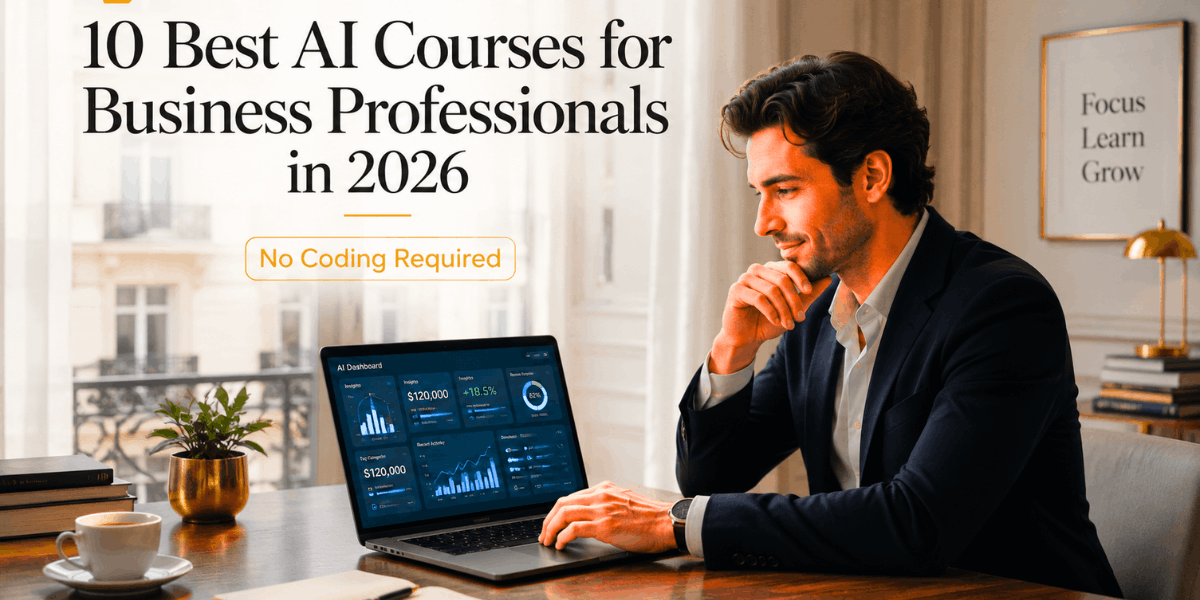
If you manage a team, run a small business, or make decisions that affect other people’s work, you don’t need to write a single line of code to use AI well. What you need is a clear sense of what these tools can and can’t do, and a bit of structured practice.
That’s the gap most business leaders are trying to close right now. Picking the best AI course for business professionals isn’t about finding the most technical program — it’s about finding the one that fits your role, your time, and what you actually plan to do with AI. This guide is built for AI for non-technical professionals: managers, marketers, HR leads, finance teams, and founders who want practical skills, not a computer science degree.
Below are ten well-established, no-code-required options, compared side by side so you can pick one and get moving.

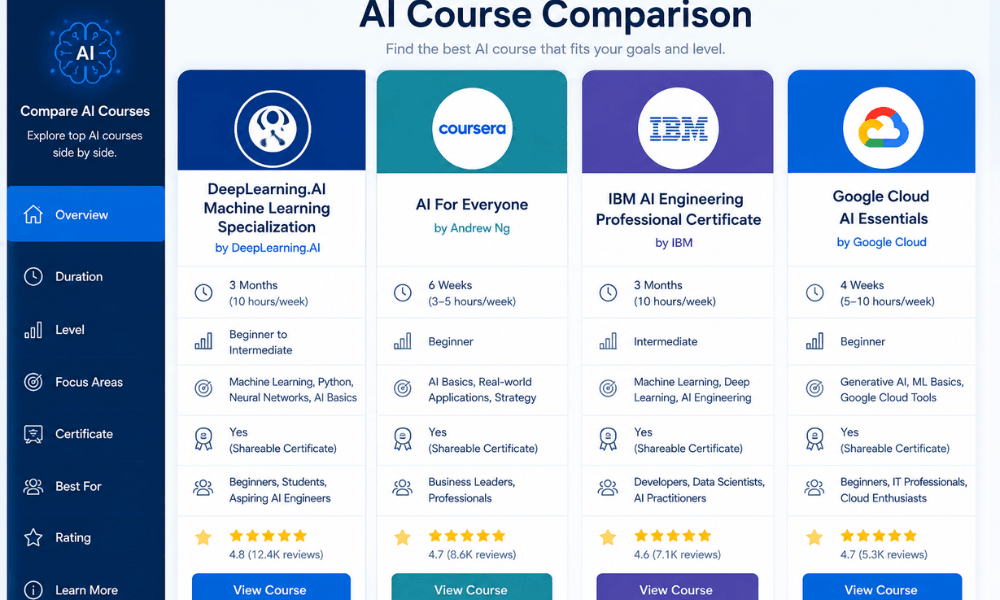
Quick Comparison: Top AI Courses for Leaders & Managers
Before diving into the details, here’s how the ten programs stack up against each other. This table is meant as a starting point — use it to shortlist two or three options, then read the full reviews below for the context that actually matters, like who each course is really built for.
Several of these count among the top artificial intelligence courses for business precisely because they don’t assume any prior technical background.
Others lean more toward AI certifications for business leaders who already have some AI exposure and want a strategy-level credential.
A few are pure no-code AI learning: short, tool-focused, and meant to be applied the same week you take them.
| Course Name | Provider/Platform | Level | Duration | Key Focus | Pricing/Certificate Type |
|---|---|---|---|---|---|
| AI for Everyone | DeepLearning.AI (Coursera) | Beginner | ~6 hours | AI fundamentals & business strategy | Free to audit; $49 for certificate |
| Google AI Essentials | Google (Coursera) | Beginner | ~8–10 hours | Generative AI tools & productivity | ~$49/month subscription |
| AI: Implications for Business Strategy | MIT Sloan & MIT CSAIL | Executive | 6 weeks | AI strategy & implementation roadmap | Subscription/course-dependent; typically several thousand USD |
| AI for Business Specialization | Wharton (Coursera) | Intermediate | ~44 hours | AI in marketing, finance, HR, ops | ~$49/month or Coursera Plus |
| AI for Business Leaders / AI Transformation Leader | Microsoft (Learn / Certifications) | Beginner–Executive | Self-paced | Enterprise AI adoption, Copilot, governance | Free learning paths; certification exam fee varies |
| Data Science and AI Principles / for Decision Making | Harvard Online / HBS Online | Beginner–Intermediate | Self-paced; ~20–30 hours | Data-driven decision making | Varies; HBS Online course around $1,850 |
| Generative AI for Executives and Business Leaders | IBM (Coursera) | Beginner–Intermediate | ~10 hours | GenAI strategy & use cases | Free to audit; paid certificate |
| Oxford Artificial Intelligence Programme | University of Oxford (Saïd Business School) | Executive | Several weeks | AI leadership, ethics, policy | Subscription/course-dependent; executive-education pricing |
| Prompt Engineering for ChatGPT | Vanderbilt University (Coursera) | Beginner | ~12–14 hours (single course) | Prompt engineering & productivity | Free to audit; ~$49/month for certificate |
| AI for Productivity / AI Product Management | Duke University (Coursera) | Beginner–Intermediate | Varies by course | AI tool use & product operations | Free to audit; paid certificate |
Why Business Leaders Must Learn AI Without Coding in 2026
I’ve spoken with enough managers this year to notice a pattern. The confident ones aren’t the technical ones — they’re the ones who built real AI literacy for leaders instead of skimming headlines and hoping for the best.
That confidence shows up in small moments. A finance director I know now uses AI-assisted research to pull market comparisons together in an afternoon, not a week. Nobody taught her to code.
Forecasting and analysis work the same way. Sales teams feed historical numbers into an AI tool and get a rough demand projection in minutes, then adjust it with their own judgment. That’s data-driven decision making with AI, not theory.
Productivity gains show up fast too. Marketing teams draft five email versions in the time it used to take for one. Operations leads set up no-code AI automation to flag late shipments before a customer notices.
Communication changes as well — managers who’ve taken even one solid course stop asking vague questions and start pushing teams toward specific answers.
None of this replaces judgment. Responsible AI use still means checking outputs and protecting customer data, especially where customer experience and operational efficiency are on the line.
Automated business process workflows need an individual to know the limitations of the system at a high-level position. This is why selecting the most suitable AI course for businesspeople is more important than adopting any newly launched product.

Detailed Reviews: 10 Best AI Courses for Business Professionals
Here’s where things get specific. These ten reviews cover exactly what each course teaches, who it’s built for, and whether it’s worth your time — everything you need to pick the best AI course for business professionals instead of guessing off a homepage.
1. AI for Everyone by DeepLearning.AI (Andrew Ng)
If you’re starting from zero, this is where I’d point you. DeepLearning.AI AI for Everyone breaks down AI fundamentals in plain language — no jargon dump, no assumption you already know what a neural network does.
Andrew Ng built this for non-technical professionals who need organizational understanding, not engineering chops. You’ll leave with enough terminology to sit in a strategy meeting without nodding along blankly.
It leans into business strategy over hands-on tool use, and honestly, that’s the point. Think of it as AI fundamentals for non-technical managers — a shared vocabulary before anything more advanced. Free to audit, $49 for the certificate, six hours well spent.
2. Google AI Essentials Specialization (Coursera)
This one’s more hands-on. Instead of theory, Google AI Essentials certification puts you straight into using generative AI tools for real workplace tasks — drafting emails, summarizing reports, brainstorming faster than you’d manage solo.
I like that it treats prompt engineering for professionals as an actual skill, not an afterthought tacked onto module four. You get a framework for writing prompts that work, which cuts down a lot of trial and error.
At roughly $49 a month and under ten hours, it’s a low-risk way to build real day-to-day fluency. If immediate productivity matters more than strategic depth, start here instead of the Andrew Ng course.
3. MIT Sloan: Artificial Intelligence – Implications for Business Strategy
MIT Sloan Artificial Intelligence: Implications for Business Strategy is a different animal entirely. Six weeks, case studies, a capstone project — this isn’t a course you finish over a lunch break.
I’d steer complete beginners away from it. The program assumes you already understand basic AI strategy and want to apply it to organizational transformation, not learn what a large language model is for the first time.
What earns it a spot here is the capstone — you leave with an actual roadmap for your own company, not just notes. Among executive AI programs, this one carries real weight for leadership decisions with budget attached.
4. Wharton: AI for Business Specialization
Wharton AI for Business Specialization takes a different approach — rather than one big strategy conversation, it splits AI applications in business into digestible chunks across finance, marketing, HR, and operations.
I appreciate that structure. A marketing manager can focus on marketing modules without wading through finance case studies that have nothing to do with their job.
This stays grounded and practical rather than technical — no code, but real strategic decision-making skills built for your specific function. At around 44 hours across four courses, it’s a bigger commitment, but the function-by-function design makes it easy to justify to a manager approving the time.
5. Microsoft: AI for Business Leaders
Microsoft doesn’t offer one single course — it’s more of an ecosystem, worth knowing before you dive in. Free Microsoft Learn paths cover enterprise AI adoption and Microsoft Copilot for business at zero cost.
For something formal, Microsoft’s newer certifications focus on AI governance and ethics for managers rather than technical implementation. Titles here shift more often than most providers, so confirm the current name before enrolling.
What’s stayed consistent is the emphasis on organizational transformation inside the Microsoft ecosystem — Copilot, security, governance. If your company already runs on Microsoft 365, this path just makes sense over switching providers entirely.
6. Harvard Online: Data Science and AI Principles for Business
Harvard splits its offerings across two distinct programs, and confusing them is an easy mistake. Data Science and AI Principles stays nearly code-free, built for an AI course for decision makers who work alongside data teams daily.
The second option, through HBS Online, goes deeper into data-driven business strategy using a tool called Julius to build and validate models — still no programming involved.
I wouldn’t call either one a single unified AI certification the way some marketing pages suggest. Check the actual curriculum first. Both suit leaders who need analytics literacy, not technical fluency they’ll never use.
7. IBM: Generative AI for Leaders and Business Decision Makers
IBM built this one specifically for executives, and it shows. Generative AI courses for business strategy get covered through actual use cases — customer service, marketing, HR, finance — not abstract theory nobody applies.
At around ten hours across three courses, it moves quickly. What surprised me was the coverage of agentic AI workflows for business professionals, an early look at AI handling multi-step tasks instead of single prompts.
Some exercises lean on IBM’s own watsonx platform, worth noting if your company runs different infrastructure. Still, for decision-making grounded in real scenarios rather than hype, this earns its place on the list.
8. Oxford: Artificial Intelligence Programme
The Oxford Artificial Intelligence Programme goes somewhere most business courses skip — deep into AI strategy and policy, ethics, and the social implications leaders increasingly need to address out loud.
This isn’t for someone dipping a toe in for the first time. It suits senior professionals and executives who might represent their company in regulatory conversations, not managers chasing a quick productivity win.
Delivered through weekly modules with Oxford faculty access, it functions almost like an AI leadership certification rather than a skills class. The price reflects that executive-education positioning — a bigger commitment, worth it if governance work is genuinely part of your role.
9. Vanderbilt University: Prompt Engineering for ChatGPT (Coursera)
Jules White’s course is the one I recommend most often for sheer usefulness. Business prompt engineering doesn’t get more foundational than this — persona prompts, few-shot examples, requests structured to actually produce something you can use.
It’s built around ChatGPT for business, and that matters because these techniques don’t transfer perfectly to Microsoft Copilot for business or Google Gemini for business. Each platform has its own quirks, so treat this as principles, not a universal script.
At 12 to 14 hours and free to audit, it’s one of the lowest-commitment, highest-payoff picks on this entire list.
10. Duke University: AI Foundations for Everyone
Duke rounds this list out with something more applied than most beginner options. AI certification without coding is the whole premise — tool use for professionals who need results this week, not next quarter.
Their AI for Productivity course covers everyday tasks, while the AI Product Management specialization pushes into business operations with AI for anyone leading cross-functional product work.
I’d treat Duke as a second course rather than a first. If you’ve already got the fundamentals down, this is where you start applying them — a natural next step once the theory actually clicks.
How to Choose the Right AI Course for Your Career Stage
Not every course on this list makes sense for every reader, and that’s by design. The right choice depends less on which program has the flashiest brand name and more on what decisions you’re actually responsible for at work.
An executive shaping company-wide AI policy has very different needs than a marketing manager who mainly wants to speed up campaign production.
Use the table below as a starting filter, then cross-reference with the full reviews above for the specifics that matter to your situation.
| Career Role | Best Course Match | Primary Benefit |
|---|---|---|
| Executive | MIT Sloan or Oxford AI Programme | Best AI certification for managers driving org-wide AI strategy |
| Mid-level Manager | Wharton AI for Business | Function-specific application across marketing, finance, ops |
| Small Business Owner | Google AI Essentials or Duke AI for Productivity | Fast, practical productivity gains with minimal time investment |
| Marketing Professional | Google AI Essentials or Vanderbilt Prompt Engineering | Prompt skills that translate directly into content and campaign work |
| Operations Manager | IBM Generative AI for Leaders | Use-case coverage across ITOps, FinOps, and process automation |
| HR Professional | Wharton AI for Business | Governance and ethics grounding for AI in hiring and people decisions |
| Product Manager | Duke AI Product Management | Cross-functional fluency for leading AI-powered product work |
| Beginner / Non-Technical Professional | DeepLearning.AI AI for Everyone | Zero-jargon starting point before anything more advanced |
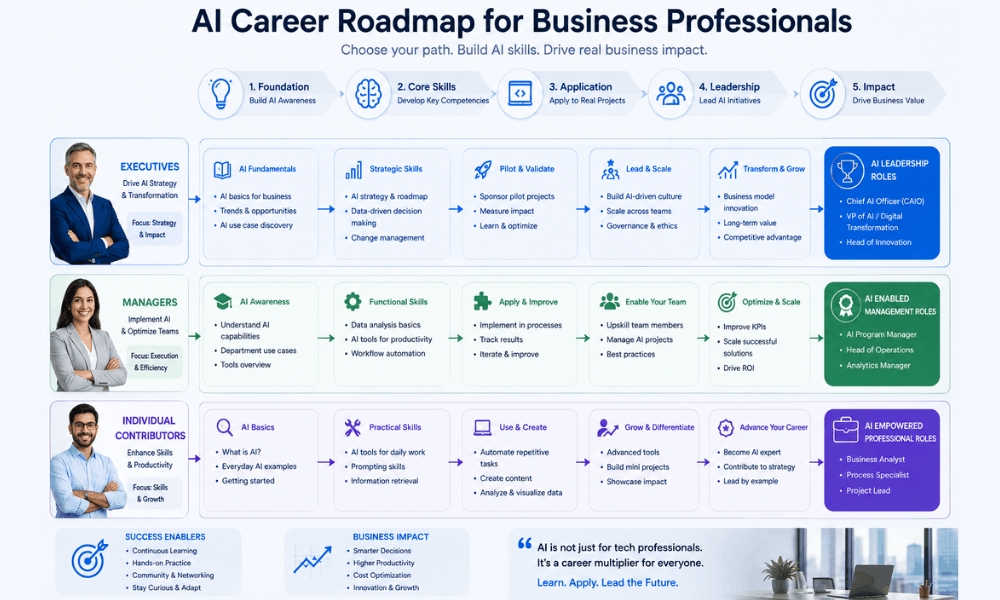
This is a general AI career roadmap for business, not a strict rulebook — plenty of professionals benefit from combining two courses from different rows.
An operations manager who takes both the IBM course and Google AI Essentials, for instance, ends up with both use-case knowledge and hands-on tool fluency, which is a reasonable strategy if you have the time.
The broader pattern worth remembering: executives tend to prioritize AI for managers and executives 2026-style strategic frameworks, while individual contributors and small-business owners usually get more immediate value from tool-focused, productivity-oriented courses.
Free vs. Paid AI Certifications: What Gives the Best ROI?
Most of the courses on this list offer some form of free audit, with the paid tier unlocking a certificate rather than additional content. That distinction matters more than people often assume when weighing free vs paid AI courses.
If your goal is purely to build skills, auditing for free and skipping the certificate can be entirely reasonable — the learning happens either way.
If you need something to put on LinkedIn or justify to a manager who approved a training budget, the certificate becomes worth the modest cost, particularly for programs in the roughly $49-to-$300 range.
Executive-level programs from MIT Sloan and Oxford sit in a different category. Their tuition reflects live faculty engagement, cohort-based learning, and brand recognition that a self-paced Coursera certificate generally doesn’t carry.
For managers weighing best value AI certification options, employer-sponsored learning is worth exploring first — many companies now reimburse professional development costs, especially for AI-related training given how fast the skills gap is moving.
Here’s the honest caveat: a certificate alone doesn’t prove AI proficiency. What tends to matter more on a resume or in an interview is being able to describe a specific way you applied AI to a real business problem.
Treat the certificate as a signal, not the substance — the practical workplace value comes from what you actually do with the skills afterward.
Conclusion & Final Verdict
Picking the best AI course for business professionals really comes down to knowing your own role first, then matching it to a course instead of chasing the biggest name on the page.
For a true beginner, DeepLearning.AI’s AI for Everyone is still my top pick — plain language, zero pressure, a solid place to start. Executives get more out of MIT Sloan or Oxford, where the depth actually matches their responsibilities.
Want practical productivity gains fast? Google AI Essentials delivers that within days. For AI strategy specifically, MIT Sloan holds the edge. Vanderbilt wins for prompt engineering, hands down — nothing else here teaches it as cleanly. Wharton covers cross-functional business applications better than any single-topic course could.
Here’s my honest advice: don’t try three courses at once. Pick the best AI course for business professionals based on what your job actually needs this quarter, finish it, then decide what comes next.
Frequently Asked Questions (FAQ)
1. Do business professionals need coding skills to learn AI?
No, and this trips people up more than it should. A no-code AI course for professionals teaches you to use AI tools well, not build them from scratch.
I’ve watched finance managers skip programming entirely and still run circles around technical peers, just by asking sharper questions.
2. Which AI certification carries the most weight on LinkedIn?
Honestly, it depends who’s looking at your profile. A recognized AI certification for leaders from MIT or Wharton impresses some hiring managers, while others care more about Google or IBM badges tied to actual tools.
Nobody’s certificate wins every room. Pick the one that matches your industry, not the one with the fanciest name.
3. How long does it take for a manager to become AI proficient?
It varies more than people admit. Basic literacy comes from a single weekend course, easily.
The real AI learning curve for professionals shows up later — building genuine habits around these tools usually takes eight to twelve weeks of regular, sometimes clumsy, practice before it starts feeling natural.
4. Which AI course gives the best ROI for managers?
Depends entirely on your goals, and I mean that literally. Chasing a promotion into strategy work? MIT Sloan pays off faster despite the higher price tag.
Just want daily time saved? A cheaper, tool-focused course like Google AI Essentials often earns its cost back within a week.
5. Can I learn business AI without learning programming?
Yes, completely. AI literacy means understanding concepts. AI tool use means prompting existing platforms well. Automation means connecting tools into a workflow.
None of that touches programming — technical AI development, building or training models, is a separate, much narrower skill entirely.