
Can You Become a Prompt Engineer With No Experience?
Honestly, yes. AI hiring right now feels a bit like the early days of web design (when nobody had a formal degree for it, but people who could actually do the work got hired anyway).
That’s roughly where prompt engineering sits in 2026. Companies need people who understand how to talk to models, and a surprising number of them don’t care where you learned it.
The first thing I tell people who message me asking about this is: coding is not the starting line here (it can help later, but it’s not what gets your foot in the door).
So if your biggest worry is “I have no experience,” take a breath. That worry is normal, and it’s also not the dealbreaker it feels like. When I first looked into this myself, I assumed I’d need a technical background just to apply. I didn’t.
What actually helped me figure out how to become a prompt engineer with no experience was realizing the job is bigger than writing catchy ChatGPT prompts. It includes checking whether an AI’s answers are actually correct, building small workflows, writing system instructions, and testing quality (basically, a mix of writing, logic, and patience).
Once I understood that, the search for ai prompt engineer jobs remote no experience required started making a lot more sense, and so did the wave of postings for entry level prompt engineer jobs remote that don’t ask for a CS degree at all.
I won’t pretend this is instant. Nobody hands you a role in a week. But it’s genuinely reachable if you put in real, consistent work.
What Does a Remote Prompt Engineer Actually Do?
The job title sounds narrow, but the actual work covers several related tasks (which is worth understanding before you start applying).

Designing Better Prompts and System Instructions
A big part of the job involves writing and refining instructions that shape how an AI model behaves. This includes system prompts, user prompts, and context that guides tone, format, and accuracy.
Beginners also learn system prompts and guardrails design, which means setting boundaries so the model stays safe, consistent, and on-topic.
Testing and Evaluating LLM Responses
Once a prompt is written, someone has to check whether the output is actually good. This means reviewing responses for accuracy, relevance, and consistency (not just whether the answer “sounds right”).
It also involves checking for bias, hallucinations, and formatting errors. Many teams now hire an AI content evaluator specifically for this, and this work is often grouped under LLM evaluation, which increasingly includes basic large language models output parsing to confirm structured data is returned correctly.
Working With AI Workflows
Modern roles rarely stop at single prompts. You’ll often work inside chatbot workflows, connect prompts together in sequence, and support structured outputs that feed into other systems.
This is where AI agent prompt design comes in — designing how an AI agent decides what to do next. Many entry-level roles now blend prompting, evaluation, and light workflow design into one job.
What Skills Do You Need for Entry-Level Prompt Engineering?
People overthink this part a lot. When I started learning prompt engineering, I made a giant list of “must-learn” skills that honestly scared me off for a week (turns out most of it wasn’t even necessary at the beginner stage). So let’s keep this simple and split it into what actually matters first.
Prompting Techniques Every Beginner Should Learn
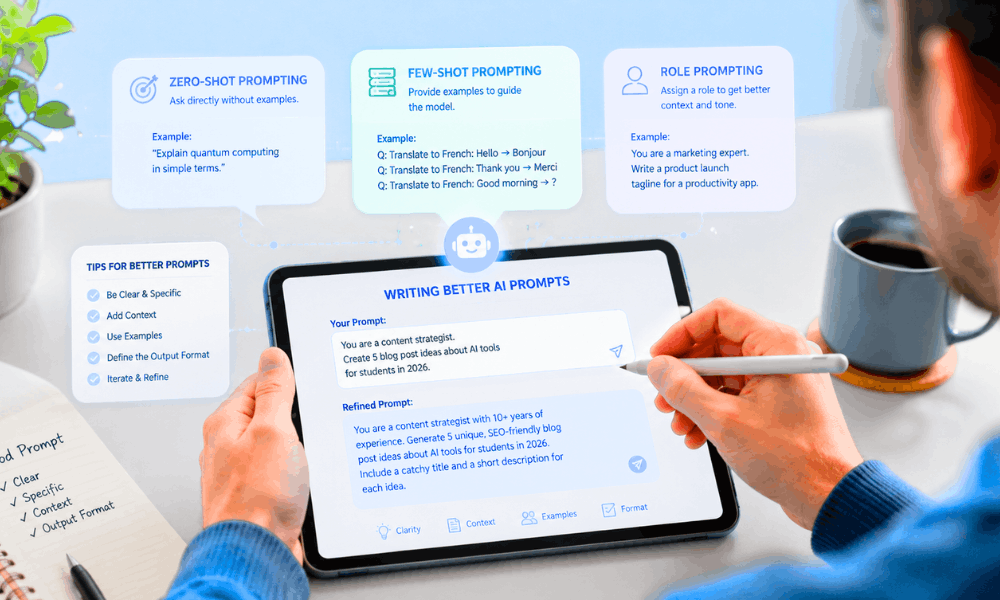
Start with zero-shot prompting, which is just asking a question with zero examples attached. Then move to few-shot prompting, where you give the model two or three sample answers so it understands the pattern you want (this alone fixed half my early prompting mistakes).
Role prompting is next, basically telling the AI “act as a support agent” or “act as a teacher.” Add structured prompting for formats like tables or JSON, and practice prompt chaining, where one output feeds into the next step.
Getting comfortable with prompt chaining and few-shot prompting techniques early made everything else click faster for me. You can also ask a model to reason step by step at a high level, without needing to dig into or expose any hidden reasoning — concise instructions and structured outputs usually work better anyway. Keep testing and rewriting until the output feels right. Iterative testing, basically.
Non-Coding Skills That Can Make You Competitive
Here’s the part people skip: critical thinking, research habits, plain writing skills, logic, attention to detail, communication, and honestly just being someone who double-checks things.
I noticed my background in writing helped more than any tutorial did, because spotting a weak or vague AI response takes the same instinct as editing bad copy.
Technical Skills Worth Adding Later
JSON, APIs, a little Python, evaluation frameworks, basic data analysis, and light automation are all worth picking up eventually (they widen the type of ai prompt engineer jobs remote no experience listings you can apply for).
But none of these are mandatory on day one. Most beginner roles genuinely don’t ask for them upfront, so don’t let a missing skill on this list stop you from applying to entry level prompt engineer jobs remote right now.
How to Land Remote AI Prompt Engineer Jobs for Beginners: A 4-Step Roadmap
Step 1 — Learn the Fundamentals for Free
Start with DeepLearning.AI’s short prompting courses and Coursera’s beginner tracks (both are free to audit, which is where I began).
OpenAI’s own documentation is also worth reading for the technical basics, even if it reads a bit dry. Don’t chase every free prompt engineering certifications for beginners badge you can find, though — a certificate is nice, but it’s not the same as a formal professional credential, and not every course hands one out.
Following a simple prompt engineering roadmap 2026 for beginners matters more than collecting course completions. Honestly, finishing courses helped me feel confident, but it wasn’t until I built something real that people actually took notice.
Step 2 — Build a Job-Winning Portfolio Without Experience
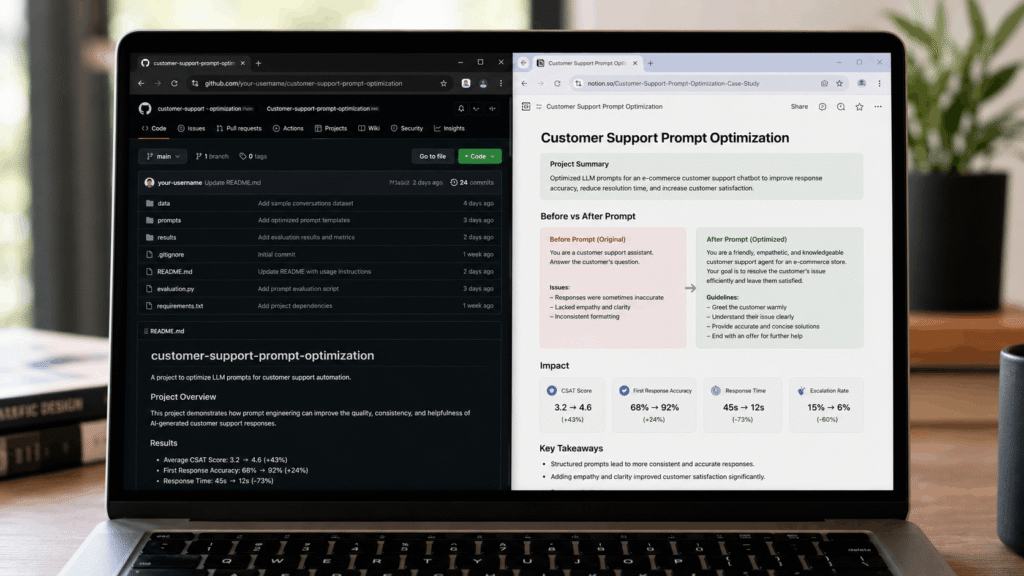
This is the step nobody wants to do, and it’s also the one that actually gets you noticed. Figuring out how to build a prompt engineering portfolio without experience just means picking a real problem and writing it up properly.
Use GitHub for organized files, Notion for case studies, or even a few GitHub Gists for smaller examples (whatever’s easiest for you to keep updated).
Try building a “Customer Support Prompt Optimization” project: show the original weak prompt, explain the problem with it, write your improved version, run a handful of test cases, compare the before-and-after outputs side by side, list your evaluation criteria, and summarize the final result. That’s it. That single project is proof of skill, and it speaks louder than any resume line.
Step 3 — Get Practical Experience Through Freelancing and AI Evaluation
Upwork and Fiverr both have gigs listed under freelance ai prompt engineer remote work, and they’re a decent way to get paid while you’re still learning.
There are also dedicated AI evaluation platforms hiring people for auditing tasks and light red teaming — searching LLM evaluation and red teaming jobs entry level often turns up more openings than searching “prompt engineer” alone.
Before you commit time to any of these, check the platform’s legitimacy, how and when they actually pay, whether your location is eligible, and whether the listing is even still active (some sit up long after roles are filled).
Step 4 — Optimize Your Resume and LinkedIn Profile
Keep your headline specific, something like “Prompt Design & LLM Evaluation,” not just “AI Enthusiast.” Link your portfolio directly. List real projects, not vague buzzwords, and include any courses you finished.
If you can quantify a result (like “improved response accuracy across 20 test cases”), do it. And please, don’t claim work experience you don’t have — a thin but honest profile beats a padded, dishonest one every single time.
Best Platforms to Find Remote Entry-Level AI Prompt Engineer Jobs
Not every platform will always have open prompt engineering roles, and availability shifts constantly. Still, these are commonly used starting points:
| Platform | Best For | Experience Level | Hiring Type |
|---|---|---|---|
| Wellfound | AI/startup roles | Beginner–Intermediate | Full-time/Contract |
| LinkedIn Jobs | Broad AI opportunities | Beginner–Senior | Full-time/Contract |
| Upwork | Freelance AI work | Beginner–Experienced | Freelance |
| Fiverr | Service-based freelance work | Beginner–Experienced | Freelance |
| Remotive | Remote jobs | Beginner–Experienced | Full-time/Contract |
| DataAnnotation | AI evaluation/training tasks | Beginner–Intermediate | Contract/Task-based |
| Outlier | AI training/evaluation | Beginner–Intermediate | Contract/Task-based |
| Internshala | Internships and fresher roles | Beginner | Internship/Part-time |

Search Beyond the Job Title “Prompt Engineer”
Here’s a mistake I made early on: I only searched for “Prompt Engineer” and wondered why so few results showed up (turns out I was looking in a way-too-narrow box). Companies label this work all sorts of things.
Try searching AI Trainer, LLM Evaluator, AI Content Evaluator, Generative AI Specialist, AI Quality Analyst, Conversational AI, AI Data Trainer, and Prompt Designer instead — you’ll be shocked how much more comes up.
Checking a few different best job boards for prompt engineers helps too, since one site’s algorithm won’t show you everything. I’d personally rotate between LinkedIn Jobs, Wellfound, Upwork, Fiverr, Remotive, and Internshala rather than sticking to just one.
Some of these are better for companies hiring prompt engineers no experience, while others lean more toward prompt engineer internships remote, so it’s worth checking each one with fresh eyes.
Entry-Level Remote AI Prompt Engineer Salary in 2026
Let’s be upfront: there’s no magic number here, and anyone who gives you one exact figure is probably guessing. Pay swings wildly depending on the country you’re in, who’s hiring you, how technical your skill set is, whether it’s freelance or full-time, the contract structure, your actual experience, and even what the role is titled.
I want to be honest about the table below too — I’m not pulling these from a live salary database, so treat them as illustrative starting ranges (rough numbers to get your expectations calibrated, not a paycheck guarantee). Real offers vary a lot by company and region, sometimes more than you’d expect.
| Region / Role Type | Typical Hourly Range (Illustrative) | Estimated Annual Range (Illustrative) |
|---|---|---|
| U.S. Entry-Level AI/Prompt-Related Roles | $20–$45 | $40,000–$75,000 |
| Global Remote Entry-Level Roles | $10–$30 | $20,000–$55,000 |
| Freelance AI Prompt Work | $15–$40+ | Variable, project-based |
| India/Fresher AI Roles | ₹300–₹900/hour | ₹3–₹8 lakh/year |
Take these as reference points, not promises. Always read the actual listing before assuming anything, especially for prompt engineer salary entry level roles, since pay can shift a lot depending on the industry behind the job.
A lot of part-time remote prompt engineer jobs pay hourly instead of salaried too, which changes how you should compare offers against each other. If you’re browsing remote generative AI jobs for freshers, my honest advice is don’t grab the first offer — check two or three before deciding.
What Can Increase Your Earning Potential?
A few things tend to bump your rate up over time: knowing how to run evaluations properly, basic comfort with APIs and Python, some automation know-how, familiarity with AI agents, and picking a domain you actually understand (like healthcare or finance).
Freelancing across a few clients instead of one also helps, and so does being able to write clearly about your process — technical writing and light data analysis both quietly raise your value.
What Are the Biggest Mistakes Beginners Make?
Some patterns show up again and again among people trying to break in:
- Assuming prompt engineering just means “using ChatGPT well”
- Applying without any portfolio to show
- Sending the same generic resume to every job
- Only searching for the exact title “Prompt Engineer”
- Copying prompts from the internet without testing them yourself
- Ignoring model evaluation as part of the skill set
- Expecting unrealistic salaries right out of the gate
- Claiming experience they don’t actually have
- Overlooking AI safety and guardrails entirely
Avoiding these mistakes matters just as much as building skills. Strong AI agent prompt design work and a genuine grasp of evaluation will separate you from the flood of applicants chasing generic ai prompt engineer jobs for beginners listings with nothing to show for it.
Final Thoughts — Your First Step Starts With a Portfolio

If there’s one thing I wish someone told me earlier, it’s this: nobody’s handing out ai prompt engineer jobs remote no experience required roles just because you finished a course (I wish it worked that way, but it really doesn’t).
What actually moves the needle is a mix of real skills, something concrete you can show, and applications sent to the right kind of roles instead of a hundred random ones.
So here’s my honest advice — don’t overthink your first move. Choose one real-world AI problem today, build a small prompt evaluation project around it, publish it somewhere visible, and use that project as the first link in your job applications (a single link, that’s genuinely enough to start).
I’ve seen beginners land their first ai prompt engineer jobs remote no experience opportunity from exactly this kind of small, honest starting point. Nothing fancy, just proof that you can actually do the work.
Frequently Asked Questions About Remote Prompt Engineering Jobs
1. Do I Need a Coding Degree for Prompt Engineering Jobs?
Nope, not for most entry-level work. I get asked this constantly, and the honest answer is that these roles lean more on language, logic, and evaluation skills than actual programming (which surprised me too when I first started looking into it). A little technical literacy, like understanding JSON, helps later, but it’s not a starting requirement.
2. How Long Does It Take to Learn Prompt Engineering From Scratch?
There’s no fixed number here, whatever anyone tells you. If you practice consistently, most people pick up the core prompting techniques within a few weeks to a couple of months. Building an actual portfolio on top of that takes extra time, and getting hired depends on effort and how competitive your target roles happen to be.
3. Is Prompt Engineering Still in High Demand in 2026?
Demand hasn’t gone away, it’s just shifted shape. A lot of companies now fold prompt work into evaluation, workflow design, AI training, and broader generative AI responsibilities (so the standalone job title shows up less than the skill itself does). The work is still very much needed, just under different names.
4. Can I Get a Remote AI Job Without Professional Experience?
Indeed, absolutely. A good portfolio, some small practical projects, an internship, and even some freelancing can do the trick for proving yourself without having any day of job experience at all.