If you’re a business analyst wondering which AI course is best for business analysts, the honest answer is: it depends on what you actually do all day.
A BA who spends most of their time writing user stories and running stakeholder workshops needs a different course than a BA who’s moving into an AI-strategy or product role.
This guide compares seven credible, well-known options — what they cover, who they suit, and how to shortlist one for your own career goal, experience level, and budget.
I’ve spent the last few years working alongside BAs who were adding AI skills to their toolkit, and I’ve gone through several of these programs myself while helping teams adopt generative AI for requirements work. What follows is a practical comparison, not a list of affiliate rankings.
The Evolving Role of Business Analysts in the AI Era
I remember sitting in a client workshop last year where half the requirements doc got drafted live, right there on screen, using a chatbot.
Nobody flinched. That’s honestly where things are now.
AI literacy isn’t some optional badge for business analysts anymore. It’s quietly becoming part of the job, the same way “comfortable with Excel” once was. You don’t explain spreadsheets in an interview these days — soon nobody will explain generative AI either.
Generative AI for business analysts has changed how requirements actually get gathered. Instead of staring at a blank template before a stakeholder call, plenty of BAs now start with a rough AI-drafted version, then spend the meeting refining it instead of building it from scratch.
Requirements elicitation using GenAI works best this way — as a starting point, never as a shortcut around actually listening to people.
Stakeholder communication has shifted too. Meeting summaries, action items, follow-up notes — all of that used to eat into an afternoon.
Now it takes minutes. That frees up real time for the harder parts of the job, like reading the room when a stakeholder disagrees with something they haven’t said out loud yet.
Documentation, user stories, reporting, even bits of workflow automation — AI touches most of it now, in small but genuine ways.
None of this means BAs need to learn Python or turn into AI engineers. That’s a different job entirely. What’s actually happening is the rise of a new kind of professional: the AI Business Analyst, someone who blends old-school BA instincts with practical, non-technical AI training for professionals.
It’s less about coding and more about knowing when to trust the output and when to push back on it. A lot of experienced BAs are making this career transition into an AI Business Analyst role without ever touching a line of code, and honestly, more people should know that’s possible.

So, Which AI Course Is Best for Business Analysts?
There isn’t one single answer to which AI course is best for business analysts — it depends on where you’re headed.
IBM’s Generative AI program works well as an all-rounder. MIT Sloan suits leadership and strategy folks. Vanderbilt is the pick for prompt engineering.
Microsoft Copilot training makes sense if your day runs through Excel and Teams. Google’s BI path fits data-heavy BAs. IIBA-endorsed training carries the most weight for BA-specific credibility, and DeepLearning.AI’s AI for Everyone is the easiest starting point if you’re new to all this.
Quick Comparison: Top 7 AI Certifications for Business Analysts at a Glance
Pricing, duration, and availability change frequently on these platforms, so treat the figures below as general guidance and confirm current details on each provider’s official page before enrolling.
| Certification Name | Platform / Provider | Best For | Duration | Skill Level | Cost | Practical AI Focus |
|---|---|---|---|---|---|---|
| Generative AI for Data and Business Professionals | IBM / Coursera | Well-rounded GenAI skills for business roles | ~3 courses, self-paced | Beginner–Intermediate | Subscription (varies; free audit often available) | High — hands-on labs |
| AI: Implications for Business Strategy | MIT Sloan (with MIT CSAIL) | Strategy, leadership, AI governance | ~6 weeks | Intermediate–Advanced | Premium, several thousand USD/EUR | Moderate — conceptual, capstone project |
| Prompt Engineering Specialization | Vanderbilt University / Coursera | Practical prompting for daily BA work | ~4 weeks, several courses | Beginner | Subscription-based | High — hands-on prompting |
| Microsoft Copilot productivity training | Microsoft / partner platforms | Word, Excel, Teams, Power BI workflows | Varies, often self-paced | Beginner–Intermediate | Varies, often included with Microsoft 365 | High — everyday tool use |
| Google BI / Data & AI professional training | Google / Coursera | Data analysis, dashboards, BI | Several months, self-paced | Beginner–Intermediate | Subscription-based | Moderate–High |
| AI-focused business analysis training (IIBA-endorsed) | IIBA-endorsed providers | BA-specific AI credibility and PD hours | Varies by provider | Intermediate–Advanced | Varies | Moderate — BA-specific case work |
| AI for Everyone | DeepLearning.AI / Coursera | Absolute beginners, non-technical foundation | ~6 hours | Beginner | Often free to audit; paid certificate | Low–Moderate — conceptual |
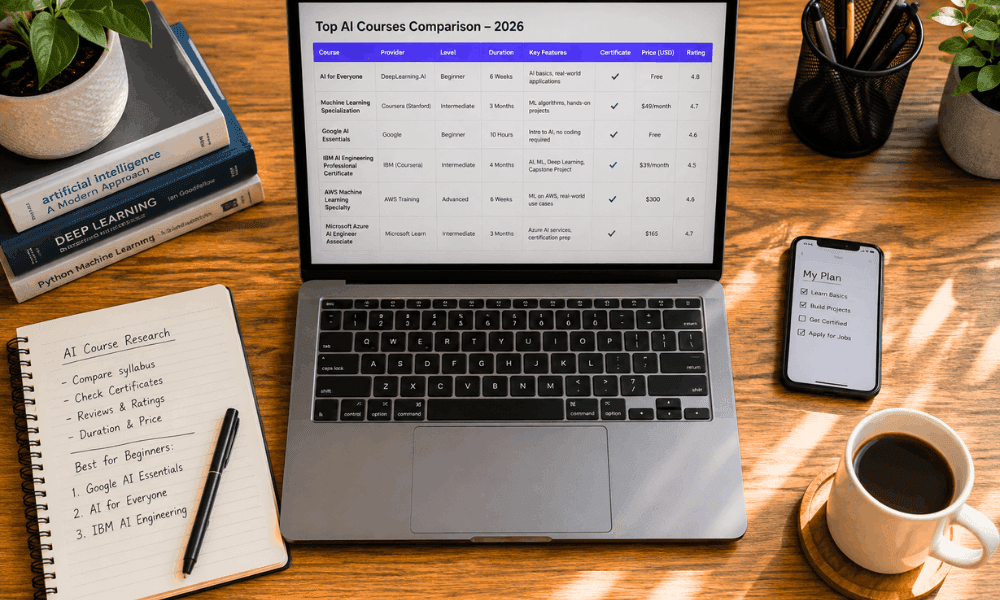
This table is meant to help you build a shortlist of two or three options, not to make the final decision for you — that comes down to your goal, which the sections below walk through.
How We Evaluated and Ranked These AI Courses
To keep this comparison useful rather than generic, each course was assessed against criteria that matter specifically to business analysts, not to software engineers or data scientists:
- Practical business application — does it teach skills you’ll actually use in a BA role this quarter?
- Relevance to business analysts — or is it built for a different job title entirely?
- Generative AI coverage and prompt engineering depth
- No-code / low-code accessibility — can you complete it without programming?
- Business strategy and AI governance content, where applicable.
- Data analysis and workflow automation relevance.
- Microsoft Copilot or similar productivity tool coverage.
- Real-world business use cases rather than purely academic examples.
- Certificate credibility and career value.
- Value for money.
A course built for AI engineers isn’t automatically a good fit for a BA, even if it’s highly rated. Several excellent, well-known AI programs were deliberately left off this list because they’re aimed at technical roles — coding, model-building, or MLOps — and wouldn’t serve most business analysts well as a first AI course.
Detailed Breakdown: 7 Best AI Courses for Business Analysts in 2026
I went through six of these seven myself before writing this, and a couple surprised me — not always in a good way. Here’s the honest breakdown.
1. IBM Generative AI for Data and Business Professionals
If you want one course that just works for most business roles, this is probably the best generative AI course for business analysts to start with.
It suits BAs who touch data occasionally but aren’t coders. The labs use IBM watsonx and everyday chatbots, so nothing feels overly technical.
The most striking thing about this is the direct relation that it has with requirements elicitation through Generative AI – first draft of requirement documents and then fine-tune with stakeholder input.
Generative AI for business analysts is present everywhere in the curriculum, from summarizing meeting notes to finding holes in documentation.
Positive: business-oriented, well-known name, flexible schedule.
Negative: IBM offers multiple courses that go by the same name, so please verify the actual program first before signing up.
Ideal for: BAs looking for one all-around base.
2. MIT Sloan: Artificial Intelligence — Implications for Business Strategy
This one’s a different animal entirely. MIT Sloan Artificial Intelligence for Business Strategy isn’t really about tools — it’s about thinking.
Six weeks, no coding, built around AI strategy and how leaders should approach adoption without getting swept up in hype.
The capstone project has you build an actual roadmap for your own organization. That part alone makes the price tag feel a bit more justified.
Expect a lot of focus on AI ROI, AI governance, and how to talk about AI decisions with people who control budgets.
Honestly, this isn’t built for a junior BA still learning the basics. It suits senior BAs, product leads, consultants, or anyone expected to guide business transformation conversations at the leadership table.
3. Vanderbilt University: Prompt Engineering Specialization
Out of everything on this list, this is the one I’d tell a working BA to try first.
Prompt engineering for business analysts sounds niche until you realize how much of your week involves getting AI to actually do what you meant.
Dr. Jules White teaches prompt patterns that genuinely change your output — I noticed a difference within the first module myself.
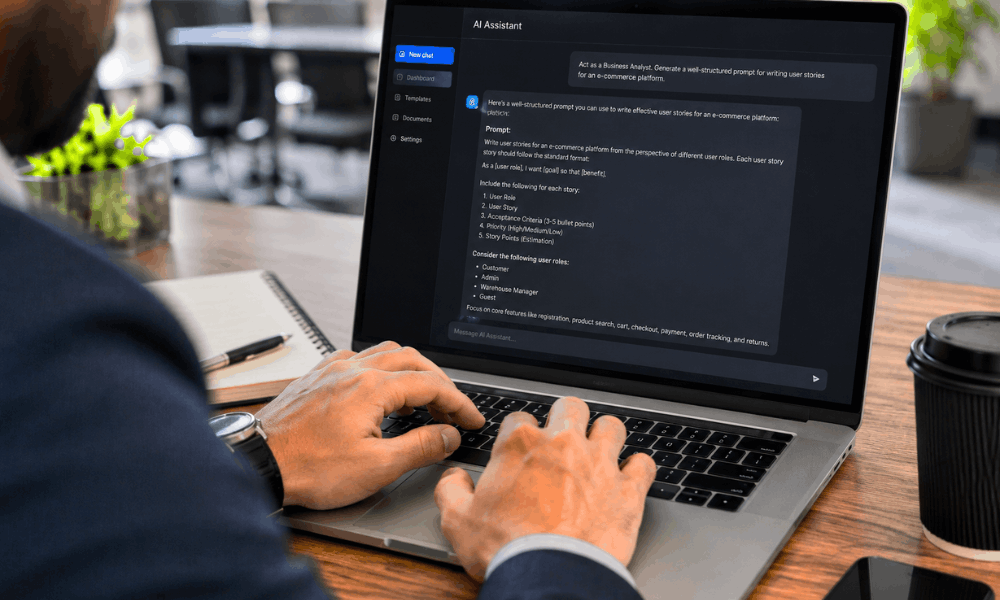
It’s especially good for AI for Agile requirement drafting and AI for user story writing, since better prompts mean fewer rewrites later.
You’ll also pick up structured prompting for brainstorming and summarization, which sounds small but saves real hours across a busy week. No coding needed, and the free single course is a low-risk way to test it before paying for the full path.
4. Microsoft Copilot-Focused AI Productivity Training
If your entire day happens inside Word, Excel, and Teams, this is where the fastest payoff lives.
Training built around Microsoft’s AI tools — sometimes marketed loosely as Microsoft Copilot for Business Analysts, though that’s not always an official course title — teaches you to draft documents, summarize long meetings, and pull together reports without starting from a blank screen.
Power BI users get extra value here, since business intelligence (BI) tools integration becomes part of the workflow too.
What I liked most was how it strengthens stakeholder communication & AI automation together — meeting notes turning into action items almost instantly.
The catch: it’s narrower than a full AI course, so pair it with something broader if you want depth beyond Microsoft’s ecosystem.
5. Google Business Intelligence / Data & AI Professional Training
For BAs who live in dashboards more than documents, a Google Data & AI Professional Certificate path is worth a serious look.
Google runs several separate certificate programs, so don’t assume they’re one bundled course — check exactly what’s included before enrolling.
The strongest parts cover data analysis, visualization, and building dashboards that actually tell a story instead of just displaying numbers.
AI-driven data analytics and predictions are becoming common features in more recently developed modules, building upon the basic BI framework.
Recommended for: BAs who have an analytical mind and like to use AI tools for their data work but still need to create reports and dashboards.
6. IIBA®-Endorsed AI in Business Analysis Training
This is the one built specifically for people already inside the BA profession, not adjacent to it.
IIBA AI-enhanced business analysis training aligns with BABOK standards and often counts toward CDUs for existing credentials like CBAP or CCBA.
Is AI certification necessary for business analysts? Not strictly. But if you already hold an IIBA credential, this feels like the natural next step rather than starting over somewhere unrelated.
Expect coverage of responsible AI, practical BA use cases, and artificial intelligence for business analysts certification paths tied directly to recognized professional standards.
It suits experienced BAs who want credibility more than raw technical skill, and who’d rather stay inside a framework they already trust.
7. DeepLearning.AI: AI for Everyone
Start here if AI still feels like a black box to you. No shame in that — most people felt the same way not long ago.
It’s one of the best AI courses on Coursera for business analysts precisely because it assumes zero technical background going in.
You’ll pick up AI terminology, common business applications, and where AI genuinely helps versus where it’s overhyped, all in about six hours total.
It’s a clean, honest answer to how business analysts can learn AI without coding, built as non-technical AI training for professionals from the ground up.
The limitation: it won’t teach you prompting or hands-on tool use. Treat it as step one, not the finish line.
Which Course Matches Your Career Goal?

| Business Analyst Goal | Recommended Course | Core Skills / Tools |
|---|---|---|
| Agile/user story automation | Vanderbilt Prompt Engineering | Prompting, GenAI, chatbot-style workflows |
| Executive / leadership BA | MIT Sloan | AI strategy, governance, ROI |
| Beginner AI literacy | AI for Everyone | AI fundamentals, business use cases |
| GenAI for business workflows | IBM Generative AI for Business Professionals | Generative AI, documentation, business workflows |
| Microsoft-centric productivity | Copilot-focused training | Copilot, Excel, Teams, PowerPoint |
| Data & BI skills | Google-focused BI/Data training | BI, dashboards, data analysis |
| BA-specific AI credibility | IIBA-endorsed AI training | AI + BABOK-aligned business analysis |
The best option is actually that which aligns itself with where you see yourself in the coming year. The BA who wants a job as an analyst that involves a lot of data, and the BA who wants to become a product leader, should not be making decisions about two of the same programs as they have different goals.
How to Choose the Right AI Course for Your BA Career Path
People ask me this constantly, and my answer’s always the same: it depends on where you actually stand today, not where you hope to be someday.
If You Are a Beginner
Don’t chase the fanciest-sounding program first. Pick something plain-English, low-cost, and completely code-free.
Build confidence before depth. A short foundational course beats a complicated one you end up abandoning halfway through.
Get comfortable with basic terminology first — everything else gets easier once the jargon stops feeling intimidating.
If You Are an Experienced Business Analyst
Skip the basics. You already know them, and revisiting fundamentals just wastes time you don’t have.
Look for courses built around productivity, strategy, and governance instead. Automation and measurable business value matter more now than definitions ever will.
If You Want to Become an AI Business Analyst
Build this in layers, not all at once. Start with AI fundamentals, then generative AI, then prompting technique.
Now add in data literacy and automation. Finish up with responsible AI and specific BA uses, to make sure that all of it connects back to practice.
Rushing through this order is always a mistake — I’ve seen people go right into complex material without first building a proper foundation.
AI vs. Data Analytics: Which Is Better for a BA?
Really, which one would be best for BA: AI or Data Analytics course? It will depend solely on the gap that exists in your existing skillset.
Choose the AI course if automation, GenAI skills, and faster requirement gathering are the goals you wish to pursue. Choose the data analytics course if business intelligence, predictive insight, and process optimization are what interest you.
Both are needed by most BAs in the long run. But if you have to start with one, go for the one that hinders you currently.

Final Verdict: Our Top Recommendation
So, which AI course is best for business analysts? After going through all seven, here’s where I actually land.
For most people, IBM’s Generative AI program is the strongest overall pick — practical, business-first, and not overwhelming.
If you’re brand new to this, start with DeepLearning.AI’s AI for Everyone instead. It removes the intimidation factor completely.
Senior BAs and strategy folks should look at MIT Sloan. It’s pricier, but the leadership angle genuinely pays off.
Want sharper prompting skills fast? Vanderbilt wins that category, hands down, with barely any real competition.
For BA-specific credibility tied to existing credentials, IIBA-endorsed training is still the safer bet.
And if your world revolves around dashboards, a Google BI-focused path fits best.
Pick one, not all seven. Confirm current pricing on the provider’s page, then just start — momentum beats a perfect decision every time.
Frequently Asked Questions (FAQs)
1. Do Business Analysts need coding to learn AI?
No, and that surprises people every time I mention it.
Most of what matters — prompting, evaluating output, applying AI to real workflows — needs zero code.
That’s exactly how business analysts can learn AI without coding, through no-code tools and chatbot interfaces built for non-technical users.
Coding only becomes useful later, if you move into automation building or a more technical AI role.
2. Is an AI certification really worth it for a Business Analyst in 2026?
Depends who’s asking, honestly.
Is AI certification necessary for business analysts? Not strictly — nobody’s rejecting a BA resume purely for lacking one.
But it adds structure, and IIBA-endorsed options count toward existing credentials.
The real value sits in the skills you build, not the certificate sitting in a drawer afterward.
3. Can I get a free AI course with a verified certificate?
Sort of, but let’s be precise here.
Free learning and free course access are common — plenty of platforms let you audit content at no cost.
A verified, shareable certificate usually needs payment or approved financial aid though.
If you’re hunting for the best free AI courses for business analysts with certificate, check the financial aid option before assuming it’s free outright.
4. How does Generative AI help in writing business requirements?
It drafts requirement summaries, user stories, and acceptance criteria fast — genuinely fast, faster than most people expect the first time they try it.
It also catches inconsistencies across long documents and turns messy stakeholder feedback into something readable.
Still, human review stays essential. AI drafts get things wrong quietly, and nobody wants that surfacing in a sprint planning meeting.
5. What is the best AI course on Coursera for a Business Analyst?
There isn’t one single winner here, despite what some listicles claim.
Among the best AI courses on Coursera for business analysts, IBM’s program and Vanderbilt’s prompting specialization come up most often, for good reason.
Which one wins for you depends on whether you want broad business application or sharper day-to-day prompting skill.
2 thoughts on “Which AI Course Is Best for Business Analysts? Top 7 Certifications in 2026”