
If you write content for a living, you already know the feeling. You open a blank doc, the cursor blinks, and somehow two hours disappear before you’ve written a single usable paragraph.
I’ve been there more times than I’d like to admit.
Over the last year, I tested dozens of platforms while trying to find the best content AI tools for my own blog and for a handful of clients. Most were forgettable. A few genuinely changed how I work.
This guide walks through the ten tools that made the cut, what they’re actually good at, and where they fall short. Stick around for #3 — it’s the one tool I now open before anything else.
Quick Summary Table
| Tool | Best For | Free/Paid | Key Feature |
|---|---|---|---|
| Jasper | All-in-one blogging | Paid (trial available) | Brand voice + content pipelines |
| Surfer SEO | SEO optimization | Paid | Real-time SEO content editor |
| ChatGPT | The game-changer | Free + Paid | Multimodal workflow integration |
| Copy.ai | Best free generator | Free + Paid | Workflow automation templates |
| Writesonic (Chatsonic) | Social media & marketing | Free + Paid | Real-time web-connected writing |
| Writer | Brand voice at scale | Paid (enterprise) | Team-wide style guide enforcement |
| Pictory | AI video & script | Free + Paid | Text-to-video scripting |
| Originality.ai | Plagiarism-free content | Paid | AI detection + fact-checking |
| Copysmith | Ecommerce copy | Paid | Bulk product description generator |
| Rytr | Best budget tool | Free + Paid | Low-cost long-form writing |

What to Look for When Choosing the Best Content AI Tools in 2026?
Knowing how to choose the best AI content generator matters more than chasing the newest name on a “best of” list.
From my experience, most people pick a tool because of a flashy demo, then regret it a month later when it doesn’t fit their actual workflow.
Before you commit, think about AI tools for GEO (Generative Engine Optimization), because search behavior has genuinely shifted this year. People ask AI systems questions directly, and your content needs to be structured so it can be cited, not just ranked.
Also check whether a tool offers AI content tools with brand voice feature support, and whether it handles multimodal AI content creation tools like images, video, and text together.
SEO Integration
A good tool should connect to real keyword and SERP data, not just guess what “sounds SEO-friendly.”
Brand Voice
If you write for a brand (or multiple clients), voice consistency saves you from constant rewrites.

Multimodal Features
Text-only tools are starting to feel limiting. The strongest platforms now handle images and video too.
Automation
Look for workflow automation, not just a chat box. Repetitive tasks should run themselves.
Pricing
Free plans are great for testing, but check what happens once you hit real production volume.
Ease of Use
If your team needs a training session just to write a blog post, that’s a red flag.
Accuracy
One thing I noticed early on: some tools invent facts confidently. Always fact-check before publishing.
Long-form Writing
Short snippets are easy. Full 2,000-word articles that stay coherent are where tools separate themselves.
Key takeaway: the right pick depends on your workflow, not the tool with the loudest marketing.
Top 10 Best Content AI Tools for Creators in 2026
Some tools here grew on me slowly. A couple I nearly dropped, then kept anyway.
These are, in my own experience, the best content AI tools worth your time right now.
1. Jasper — Best for All-in-One Blogging
Best For: Bloggers who want automated blog writing without losing brand tone.
Overview: Jasper now runs like a content system, with a “brand memory” that keeps drafts sounding like you.
My Personal Experience: I was expecting lots of rewrites. The initial write-up did not require many changes.
Features: Brand voice memory, content pipelines, SEO mode.
Pluses: Consistent tone, excellent for teams.
Minuses: More expensive than most.
Pricing: Paid, short trial; check current rates.
Who Should Use It: Agencies publishing weekly.
Final Verdict: Worth it if consistency beats saving a few dollars.
2. Surfer SEO — Best for SEO Optimization
Best For: Writers who have grown tired of speculating on what “SEO-friendly” means.
About Surfer AI: Surfer’s SEO content editor evaluates your content against top-ranking pages, analyzing structure in real-time.
Personal Experience With Surfer AI: Prior to using Surfer AI, I analyzed ten articles manually. Now, that process takes me just fifteen minutes.
Key Features: Real-time editor, SERP checker, keyword suggestions.
Pluses: Definitely helpful for competitive keywords.
Minuses: Not that useful as a solo copywriter.
Price: Subscription model; double-check pricing options before proceeding.
Recommended For: SEOs and affiliates.
Final Word: Great choice if your aim is ranking.
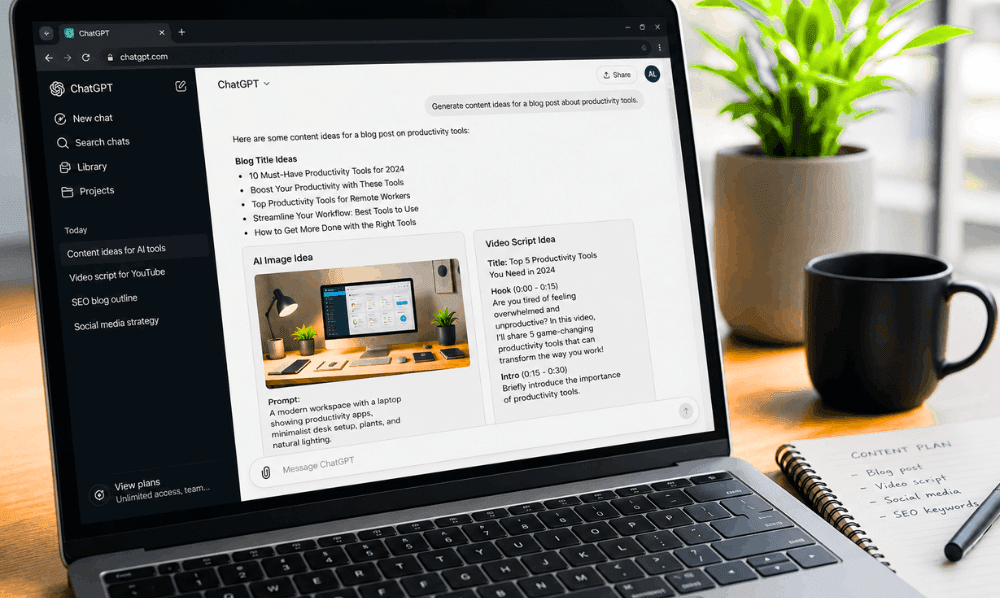
3. ChatGPT — The Game Changer You Can’t Miss
Best For: Anyone wanting all-in-one functionality for researching, writing, and editing.
Overview: ChatGPT became the underpinning of half of the products on this list without making any noise about it.
The big change in 2026 in terms of how multimodal AI content creation tools function involves how effortlessly they integrate multiple modes of content into one conversation.
The reason why ChatGPT is an essential AI content tool in 2026 is precisely that.
If I were starting from zero, this is where I’d put my money first.
I got it wrong early on, typing lazy prompts and expecting magic.
Once I gave it real context, my audience, my goal, a sample of my own writing, the output jumped noticeably.
It’s also the glue between everything else here. I brainstorm angles before Surfer sharpens structure, then draft scripts before Pictory turns them into clips.
That AI workflow integration is why it holds a permanent spot in my process, and it’s helped me build real topic authority on subjects I used to only skim.
Features: Conversationally drafted writing, research assistance, image creation, tone customization.
Pros: Incredibly versatile, good logic, integrates with everything.
Cons: Requires good prompting; lacks native SEO scoring.
Pricing: Available for free; premium offers higher limits.
Who is it best for? All writers, beginner to agency.
Conclusion: If you can only pick one tool on this list, it should be this one.
4. Copy.ai — Best Free AI Generator
Best For: New users seeking a ChatGPT competitor for writers.
Description: Copy.ai depends on templates available to begin with, while its free version is genuinely useful.
My Personal Review: I used the free version first before subscribing to the platform. One of the best among free AI content creators.
Features: Workflow templates, brand voice, free version.
Advantages: Low cost of entry.
Disadvantages: The larger pieces still require editing.
Price: Free version; paid plans enable larger volume.
Best For: Students and freelancers experimenting.
Conclusion: A wise and free foray into content writing.
5.Writesonic (Chatsonic) — Best for Social Media
Best For: Marketers needing an AI copywriter that keeps up with trends.
Overview: Chatsonic stays connected to live web data, earning it a spot among the best content AI tools for anything trend-driven.
My Personal Experience: Most AI copywriters fall apart once content needs to feel current. Chatsonic solved that.
Key Features: Real-time web search, template library.
Advantages: One of the best AI tools in content marketing.
Disadvantages: Templates lack uniqueness without customization.
Cost: Starts with free version and goes on to paid versions.
Recommended Users: Social media managers with multiple channels.
Final Verdict: Opt for this if efficiency matters more than elegance.
6. Writer — Best Brand Voice Tool
Best For: Large groups who need all writers to match their brand voice.
Overview: Writer manages style guides for entire teams without the need for continual manual monitoring.
My Own Experience: For ten or more writers, this is a place to begin, among the very few AI content software packages offering extensive features for brand voice.
Key Features: Style guide compliance, terminology management.
Strengths: Excellent governance for large organizations.
Weaknesses: Overkill for solo blogging.
Pricing: Enterprise; reach out to sales.
Best For: Larger corporations controlling their brand voice.
Final Takeaway: Designed for scalability; avoid if you blog on your own.
7. Pictory — Best AI Video & Script Tool
Good For: Bloggers looking to convert blog posts to short-form videos.
Details: Pictory is an AI tool that automatically converts your script into a video – great choice for content creators who do not know how to edit videos.
My Experience With It: I tried out some repurposing tools first, but Pictory reduced the time it took to produce my videos.
Features: Text-to-video, automatic captions.
Advantages: Easy to use, quick.
Disadvantages: Good enough for making social videos, not for movies.
Price: Free trial; paid versions depend on how long your video is.
Recommended Users: Writers venturing into video-making.
Conclusion: A useful transition from writing to video-making.
8.Originality.ai — Best Plagiarism-Free Tool
Best for: Publishing houses that require proof of the originality of the text.
About: Originality.ai is a combination of a plagiarism checker and AI detector.
Personal Experience: This tool was introduced because of a request from a client to show that the text is original. Now it is among the fact-checking AI tools I always use.
Features: Plagiarism check and AI detection scoring.
Benefits: Establishes customer trust, helps detect problems early.
Drawbacks: The scores are not perfect; take them for what they’re worth.
Price: Pay-per-credit or subscription model.
Recommended For: Agencies requiring proof of originality.
Final Verdict: Among the best content AI tools here, built for peace of mind.
9. Copysmith — Best for Ecommerce
Best For: Retailers who require a bulk product description generator that can be integrated into their AI technology.
About: Copysmith provides bulk product description generator with platform integration capabilities.
My Personal Experience: I used this product for my client with more than 500 product descriptions in their catalog.
Features: Bulk generation, platform integration.
Pros: Saves a lot of time for large catalogs.
Cons: Not cost-effective for rare product pages.
Price: Paid, based on the quantity of generations.
Who Should Use It: eCommerce companies with big inventory volumes.
Verdict: Specialist solution, but the correct one for eCommerce stores.
10. Rytr — Best Budget Tool
Best For: Freelancers who want affordable AI writing software without a big monthly bill.
Overview: Rytr keeps things simple, a clean editor with one of the lowest price points here.
My Personal Experience: This is the tool I point freelancer friends toward when every rupee counts. It won’t replace Jasper for heavy work, but it doesn’t try to.
Key Features: Low-cost plans, tone settings.
Pros: Really affordable, easy to understand.
Cons: Not good for extremely long texts.
Price: Free package + affordable pricing plans.
For Who: Budget-conscious freelance AI writing tool users.
Conclusion: No content AI tools list can be complete without an affordable tool, and this is the one.
Free vs Paid Content AI Tools
| Feature | Free | Paid |
|---|---|---|
| Word/generation limits | Capped monthly | Higher or unlimited |
| Brand voice memory | Rarely included | Usually included |
| SEO scoring | Basic or none | Real-time SERP-based scoring |
| Team collaboration | Limited | Full workspace access |
| Support | Community/self-serve | Priority or dedicated support |
| Best for | Testing, students, hobby blogs | Agencies, businesses, scaled publishing |
If you’re just exploring best AI content writing tools free and paid options, start free. Upgrade once a tool becomes part of your actual weekly workflow, not before.
How to Use AI Content Tools Without Hurting Your Google SEO (2026)
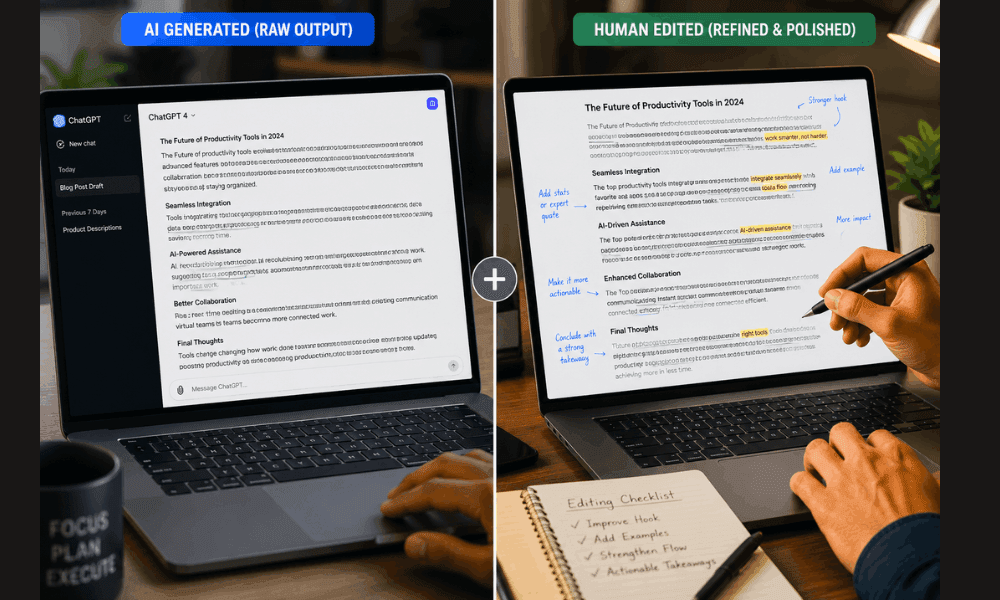
Google’s Helpful Content system doesn’t penalize the use of AI. It penalizes low-value, unedited material, regardless of whether it’s written by humans or generated using AI.
Here’s what helped me out:
The quality of your prompt counts. A poor prompt results in vague, generic content that’s indistinguishable from AI-generated articles.
Human editing is non-negotiable. I always rewrite the intro and add a personal example, because that’s where real E-E-A-T shows up.
GEO changes the target. Structure content so it directly answers questions, since AI search engines quote clear, well-organized answers.
Original insights beat volume. One real example from your own work outperforms ten generic paragraphs.
AI detection myths get overstated. Google has said repeatedly it doesn’t penalize AI content simply for being AI-generated. It penalizes content that isn’t helpful.
Key takeaway: AI drafts the skeleton. Your experience and editing are what make it trustworthy.
Final Verdict: Which AI Content Tool Should You Choose?
Honestly, there’s no single winner here.
It depends on where you’re standing right now.
If you’re a beginner, start with ChatGPT’s free tier or Copy.ai.
Get comfortable with prompts before you spend a rupee on anything fancier.
If you’re a blogger, pair ChatGPT with Surfer SEO.
One handles the thinking, the other handles the ranking, and together they cover most of what a best AI content generator setup needs.
If you’re a freelancer, Rytr keeps your costs low while you build a client base worth raising your rates for.
If you’re running an agency, Jasper or Writer will hold brand voice steady across a whole team of writers.
If you’re a business selling products online, Copysmith earns its keep fast.
If you’re an SEO expert, Surfer SEO and Originality.ai cover both ranking and trust.
At the end of the day, the best content AI tools only work as well as the person editing them.
Pick one from this best content AI tools list, use it for real for thirty days, then judge it on your own results.
Stop researching and start writing your next post today.

Frequently Asked Questions
1. Which is the best free AI tool for content creation in 2026?
Copy.ai and ChatGPT’s free tier are the strongest starting points.
Both give you real, usable drafts without asking for a card number.
I still open Copy.ai first when I’m brainstorming a rough outline for a client.
2. Does Google penalize AI-generated content?
No, not simply for being AI-generated.
Google has said this repeatedly, and I’ve seen it hold up in practice.
What actually gets penalized is thin, unedited, unhelpful writing, whether a human or a machine typed it.
3. What is the #1 AI writing tool for bloggers?
There isn’t one universal answer here.
For most bloggers, ChatGPT paired with an SEO editor like Surfer covers nearly everything you’d need.
4. Can AI replace human writers?
Not fully, and honestly, I don’t think it will anytime soon.
AI drafts fast and researches well, but judgment, original experience, and fact-checking still need a real person in the loop.
5. Which AI tool is best for SEO?
Surfer SEO remains one of the strongest picks for real-time, data-backed content editing.
It’s the one tool here I never skip before publishing.
6. Are AI-generated articles safe for affiliate marketing?
Yes, as long as you edit, fact-check, and add genuine value.
A raw, unedited draft published straight from a chatbot is where the risk actually starts.
7. How can beginners start using AI content tools?
Start free, learn to write specific prompts, and always edit before you hit publish.
That last step matters more than people expect.
10 thoughts on “10 Best Content AI Tools in 2026 (Don’t Write Another Word Without #3!)”