
If you’ve ever assumed that a job at Google requires a computer science degree and years of coding practice, it’s worth stepping back.
So what is the best non-technical career path at Google? The honest answer is that it depends on your background, but the bigger point is that Google’s business runs on far more than engineering.
Product strategy, operations, marketing, user research, customer relationships, and people management all keep the company running, and none of those functions require you to write a line of code.
I’ve spent time studying how large tech companies structure their hiring across different functions, and one thing becomes clear quickly: Google non-tech jobs in 2026 span dozens of departments, from Product Management to HR.
This article walks through the strongest non-technical career paths, what they actually pay based on public job postings, how the hiring process works, and how to land a job at Google without an engineering degree — realistically, not with false promises.

Does Google Hire People Without a Coding Background?
Short answer: yes. I get asked this a lot, and honestly people are surprised how much of Google runs on people who never touch a codebase.
Think about it for a second. A product doesn’t sell itself. Someone has to market it, support the customers using it, hire the engineers building it, and figure out if it’s solving a real problem in the first place. That’s where business, marketing, operations, HR, research, and customer-facing teams step in.
Here’s the nuance most articles skip. Not coding isn’t the same as knowing nothing about tech. If you’re chasing one of the top non-coding roles at Google, you still need to follow a product conversation, read a basic dashboard, or get why a feature works the way it does.
So what actually gets you noticed? Communication. Sharp analytical thinking. Good business judgment. Being able to work with people who think nothing like you do.
These are the things that carry weight in non-tech Google careers with high salary potential, especially once you’re a few years in.
But is it possible to be employed without a computer science degree? Yes, but be aware that working at Google even without the computer science degree will require you to show that you can think fast.
Quick example. I once read about someone from a customer support background who taught herself basic SQL in her spare time and started poking around product usage data just out of curiosity.
That single habit is what made her stand out when an internal operations role opened up — not because she could code, but because she could speak the data language well enough to hold her own.
That’s really what non-coding careers in tech in the age of AI look like right now, built quietly, one skill at a time.
What is the best non-technical career path at Google? Honestly, for her it turned out to be operations, not because it’s the “best” one on paper, but because she’d already built proof before she even applied.
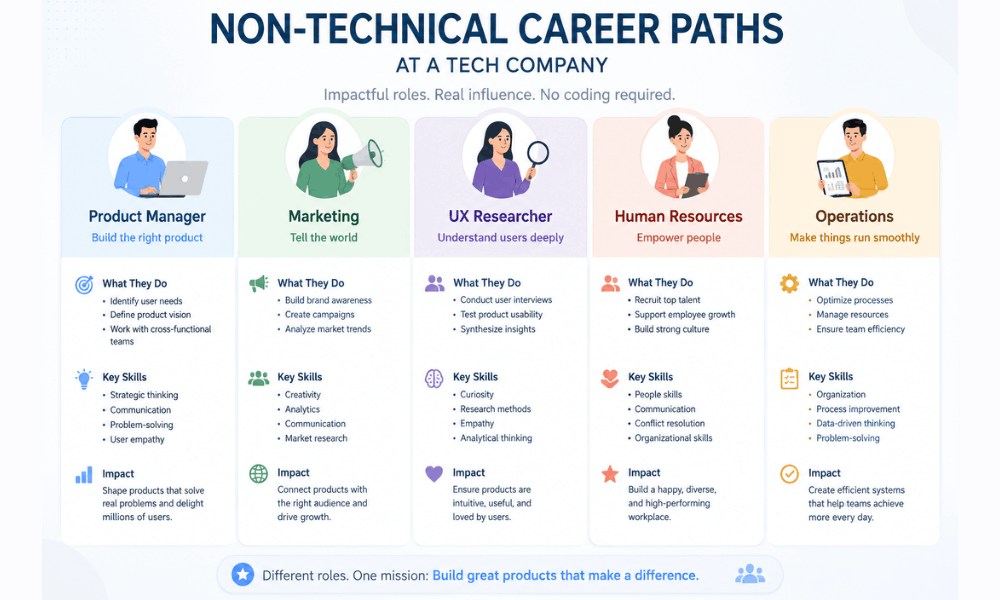
Top 6 Best Non-Technical Career Paths at Google
1. Product Management (PM)

Product Manager roles at Google are usually the first thing people mention when this topic comes up, and there’s a reason for that.
A PM decides what gets built and why. You’re translating a messy user problem into something engineers and designers can actually act on, then fighting for priorities when everyone wants their feature shipped first.
A normal day looks like reviewing metrics, sitting in a design review, writing a product doc, and having three different conversations that all need a different tone. That’s the job in a nutshell — constant cross-functional collaboration.
You don’t need to code, but you do need enough technical grounding to hold your own in a room full of engineers. That’s honestly what makes PM feel like one of the strongest non-coding paths into tech.
Backgrounds vary a lot here — business, engineering-adjacent roles, even consulting. Growth potential is real too; senior PM and Group PM roles are consistently mentioned among the highest paying non-tech roles at Google, though actual pay always depends on level, location, and negotiation.
Getting in isn’t easy. If you’re starting from zero, build a mini case study on a product you use daily — what’s broken, what you’d change, why. That single habit says more than a resume line ever will.
2. Program & Project Management (PgM / BizOps)
If PM is about deciding what to build, Program Manager and Strategy & Operations work is about making sure it actually happens on time and doesn’t fall apart along the way.
Business Operations folks often get pulled into messy, ambiguous problems — think of them as an internal consulting team solving whatever fire is burning that quarter.
Day to day, expect a lot of stakeholder management, tracking dependencies across teams, spotting risks before they become real problems, and pushing decisions using actual data instead of gut feeling.
This path fits people from consulting, an MBA program, operations, or traditional project management surprisingly well. The instincts transfer almost one-to-one.
No coding required, though comfort with spreadsheets and structured thinking is non-negotiable. Entry is competitive, especially for external hires, and compensation swings a lot by level and location — I’d avoid trusting any number that isn’t from an official posting.
Beginners can start by leading a real project end-to-end somewhere, even a small one, and being able to talk through how they managed the chaos.
3. Product Marketing Manager (PMM)
The Google Product Marketing Manager career path is really about answering one question well: why should anyone care about this product?
PMMs shape positioning and messaging, run customer research, plan launches, and dig into what competitors are doing before deciding how to stand out.
A typical week mixes writing messaging docs, reviewing customer interview notes, and sitting with product teams to plan a launch calendar together.
This role suits people from a marketing, communications, or brand background more naturally than most others on this list. It rewards writing ability just as much as strategy.
No coding needed here either, but you do need to understand the product deeply enough to explain it simply. Go-to-market strategies are the bread and butter of this job.
Before applying, try running a small launch yourself — even for a side project — and document what worked. With AI reshaping how teams plan go-to-market work, showing you can adapt fast matters more than it used to, and it genuinely helps your case.
4. User Experience (UX) Researcher & Product Designer
UX Researcher jobs at Google exist to answer a simple but hard question: does this actually work for real people, or does it just look good in a mockup?
That means running user interviews, watching usability tests, and turning messy observations into insights a design team can act on.
Product Design roles sit close by, focused on human-centered design — the actual look, feel, and flow of a product, plus accessibility for people with different needs.
Both are mostly non-coding, but don’t mistake that for easy. These roles expect a strong portfolio, formal training in research methods or design, and a real grasp of user psychology.
People from psychology, HCI programs, or design backgrounds tend to do well here. Entry is tough — arguably tougher than PM in some cycles — simply because there are fewer seats and everyone applying has a polished portfolio.
If you’re starting out, run one real research study on your own, write it up properly, and use it as proof of how you think.
5. Technical Account Manager & Sales Engineering at Google Cloud
Technical Account Manager roles at Google Cloud live right at the border between technical and customer-facing work, which is why I’d call this technical-adjacent rather than fully non-technical.
TAMs manage customer relationships, walk through solution discussions, and help shape account strategy so a client actually gets value out of Google Cloud long term.
Expect real conversations about architecture and infrastructure. You’re not writing code, but you need enough technical literacy to not get lost when engineers on either side start talking specifics.
People coming from customer success, technical support, or solutions consulting backgrounds tend to transition into this well, especially with some cloud fundamentals under their belt.
Growth can lead toward senior TAM or account strategy leadership over time. Entry difficulty sits in the “competitive” range — doable, but expect the interview to test real technical knowledge, not just soft skills.
A good first step is getting a basic cloud certification and being able to explain, in plain language, how a customer’s systems might connect to a platform like this.
6. People Operations (HR) & Talent Acquisition
Google HR roles, including Talent Acquisition and People Operations, are fully non-coding and honestly a bit underrated as an entry point into the company.
These teams handle recruiting, employee experience, workforce planning, and quietly keep organizational culture functioning as the company scales.
A typical day might mix candidate interviews, workforce data reviews, and supporting a manager through a tricky people situation — part strategy, part hands-on support.
People from traditional HR, recruiting, or organizational psychology backgrounds transfer in naturally, and this path can later open doors into broader business roles too.
Entry is moderately competitive compared to PM or design — still real work to get in, but slightly more accessible for career changers building experience through recruiting or HR-adjacent roles first.
Comparison of Top Non-Technical Roles at Google
| Job Role | Typical Compensation Context | Key Skill Required | Ease of Entry |
|---|---|---|---|
| Product Manager | Approximate market range, varies widely by level and location; base pay often in the $150K–$250K+ range per public postings, plus bonus and equity | Strategic thinking, cross-functional collaboration | Very Competitive |
| Program Manager / BizOps | Similar to PM range at comparable levels; varies by team and location | Stakeholder management, process improvement | Very Competitive |
| Product Marketing Manager | Market-competitive with tech marketing roles broadly; varies by level | Go-to-market strategy, communication | Competitive |
| UX Researcher / Product Designer | Comparable to specialized research/design roles in tech | Human-centered design, research methods | Very Competitive |
| Technical Account Manager (Cloud) | Comparable to technical customer-facing roles in tech | Customer success, technical literacy | Competitive |
| People Operations / Talent Acquisition | Market-competitive with HR leadership roles in tech | Organizational culture, workforce planning | Moderately Competitive |
All figures are approximate, drawn from publicly available job postings and industry context. Actual Google compensation varies by level, location, experience, bonus, and equity, and should be verified on Google’s official careers site for any specific role.
Google Non-Technical Hiring Process & Selection Steps (2026)
Here’s the one thing no one will tell you straightaway – The Google non-technical recruitment process in 2026 is not an exclusive one. It varies based on team, position, level, and even location.
That said, most journeys follow a rough shape. It starts with actually finding the right opening, not just applying to anything with “Google” in the title.
Read the job requirements properly before you apply. I know that sounds obvious, but half the rejections happen right here, before a human even sees the resume.
Once you submit your application, if it’s a decent match, a recruiter usually reaches out first. This early contact matters more than people think — it’s often your first real filter.
Knowing how to pass Google’s non-technical resume screening helps a lot at this stage. Clear language, relevant keywords, real outcomes instead of vague duties.
From there you move into role-specific interviews, which vary quite a bit across the Google interview stages depending on what you’re applying for.
Somewhere in that loop, expect a Googleyness and leadership behavioral round. This is where structured, honest answers about how you’ve actually handled ambiguity or conflict matter more than rehearsed lines.
After interviews, a hiring committee reviews everything together, not just your interviewer’s opinion. Then comes team matching, and finally, if things align, an offer with a compensation conversation attached to it.

Google Non-Tech Hiring Timeline & Interview Stages
| Stage | Focus Area | Preparation Strategy |
|---|---|---|
| Job search | Finding roles that genuinely fit your background | Read 10–15 postings closely before applying anywhere |
| Application | Getting past the first filter | Tailor your resume to that specific role, not a generic version |
| Resume screening | Clarity and relevance | Lead with outcomes, use language from the actual posting |
| Recruiter conversation | Motivation and fit | Have a clear, honest story about why this role |
| Role-specific interviews | Practical, job-related skills | Practice with real scenarios close to the actual job |
| Behavioral interviews | Googleyness and leadership | Prepare STAR-style stories from real experience |
| Final evaluation | Committee-level review | Stay consistent across every answer you gave earlier |
| Offer | Compensation discussion | Know your market value before you say yes |
Timelines vary a lot here — some people move through this in a few weeks, others wait much longer depending on the team and how many rounds get added along the way.
How to Build an ATS-Friendly Resume for Google Non-Tech Roles
Let’s clear something up first — Google doesn’t run resumes through one simple formula that either passes or rejects you. It’s more nuanced than that, so stop hunting for a magic trick.
Still, some ATS resume tips for Google genuinely work. Start by matching the actual job description, not a generic version of your resume you send everywhere.
Use relevant terms naturally, the way they’d appear in a real sentence. Stuffing keywords in awkwardly does more harm than good, and it reads badly to an actual human too.
Lead with achievements, not duties. Cut anything that doesn’t support the specific role. Clean formatting matters more than people realize — no cluttered templates, no tiny fonts.
Transferable skills deserve real space here, especially if you’re eyeing Google’s non-technical entry-level and MBA internship programs and don’t have direct experience yet.
Quantify wherever you can. Show actual business impact, even if the number feels small — small proof still beats vague claims.
Here’s a quick before and after. Weak: “Handled customer queries and improved satisfaction.” Stronger: “Resolved 200+ customer queries monthly, lifting satisfaction scores by 18% in two quarters.”
When prepping for interviews later, build your stories using the STAR Method now, so your resume and your answers actually match. Honestly, this one habit saves people a lot of last-minute panic. If you’re wondering what is the best non-technical career path at Google for your specific background, your resume is usually the first honest signal — treat it that way.
Skills Required for Non-Technical Jobs at Google in the Age of AI
Let’s be honest about something first. AI isn’t wiping out non-technical jobs at Google — it’s just changing what “good at your job” actually means now.
AI literacy sits at the top of that list. Not becoming an engineer, just knowing what these tools do well and where they still fall apart.
Generative AI tools are showing up in day-to-day work everywhere, from drafting first versions of documents to speeding up research that used to take hours.
Data analysis and business analytics still matter a lot. If anything, AI-assisted productivity makes it easier to dig into numbers faster, but you still need to know what question you’re even asking.
Strategic thinking hasn’t gone anywhere either. Neither has communication, honestly it might matter more now, since you’re often explaining AI-driven decisions to people who don’t fully trust them yet.
The importance of stakeholder management and cross-functional collaboration remains just as vital, particularly in the field of AI Product Operations and GTM, where speed and ever-changing priorities reign supreme.
A good knowledge of the customer, problem solving, and adaptability complete the package. These are the uniquely human abilities that AI can never replicate.
Responsible AI awareness is becoming a real expectation too, not just a buzzword teams throw around in meetings.
What I’ve noticed studying this space is simple. People building actual career resilience right now aren’t choosing between human skills and AI tools — they’re pairing both, using AI product strategy thinking to work smarter, while still leading with judgment only a person can bring.
It is that unique combination, rather than a specific tool, which will define the future non-coding career in tech.

How to Stand Out When You Don’t Have a Computer Science Degree
No CS degree doesn’t mean no shot. It just means your proof has to come from somewhere else.
Transferable skills are your starting point. Whatever you’ve done before — sales, teaching, ops, customer support — chances are some of it maps directly onto what Google’s non-technical teams actually do.
Build something you can point to. A portfolio project, a small case study, even a messy side project you finished. If you’re figuring out how to land a job at Google without an engineering degree, this is where most people fall short. They talk about skills instead of showing them.
Certifications and relevant courses genuinely help too, but only as a starting point. I’ll say this honestly — I’ve taken a few career courses myself, and they’re useful for structure, for knowing what to learn next. They don’t replace actually doing the work.
Volunteer projects, freelance gigs, internships, even an MBA if it fits your path, all add real weight. Google’s non-technical entry-level and MBA internship programs exist for exactly this reason, so use them if you’re early on.
Clean up your LinkedIn. Actually network, meaning real conversations, not cold connection requests. Referrals help, sure, but lean on them too hard and you’ll skip the part where you build actual career resilience through your own work.
Final Takeaway: Start Building Your Non-Tech Google Career
Coding was never the only door into Google. That’s really the whole point of everything above.
Product, operations, marketing, UX, customer success, HR, strategy — real careers exist across all of it, and none of them ask you to write code.
Competition stays high though, I won’t pretend otherwise. What actually separates candidates is evidence, not just a degree sitting on a resume.
AI literacy is quietly becoming one of those quiet advantages too, the kind that doesn’t show up in a job title but shows up in how you work.
Honestly, the right path depends on you. So what is the best non-technical career path at Google? There isn’t one universal answer — it comes down to your strengths, your goals, what you’re actually good at.
If you’re serious about starting your non-tech career at Google, here’s where I’d begin. Pick one role. Study 10–20 real job descriptions for it. Find the gaps between where you are and what those postings want.
Cover those areas by doing projects, taking courses, or gaining actual experience. Create your resume correctly. Prepare for behavioral interview questions until you are comfortable answering them. You can then apply yourself strategically.
It is possible to get a job at Google without a computer science degree, but you need to be prepared.
Frequently Asked Questions (FAQs)
1. What is the highest paying non-technical job at Google?
Honestly, there’s no single answer here. Pay depends on level, location, equity, bonus, and experience — all of it shifts the number.
That said, senior Product Management, business leadership, and strategy roles tend to show up near the top when people talk about highest paying non-technical jobs at Google in 2026.
Some technical-adjacent roles land there too. I’d be careful trusting any list that names one “highest paying” role — the highest paying non-tech roles at Google shift year to year and vary a lot by individual offer.
2. Is it hard to get a non-tech job at Google?
Yes, honestly. Hiring stays highly competitive even outside engineering, sometimes more so since there are fewer non-tech seats open at any given time.
But hard doesn’t mean impossible. People genuinely do get in — usually the ones who build real evidence first, tailor everything they submit, and don’t apply blindly to twenty roles at once.
3. What is the best non-technical career path at Google?
There’s really no single best answer to this one, and I’d be skeptical of anyone claiming otherwise.
For beginners especially, it comes down to your existing strengths, background, and what you actually enjoy doing day to day. Operations, recruiting, marketing, UX research support, and program coordination all make solid entry-level non-tech Google jobs to start exploring, depending on where your experience already sits.
4. Does Google hire non-coders?
Yes, across plenty of business and functional teams where writing software just isn’t the core requirement. Marketing, HR, operations, customer-facing roles — all real options.
Worth knowing though, some of these positions still expect a baseline of technical literacy, even if you’re never touching production code yourself.