Overview
Businesses are changing faster than ever in 2025, and this will continue into 2026. However, traditional project management methods are struggling to keep up. To provide accuracy, speed, and smart insights, artificial intelligence project management software blends human decision-making with machine learning.
This software manages resources, predicts risks, automates repetitive tasks, and gives data-driven advice to project managers to help them make better choices. It’s crucial to work more intelligently, not just more quickly.
In simple terms, artificial intelligence project management software acts as a virtual project assistant. It sets up meetings, assigns tasks, and spots potential problems before they escalate.
Project management is getting a smart upgrade in 2025. It’s no surprise that companies are adopting AI tools for greater efficiency and innovation. Let’s look at how AI is transforming project management in various areas, including communication, risk assessment, scheduling, and cost planning.
Why AI in Project Management?
How Traditional Project Management Fails in 2025
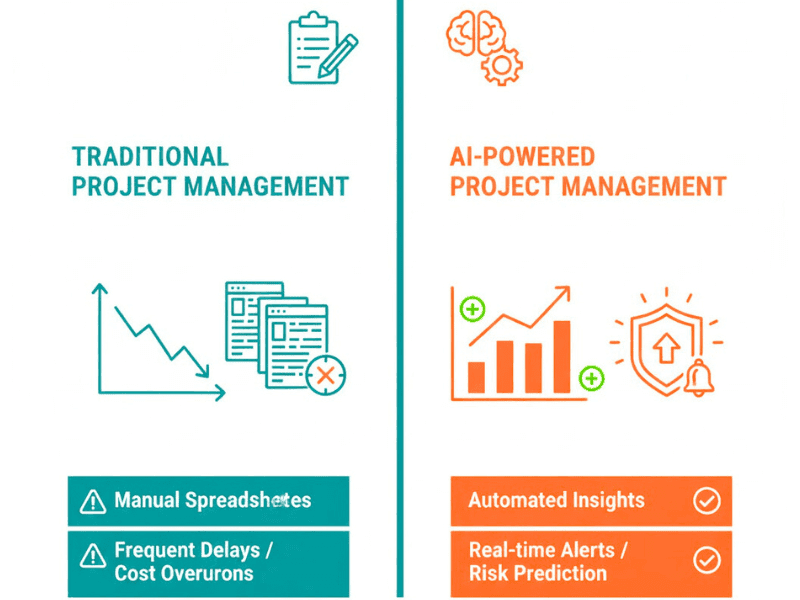
Traditional project management will have significant constraints in 2025. Teams who still use spreadsheets and manual updates find it difficult to stay up with the rapid-paced projects of today. Missed deadlines and higher expenses are frequently caused by human mistake, misunderstandings, and a lack of real-time visibility.
These antiquated methods are ineffective as corporate operations grow more data-driven and digital. For this reason, a lot of businesses are implementing artificial intelligence project management software. Planning is automated, progress is monitored, and problems are immediately brought to light before they become more serious.
AI tools help managers stay proactive rather than reactive by anticipating issues before they arise. That degree of knowledge and accuracy is just beyond the capabilities of traditional project management.
Real Reasons to Use AI in Project Management
Artificial intelligence project management software is becoming more and more necessary, not simply a fad.
AI makes it possible to schedule tasks more intelligently, make decisions more quickly, and improve teamwork. In a matter of seconds, it analyzes project data, finds trends, and offers useful insights.
Workflows are streamlined by AI-powered platforms that analyze project health, generate reports, and allocate jobs automatically. This improves accuracy and accountability in addition to saving hours of human labor.
AI tools can also improve departmental communication, foresee budget overruns, and recommend the best way to allocate resources.
To put it briefly, artificial intelligence (AI) transforms project management from a guesswork to a science, assisting companies in reaching their objectives more quickly, effectively, and with fewer errors.
Artificial Intelligence for Project Managers
Will AI Replace Project Managers?
Whether AI will take the role of human project managers is one of the main questions for 2025.
In actuality, artificial intelligence project management software is meant to complement rather than to replace. AI still lacks human creativity, emotional intelligence, and leadership, even while it can automate data processing, reporting, and scheduling.
No algorithm can fully replace the vital role that project managers play in inspiring teams, settling disputes, and formulating strategic plans. AI solutions free up managers’ time to concentrate on people and performance by handling the analytical and repetitive aspects of project management.
In essence, artificial intelligence project management software acts as a trusted co-pilot — offering data-driven insights while humans steer the project toward success.
AI as a Smart Assistant for Project Teams
Project teams can benefit greatly from artificial intelligence (AI), which is like having a smart assistant that never sleeps. Asana Intelligence, ClickUp Brain, and Notion AI are examples of contemporary systems that assist with task assignment, deadline management, and update summarization.
These platforms track performance, synchronize communication, and maintain alignment by utilizing artificial intelligence project management software. Managers have access to a single central hub driven by intelligent automation, eliminating the need to chase team updates or juggle numerous apps.
Additionally, AI helpers examine productivity patterns and recommend workflow enhancements. As a result, teams are happier, projects are completed more quickly, and errors are reduced. In the end, AI is strengthening teamwork rather than replacing it, enabling each member to give their all without becoming bogged down in monotonous duties.
AI in Project Scheduling
How AI Predicts Delays & Saves Time
Early delay prediction is crucial for complicated projects, which is where artificial intelligence project management software comes in handy. To predict possible slowdowns, AI systems examine past timelines, job dependencies, and real-time project data.
The software automatically notifies managers when a work is going longer than anticipated and recommends remedial measures, such redistributing resources or modifying deadlines. AI is able to identify early warning indicators much earlier than a human would by analyzing thousands of data sets.
This proactive strategy guarantees better time management and keeps projects on track. Businesses who use artificial intelligence project management software in 2025 are finishing projects more quickly, with fewer last-minute surprises, and with more seamless delivery at every level.
Real Tools Using AI for Scheduling
AI-based scheduling is now being led by a number of contemporary tools. Platforms such as Smartsheet AI, Forecast.app, and Wrike AI Copilot automatically optimizes project calendars and dependencies through machine learning.
The workloads of each team member are examined, the most effective task sequences are suggested, and even reasonable deadlines are suggested. AI now makes schedule adjustments for managers in real time, eliminating the need for them to do so by hand.
With artificial intelligence project management software, scheduling becomes dynamic and self-correcting. When things change, it rapidly adjusts to maintain the ideal balance between schedules and resources.
In addition to saving numerous hours, this improves transparency and makes it possible for everyone to see the entire project progress without any misunderstandings or delays.
AI Framework for Project Management
Step-by-Step AI Integration Model
Developing a clever integration structure is more important than simply purchasing a solution when using artificial intelligence project management software. The first step in the process is to evaluate your project’s requirements and pinpoint the areas where automation can have the biggest influence.
The next step is to choose an AI solution that complements your current workflow and business objectives. Next, teach your staff how to utilize the program efficiently to guarantee a seamless adoption process and optimize outcomes.
After implementation, keep an eye on performance indicators to improve your AI-powered procedures. The system gains knowledge from your data over time, improving the accuracy of risk management, scheduling, and project planning.
By following this methodical approach, artificial intelligence project management software is guaranteed to transform from a mere digital tool into a strategic asset.
Tools That Support This AI Framework
Intelligent and adaptable tools are essential to a strong AI architecture. Platforms like as Trello Smart Cards, ClickUp Brain, and Asana Intelligence are made to blend in perfectly with this framework.
They make it possible for machine learning-powered task assignment, progress tracking, and performance predictions to be automated. Without interfering with current procedures, these solutions assist firms in scaling from simple automation to sophisticated predictive analytics.
To ensure a cohesive project ecosystem, a few artificial intelligence project management software even permits API interaction with analytics dashboards, HR systems, and CRMs. AI frameworks are appropriate for both startups and major corporations due to their versatility.
Teams can achieve better collaboration, real-time visibility, and a data-driven basis for more intelligent decision-making when the framework is supported by the appropriate technologies.
AI Opportunities in Project Management
Cost Saving & Resource Optimization
The capacity of artificial intelligence project management software to easily optimize resources and save costs is one of its greatest benefits. To find areas where time and money are being wasted, AI examines financial measures, team performance, and project data.
By dynamically allocating jobs according to employee strengths, it avoids underutilization or overstaffing. AI helps businesses cut down on wasteful spending by forecasting how long each task would take and how many resources are required.
Managers can create more intelligent budgets and make sure all resources are spent efficiently with this degree of accuracy. Organizations using artificial intelligence project management software often report up to 30% cost savings while maintaining higher productivity and smoother operations.
AI-Powered Risk Management
Project managers have always had significant challenges with risk management, but AI is revolutionizing the field. By examining trends, dependencies, and performance indicators, contemporary artificial intelligence project management software can identify dangers early.
It assesses the likelihood and consequences of possible problems, providing managers with a transparent risk score and useful information. This implies that teams can plan ahead for crises rather than responding to them after they occur.
Additionally, AI keeps learning from its previous endeavors, which enhances its capacity to anticipate future issues. Businesses can obtain a proactive defense against uncertainty by incorporating machine learning models into their regular operations.
With the use of artificial intelligence project management software, risk management becomes more about foresight than firefighting, enabling teams to complete projects with more assurance and stability.
AI Impact on Project Management
Benefits (with real-world examples)
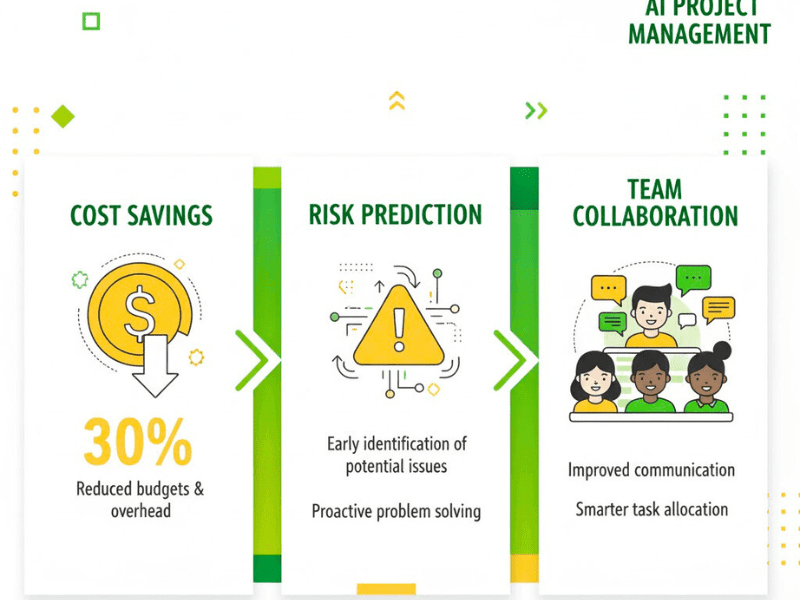
Artificial intelligence project management software has had a profoundly transformational effect on contemporary businesses. Productivity, accuracy, and efficiency have all dramatically increased for businesses utilizing AI-driven solutions.
For example, IBM Watson Orchestrate saves hours of manual coordination by automating IT procedures. Asana Intelligence transforms project updates into intelligent, useful summaries, and Jira AI assists software teams in forecasting sprint delays.
By offering real-time insights, predictive analytics, and automatic reporting, these solutions improve teamwork and keep everyone on the same page. Businesses that use artificial intelligence project management software also claim more accurate forecasting and quicker project completion, which helps them remain ahead of the competition in cutthroat markets.
The greatest advantage of AI is that it can turn disorganized data into clear, actionable guidance, which makes project management more strategic than it has ever been.
Challenges & Limitations
Although AI has many advantages, there are some drawbacks as well. Strong technical infrastructure, appropriate training, and high-quality data are necessary for implementing artificial intelligence project management software.
Issues with data integration or setup fees may be a problem for smaller businesses. Furthermore, relying too much on technology can occasionally impair human intuition when making decisions. Additionally, for AI algorithms to continue to be effective, they must be updated and monitored frequently because biased or out-of-date data might produce false insights.
Since these tools frequently handle sensitive project data, security and privacy are additional concerns. Despite these drawbacks, most obstacles may be surmounted with careful preparation and ongoing development.
When applied properly, artificially intelligent project management software can be a strong ally rather than a substitute, assisting teams in striking a balance between machine intelligence and human innovation.
AI and Project Management Articles & PDF Resources
Best AI Project Management PDF Guides
A number of PDF guidelines for artificial intelligence project management software are available from reliable firms for experts who are keen to delve further. Comprehensive manuals outlining how AI fits into Agile, Scrum, and hybrid frameworks have been released by the Project Management Institute (PMI), Gartner, and Deloitte.
These PDFs include strategic models, practical examples, and step-by-step instructions for integrating AI-driven technologies into your workflow. They are particularly helpful for managers who want to create long-term plans for digital transformation.
Professionals can automate planning, lower risks, and execute projects more intelligently in 2025 and beyond by learning from these artificial intelligence project management software tools.
Trusted Articles & Research You Should Read
The secret to success in AI-driven project management is staying informed through professional study. Prominent journals including Forbes Tech Council, McKinsey, and Harvard Business Review have published in-depth articles on project management and artificial intelligence that examine current applications and case studies.
McKinsey’s “AI Project Lifecycle Optimization” is a noteworthy resource that illustrates how predictive analytics enhances long-term project results. Another, “AI Opportunities in Project Management,” explores how leading companies use automation to save money and foster creativity.
These studies demonstrate that artificial intelligence project management software is a strategic advantage rather than only a tool. Managers may stay ahead of trends, spot new AI solutions, and make more informed decisions for their projects by routinely reading these kinds of publications.
Best Artificial Intelligence Project Management Software
Selecting technologies that offer automation, intelligence, and practical utility is crucial while searching for robust artificial intelligence project management software. The top five candidates for 2025 are shown below; each has unique characteristics, pricing points, and advantages and disadvantages.
1. Wrike
- Features: provides AI-powered work intelligence that visualizes dependencies, automates processes, prioritizes activities, and forecasts project hazards.
- Pricing: Prices for the paid plan, which includes free trial options, start at about US $10 per user per month (billed annually).
- Pros: Excellent for complex operations and big teams; ideal for resource planning and advanced analytics.
- Cons: steep learning curve for full AI functionality; some essential features may require higher-tier plans; can be costly for smaller teams.
2. Asana (with AI features)
- Features: offers goal-setting, task automation, project analytics, and AI-driven productivity advice.
- Pricing: For AI-enabled capabilities, paid subscriptions start at about US $13.49 per user per month.
- Pros: interface that is easy to use, robust for teams of all sizes, and has a good ecosystem of integrations.
- Cons: Some sophisticated AI add-ons are more expensive and might not offer as many functions for resource management as programs with a more enterprise focus.
3. ClickUp
- Features: provides job automation, AI-generated recommendations, natural language commands, and workplace personalization.
- Pricing: The paid subscription with AI features starts at about $12 USD per user per month (billed annually).
- Pros: Excellent value for money, highly customizable, and suitable for both small and large teams.
- Cons: With so many capabilities, the interface might feel overwhelming; some users complain about little problems and a learning curve.
4. Monday.com (AI-enhanced version)
- Features: AI assistants, visual project boards, and AI “blocks” for scheduling, sentiment analysis, and summarization.
- Pricing: AI features may necessitate higher tiers, with entry plans starting at about US $8/user/month invoiced annually.
- Pros: Fast onboarding, intuitive user interface, ideal for visual teams.
- Cons: Not as comprehensive in AI-driven analytics as certain specialized applications; more sophisticated features may require higher prices.
5. Teamwork.com (with AI features)
- Features: comprises client-work management, status update automation, AI job generation, and integrations.
- Pricing: Key features start at about US $10 per user per month; higher plans add AI advancements.
- Pros: Designed with client-focused teams and agencies in mind; robust support for external stakeholders and cooperation.
- Cons: There are fewer sophisticated resource-forecasting solutions than enterprise-focused systems, and some AI features might still be developing.
Summary
These five applications range from enterprise-grade (Wrike, Asana) to agile and startup-friendly (ClickUp, Monday.com) artificial intelligence project management software.
Select according to your desired features, budget, team size, and level of AI-driven insight.
With the correct tool, your team will be able to focus on strategic activities, automate tedious tasks, and uncover insightful information.
Future of AI in Project Management
Artificial intelligence in project management appears to have a very promising future. Predictive analytics, real-time reporting, and generative AI will revolutionize teamwork in the coming era.
Experts predict that by 2030, up to 80% of project management tasks will be handled by AI , freeing up human managers to concentrate on innovation and leadership. AI use by businesses today is already resulting in improved workflows and a higher return on investment.
Therefore, now is the ideal moment for your company to begin investigating AI tools if it hasn’t already. By adopting early, you can avoid falling behind later and stay ahead of the curve.
Conclusion
In conclusion, artificial intelligence project management software is now a necessary business tool and is no longer a sci-fi fantasy.
AI is changing how teams plan and carry out projects, from scheduling and budgeting to resource optimization and risk management.
Teams led by project managers who adopt AI now will be more intelligent, quicker, and more effective.
AI should be your project partner if you want better results in 2025.
FAQs
Q1. Is there an AI tool for project management?
Yes, there are several AI tools made for project management. These artificial intelligence project management software platforms help automate repetitive tasks, predict project risks, allocate resources effectively, and improve collaboration. Popular examples include Wrike, Asana, ClickUp, and Monday.com. They all offer AI-powered features like task prioritization, real-time analytics, and smart reporting.
Q2. How is AI used in project management?
AI is utilized in project management to track performance, predict deadlines, automate scheduling, and detect dangers early. Managers can rapidly examine project data, receive insightful recommendations, and make data-driven decisions with artificial intelligence project management software. AI also aids in budget management, workload distribution optimization, and progress reporting via smart dashboards.
Q3. What is the best AI tool for PMs?
The size and objectives of the team determine which AI technology is appropriate for project managers. ClickUp and Monday.com are perfect for startups and small organizations, whereas Wrike and Asana are excellent for large teams that require sophisticated analytics. Every artificial intelligence project management software choice has its own special characteristics for automation, teamwork, and forecasting.
Q4. Which AI is best for making a project?
Tools like ClickUp AI, Notion AI, and Motion are particularly useful for effectively planning and executing projects. These AI solutions provide workflow automation, task creation, and project planning. By utilizing predictive planning tools and intelligent templates, they assist teams in saving time and minimizing human labor.
Q5. What are the 4 types of AI tools?
Reactive machines, limited memory AI, theory of mind AI, and self-aware AI are the four primary categories of AI technologies. The majority of artificial intelligence project management software now on the market uses limited memory AI to gradually increase the accuracy of decisions by learning from project data.
1 thought on “Artificial Intelligence Project Management Software You Need to Know (2025)”