

AI is booming in 2026 .
From ChatGPT-like applications to autonomous AI systems, organizations are competing to recruit employees who truly comprehend artificial intelligence, not just its application.
That’s exactly where the Stanford Generative AI course enters the picture.
In case you find yourself perplexed about whether to spend thousands of dollars on this course, you’re not alone.
I had the same doubts before delving into research on the course.
Quick answer
If you are looking to make a career in artificial intelligence, machine learning, or innovative products, the Stanford Generative AI course may be worth your time.
However, if you are looking for some shortcuts to success without any hard work, the course will not help much.
It will cost between $995 for short courses to $2985 and above for full certificate courses.
Yes, it is costly. However, this will all depend on what happens after the education. This is how we analyze things step by step.
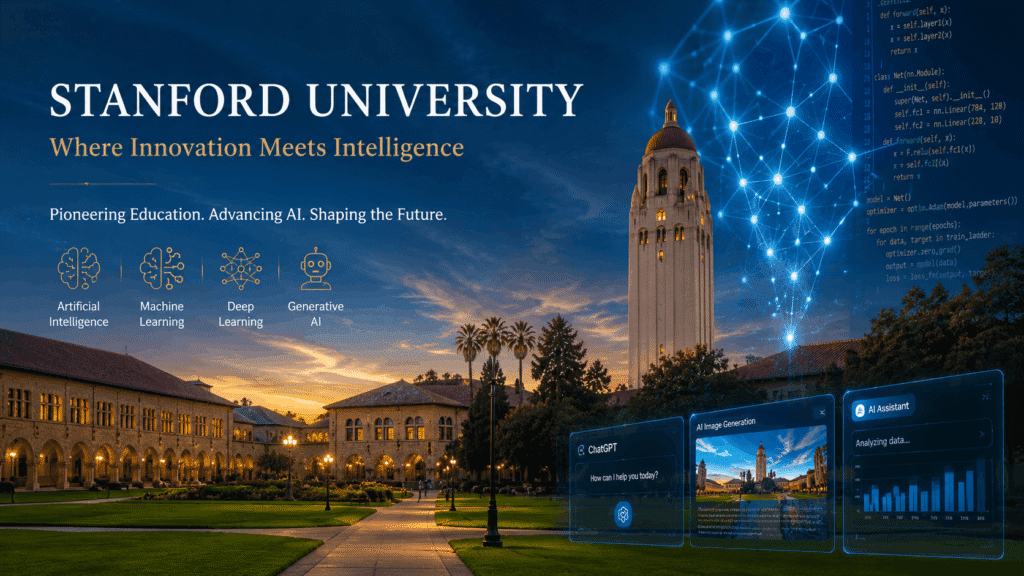
Overview of Stanford’s Generative AI Program
Stanford Generative AI course is designed by the experts from Stanford University School of Engineering and delivered through Stanford Online, which is run by the renowned Stanford Center for Professional Development.
When I initially came across it, what really caught my attention was not just its association with Stanford University but its well-structured nature and practicality.
This is not another fluffy class that simply discusses the trends in AI.
Instead, it is aimed at individuals who seek a career in the field rather than studying for knowledge’s sake.
This class is part of professional AI education since it meets all the expectations of an educational program in the field.
If you have coding experience or are already in the IT world, this class seems like a natural extension.
To me, I thought that this course is appropriate for developers, data experts, as well as product managers who are interested in understanding the construction of AI products.
What I liked about the course is that it links theory to application.
It doesn’t only teach the theory behind AI, but also how businesses are using it.
It will make a significant difference when you prepare yourself for AI roles.
When it comes to career benefits, there’s no denying its worth.
Stanford University on your résumé will immediately draw the eye, particularly in crowded recruitment environments.
It will instill self-confidence since you will be learning in an organized manner through the guidance of experts.
Who Should Take This Course?
The Stanford Generative AI course is not for everyone, and this is a positive point in my view.
For developers who have knowledge about Python and wish to explore AI, I feel the Stanford Generative AI course will be a step up.
I have encountered numerous situations where talented software engineers have had difficulty transitioning into an AI role due to a lack of formal training.
Product managers could also be interested, particularly if they are handling AI-powered products.
Understanding how models work is key to making good decisions rather than just depending on engineers.
This may appear daunting to novices.
If you have no prior experience, it would be wise to start with the basics first.
Experienced professionals would benefit the most from this resource.

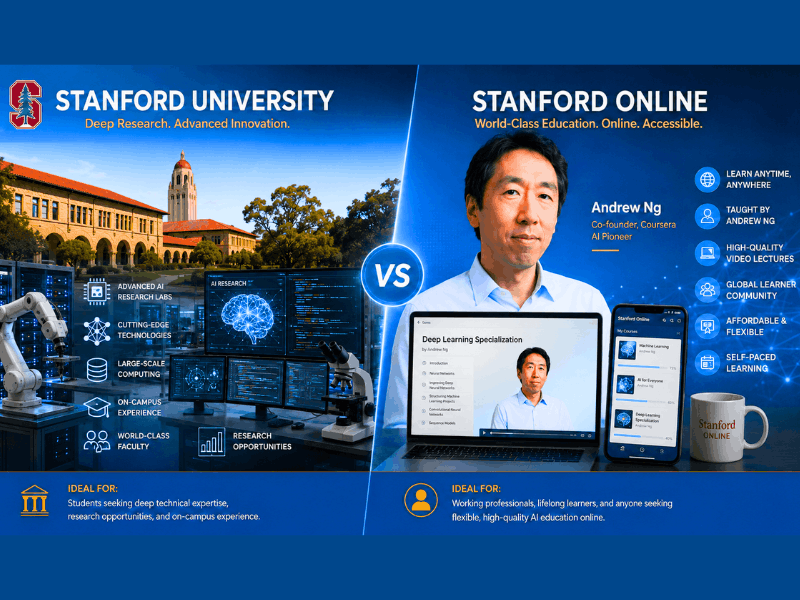
Stanford vs Andrew Ng Courses
Having compared both myself, the contrast between them is obvious.
Stanford Generative AI course have a more profound content, but Andrew Ng’s courses are more approachable.
For beginners who want to dive into the world of Artificial Intelligence, the content presented by Andrew Ng sounds more welcoming.
Everything is explained in such a way that even a complete beginner won’t be confused or intimidated.
However, after getting a basic understanding of what AI is all about, there may appear a desire for more.
And there comes Stanford.
It is more focused on practical systems rather than theoretical knowledge.
Thus the plain truth is that one should begin with Andrew Ng and graduate to Stanford as he progresses towards becoming an AI professional.
Here’s the honest breakdown:
| Feature | Stanford Generative AI course | Andrew Ng Courses |
|---|---|---|
| Depth | Advanced | Beginner-friendly |
| Cost | Expensive | Affordable |
| Certification | High prestige | Moderate |
| Practical rigor | Very high | Moderate |
Detailed 2026 Syllabus: What’s Inside?
The syllabus for Stanford Generative AI corse is truly when things get interesting.
After researching it initially, it became apparent that it is a lot more about real-life application of generative AI than theory.
In its syllabus, the Stanford Generative AI course combines foundational knowledge, cutting-edge software, and analytical skills in an industry-relevant manner.
Core Fundamentals of GenAI
The foundation section is solid, and in fact, I appreciate how it does not rush through anything.
You begin with Deep Learning, which forms the basis of pretty much all artificial intelligence applications today.
It then continues on to LLMs, which stands for Large Language Models, where you learn about how systems like ChatGPT function internally.
This section was quite reminiscent of the Stanford course, CS224N: Natural Language Processing.
It’s also worth learning about the Diffusion Models, which are utilized for the creation of image generators.
What was useful about it is that, besides explaining the theories, it provides practical examples of training and implementing these models.
Hence, rather than memorizing the terms, you start getting to know the logic behind them.
This becomes very helpful when creating something by yourself.
Advanced Topics for 2026
That’s the part where the course becomes unique to the upcoming 2026 trends.
Agentic AI involves learning about systems that are capable of performing their actions on their own rather than being reactive.
This is followed by RAG (Retrieval-Augmented Generation), which is possibly one of the most useful skills.
It allows the AI to provide correct answers by accessing external information.
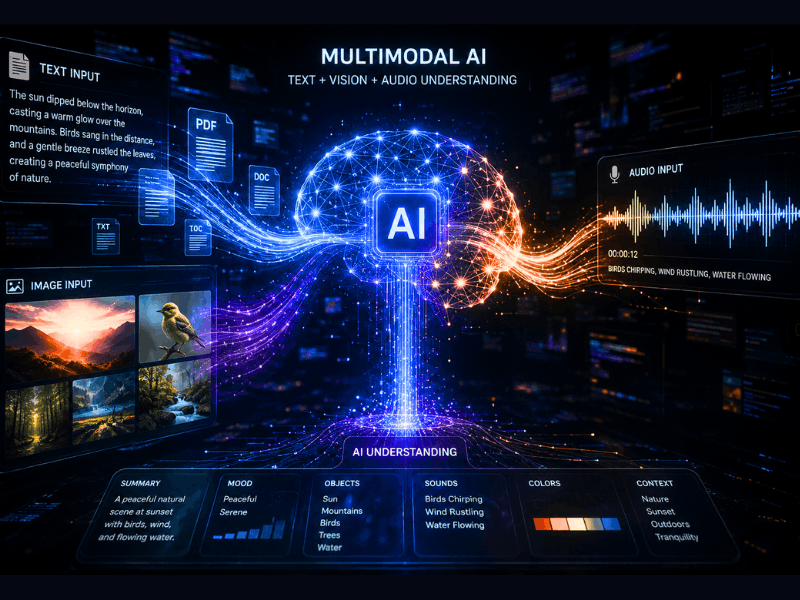
You will also cover Multimodal AI, where machines can understand text, imagery, and even sound simultaneously.
This technology is currently being applied in state-of-the-art applications.
Fine-tuning is another key concept that you will learn about.
From my perspective, this is one of the most valuable skills to master, as companies no longer use off-the-shelf models.
They require customized solutions.
Ethical AI and Governance
This subject matter is highly pertinent, especially in today’s world of artificial intelligence.
The module explains Responsible AI, meaning the development of ethical and secure AI systems.
Furthermore, data privacy is covered in terms of its relevance in the age of AI systems acquiring data on a large scale.
One more aspect which I found interesting was the discussion on AI risks such as bias, disinformation, and abuse.
What impressed me positively was that it does not sound like a theoretical lecture.
These concepts are analyzed through examples of real-life cases, including user data processing or preventing biased outcomes from AI systems.
In this context, this part has changed my attitude to AI significantly.
Cost Analysis: Stanford AI Course Fees 2026
Well, let me admit that what strikes one as soon as they look at the Stanford Generative AI course is its pricing aspect.
As far as my findings go, short professional courses cost somewhere around $300-$800, while advanced ones are as high as $1,750 and above per course.
Once one looks deep into programs and courses, the price level increases significantly, ranging above $20,000+.
If we translate the amount in Indian currency, then it starts from ₹25,000 up to ₹17 lakhs+ or ৳30,000 up to ৳20 lakhs+.
Typically, the payment methods include paying for each course, and there are even instances where companies pay for their employees.
There isn’t much financial aid, and to be honest, I couldn’t find any for individuals.
Therefore, yes, it is definitely an expensive investment.
Is It Expensive for Indians?
Short answer, it sure does seem expensive once you do the math.
I must admit that I did pause for a second upon calculating the price tag.
Even ₹80,000 spent on a short course isn’t easy money in India.
That being said, this is how it should be looked at practically.
If you are in IT and trying to enter the field of high-paying jobs in AI, then the price becomes justified.
Most professionals enroll in this program through corporate sponsorship or learning allowances.
If you are new or have doubts regarding the field of AI, then this can be dangerous for you.
The real issue, therefore, is not only the cost but also your preparedness to apply your knowledge.
ROI & Career Impact: Will It Get You Hired?
This is the section that everybody is interested in, and to be honest, I have the same concern before taking up the Stanford Generative AI course.
Does it really help you find a job? Or does it just give you a certificate to show off?
Based on my experience, it will definitely add value to your resume.
And having Stanford University on your resume will definitely get attention.
This is the reality; it will not secure a job for you.
It will help you develop your skills, and there lies its importance.
There is high demand for AI professionals at present, and they earn well.
An increment in salary is possible, but only with application of the acquired knowledge.
In my opinion, the Stanford Generative AI course paves the path, but it is up to you to traverse it.

Real Career Opportunities in 2026
Job trends have shifted significantly since several years ago.
Having taken the Stanford Generative AI class, you do not have to stick to just one career path.
Some of the career choices that you can look into include the AI Engineer job where you get to create and deploy real models for companies.
The job is quite popular, especially amongst startups and tech companies.
The next career is the GenAI Specialist job.
Such experts deal with AI tools and technology such as chatbots, automation tools, and artificial intelligence in content generation.
One promising path to explore in this case would be that of an AI product manager.
As you might know, this job involves both the business and the technical side of AI, which I believe makes this occupation a great choice for people who do not want to write code throughout their day but are still keen on staying in AI.
It should be said that companies do not hire only theory-experienced people.
On the contrary, they require people with practical skills in AI application.
Comparison: Stanford vs Other AI Courses
Here’s a clear comparison
| Platform | Cost | Level | Best For |
|---|---|---|---|
| Stanford | $$$$ | Advanced | Serious AI careers |
| Google Professional AI vs Stanford | $$ | Intermediate | Practical skills |
| MIT AI certification vs Stanford | $$$$ | Academic | Research-focused |
| Microsoft Azure AI vs Stanford | $$ | Cloud-based | Enterprise AI |
Stanford is best if you want deep expertise + brand value.
Final Verdict: Should You Join in 2026?
After all this, it seems like the choice has nothing to do with the class but you yourself. The Stanford Generative AI course is really amazing, no doubts.
However, this will only work if you know what exactly you want from it and if you’re willing to work on it. I saw many people investing in expensive classes, yet not doing anything further than learning.
But before parting with any money, you must be honest with yourself first. Are you willing to learn, develop projects, and stick to it for several months?
If yes, then this course will indeed make a difference for you. But if not, it may just end up being yet another certificate that you don’t even use. Let’s simplify it all.
Who SHOULD take it
If you have some background in technology, this class fits perfectly well.
The developers that wish to specialize in artificial intelligence would find this class more beneficial.
In my opinion, I would recommend this class for professionals interested in having better career prospects.
For those that are serious about their careers in artificial intelligence, this is worth investing in.
Even the product managers that deal with such products can benefit from this class significantly.
Who should AVOID
It may seem daunting for someone who doesn’t know anything about coding at all.
I don’t recommend beginners to start with an AI course.
Moreover, if you are looking for a fast solution and want to get placed immediately, this is not what you need.
For those individuals who aren’t sure about their future, I would suggest trying out affordable courses first.
Since you don’t have any idea what your future holds, you can’t benefit from this expensive course.
Frequently Asked Questions
1. What are the prerequisites?
Familiarity with basic concepts of programming languages like Python, math subjects like linear algebra, and machine learning algorithms is necessary.
For those who have some background in taking introductory courses, things become easy for them.
But without that background, learning the course will be tough.
2. Is it free or paid?
Stanford Generative AI course is a paid one.
Introduction lessons might not cost anything, but full access will involve some payments for a certified course.
Professional training in AI comes with high prices because of its nature.
3. Duration of course?
Course duration varies according to your choice.
Short courses take around 8-12 weeks, whereas full-length courses may last 1 year or even more.
It’s flexible, yet there should be a continuous effort from your side.
4. Stanford vs MIT which is better?
They are both first-rate institutions, but their objectives differ.
Stanford is more inclined to pursue applied AI, whereas MIT places emphasis on theoretical research.
For individuals seeking to acquire marketable skills, Stanford may be more suitable.
5. Can beginners take it?
Beginners can give it a shot, but it is not the easiest way to start out.
It is better if one develops his/her fundamentals through some beginner-level AI classes first.
Only after that does this course become really helpful.