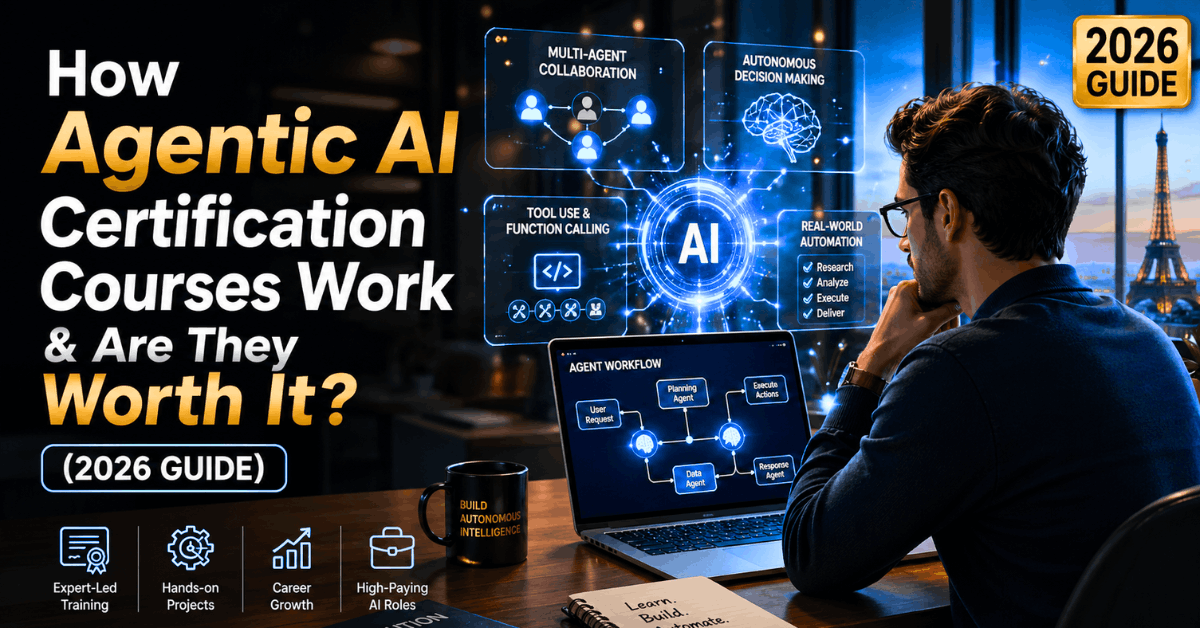
Description : The Evolution from Generative AI to Agentic AI
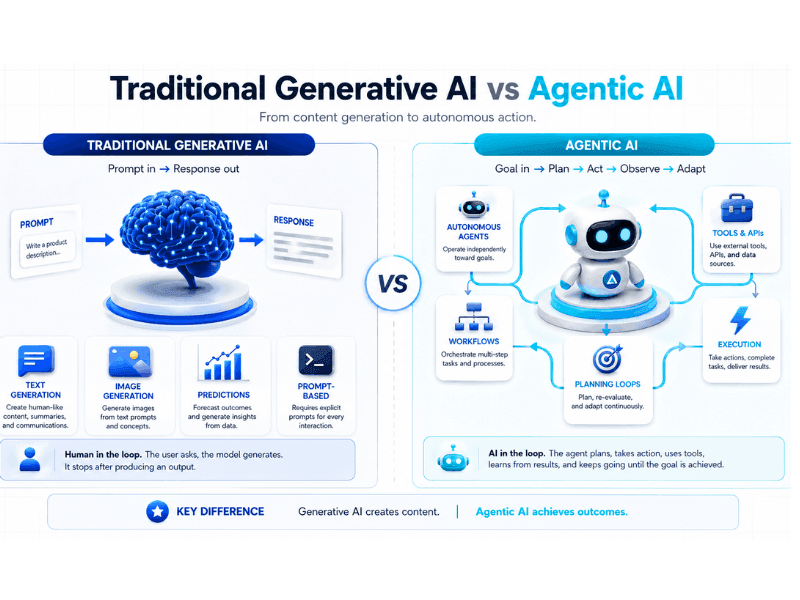
Are you confused why everyone suddenly started talking about Autonomous AI Agents? Here’s the quick explanation: AI doesn’t just respond; it acts!
By 2026, it becomes apparent that the transition from prompt-based systems to agent-based models has occurred, where AI systems can plan their tasks, utilize tools, and execute full work flows autonomously.
It was something I found out while trying out some of the tools myself—it didn’t require a series of prompts anymore but did everything in one process.
And that’s precisely why knowledge on How Agentic AI Certification Courses Work has become crucial, given the new AI employment market trends of 2026.
There is an increasing need for people who have the ability to create systems that perform both reasoning and action, but not merely generate output.
Agentic AI is gaining popularity because of its efficiency in producing results, not just giving answers.
Traditional AI Courses vs Agentic AI Courses
Before diving deeper, let’s quickly compare how learning has evolved:
| Feature | Traditional AI Courses | Agentic AI Courses |
|---|---|---|
| Focus | Models & predictions | Autonomous agents & workflows |
| Interaction | Prompt-based | Multi-step decision making |
| Learning Style | Theory-heavy | Hands-on, project-driven |
| Output | Predictions, text, images | Actions, automation, execution |
| Tools | TensorFlow, PyTorch | LangGraph, AutoGen, CrewAI |
| Career Roles | Data Scientist, ML Engineer | AI Agent Architect, Agent Engineer |
The Blueprint: How Agentic AI Certification Courses Work
When I first started taking these classes, I was expecting another heavily theoretical AI class.
However, the whole structure is totally different, and it even seems like you’re building a digital worker.
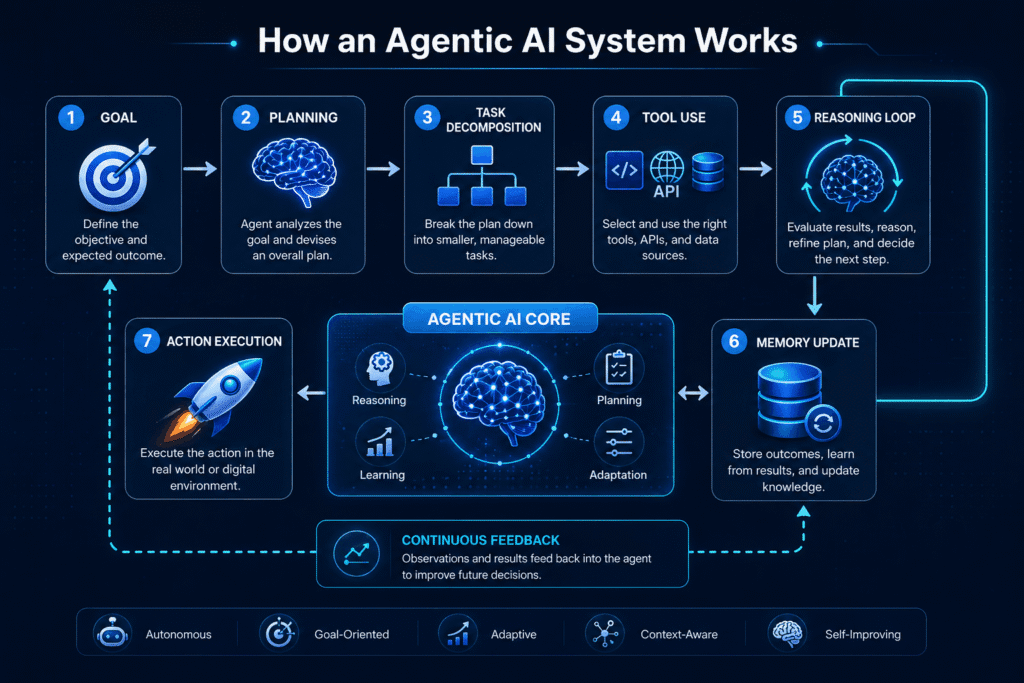
These classes are based on the Autonomous Agent Workflow model, and you learn about how things are done step-by-step in these systems.
Everything is interconnected, and the system evolves over time as you gain knowledge.
The first thing that usually needs to be learned is how the agents think using the cognitive architectures.
That will give you an idea about how the agent chooses its next move, how it divides tasks, and how it adapts to unforeseen circumstances.
Once there was a case where I had to create an agent for research that could search, summarize, and optimize by itself.
It was only this assignment that allowed me to grasp the idea fully, unlike any tutorials.
Now, however, comes the real transition—from studying how things work to developing actual workflows.
You begin integrating APIs, tools, and logic into actual systems capable of getting useful stuff done.
And this stage usually marks the point at which students either get really enthusiastic or really scared since now it all becomes very practical.
The bottom line is very simple: Skill Validation for 2026 means creating something useful, not knowing about it.
Assignments are not assessments; assignments are working systems that can be included in a portfolio.
By the time you finish, you won’t have just learned about artificial intelligence; you’ll have gained the skills to design autonomous and problem-solving systems.
Theory vs Real-world Execution
One positive aspect is that the theoretical content is well balanced with practical exercises without being tedious.
Concepts are taught, yet at all times linked to implementation within an agent of your choice.
For instance, you get taught reasoning loops, after which you have to implement a loop on your own agent.
And then comes the stage of planning frameworks, when agents start learning to divide their major objective into smaller steps.
That’s where everything starts to become very similar to actual systems that operate in business settings.
In fact, I once developed a task manager agent, which was even able to plan multiple-step actions.
The next component is agent memory management, which was a big surprise for me personally.
You are taught how agents remember things and how they use that memory to make smarter decisions.
It seems like, without memory, an agent feels stupid. But with memory, it acts almost humanly.
By this point, it is no longer just programming but shaping behavior as well.
The 2026 Curriculum: What You’ll Actually Learn
Upon researching the detailed curriculum, I found out that this is not just another generic AI class with theories and presentations.
The curriculum of Agentic AI programs is built around real systems that companies are already using today.
It begins with Multi-Agent Orchestration, which involves several agents working in tandem as a team.
It may seem complicated initially, but after building it, it is rather easy and makes perfect sense.
Agentic RAG follows next where agents can get real-time data and take better decisions based on it.
I had the chance to use it for a project and it actually was like providing the agent a brain on steroids.
Another critical element is Tool-use & Function Calling, wherein the agents interface with APIs, applications, and databases.
It is where AI becomes more than conversation and begins to have practical value in workflows.
MCP (Model Context Protocol) is also covered, allowing you to manage agent context effectively.
This section actually took some time on my part, but when it clicked, everything began falling into place.
If you wish to know all about how Agentic AI certification courses work then you have arrived at the right curriculum.
This is no haphazard collection of subjects; it’s a methodical system of thought development.
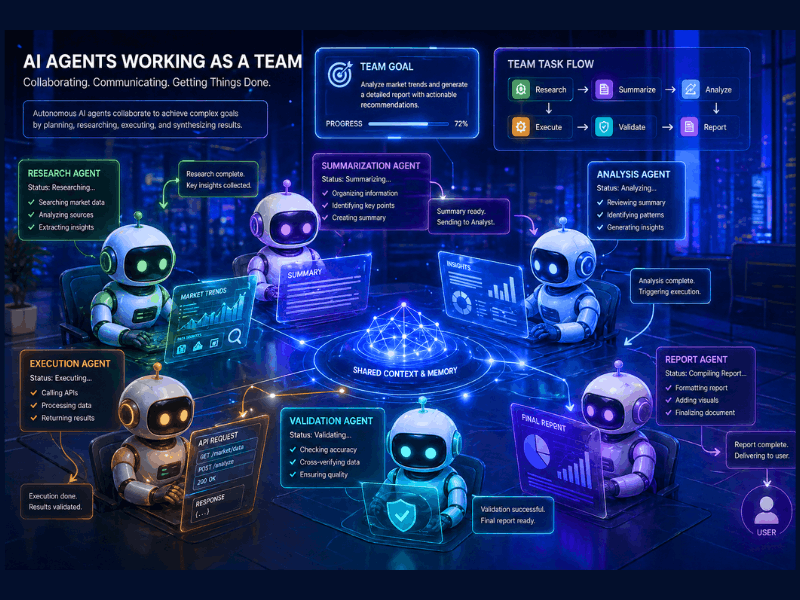
Mastering Industry Tools
This is where the real confidence will come from working with the actual tools.
While most courses provide concepts, training is done on frameworks such as LangGraph and CrewAI.
I can recall that while I struggled with LangGraph initially, once I figured out the flow logic, it became my favorite tool.
This makes designing agent workflow easy through visualization of the process.
There’s also Microsoft AutoGen which seems more suitable for large-scale and robust agent development.
A little complicated but extremely practical for real world use cases.
There is also practical involvement in PydanticAI for structuring and validating the output of your agents.
It may seem insignificant, but it is very important for developing robust software.
The biggest advantage of using these tools is that they are never talked about as individual tools, but always applied in practice.
Not only are you acquiring skills, but you are also learning how to apply those skills in a cohesive process.
Eventually, you are no longer merely familiar with the vocabulary but have become confident enough to construct something on your own.
Hands-on Phase: Building Real AI Agents
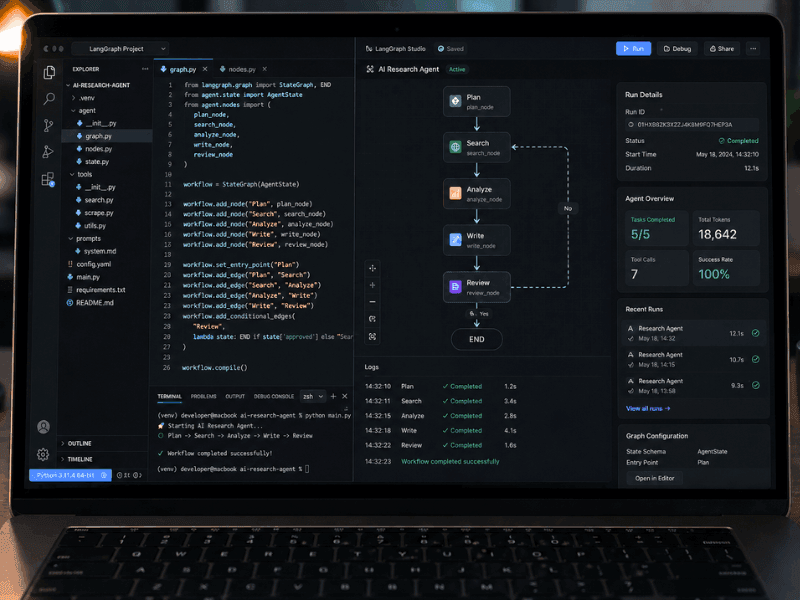
The most important element of these classes often comes into play after the theory ends, and construction commences.
Students are now tasked with working on Hands-on Agentic projects, which are very unlike the theoretical experiments that take place inside classrooms.
Instead of merely studying an intelligent system, you build your own and learn how it reacts when you interact with it.
This is vital since practical learning is very different from passive learning.
The first project will normally be relatively simple, like designing a device that conducts research on a topic all on its own.
The class then gradually progresses to learning about API integration.
The agent can link up with search engines, calendars, CRM software, or even your internal databases to get things done.
During my own tests, there was something oddly satisfying about watching an agent retrieve real-time information.
It wasn’t some kind of chatbot anymore because it actually worked like an assistant. Understanding the technical concepts becomes a lot easier with that kind of context.
Another key aspect of the course involves understanding how to create Autonomous workflows that operate without continual oversight.
You learn how an agent receives a goal, decomposes it into tasks, and executes each task autonomously. In some assignments, you have to develop customer support systems.
Some pay attention to sales automation, pipeline research, or internal business applications. That way works well since not all learners want the same careers related to artificial intelligence.
I am sure that such mistakes are always encouraged in the course. Sometimes the best experience is learning from an agent’s mistakes and correcting them.
That procedure involves much more learning than watching videos on lectures. At the end of this period, you are no longer just executing commands.
You start to think like a designer of artificial intelligence systems for practical purposes.
Are These Courses Worth It? ROI Breakdown
This is where all the fun stuff comes into play—does it really make sense or not.
Based on my experience, the ROI in terms of Agentic AI Training seems to depend more on the skills acquired rather than the actual certification.
As long as you work seriously on projects, the results can be very surprising.
Job positions such as AI Agent Architect are beginning to appear, and these pay good money as there are few qualified professionals at the moment.
They have been applied by some individuals in freelance work, automation consulting, and even corporate positions in firms.
The power of such skills really lies in this, rather than in a particular job title alone.
There are learners who use it to make a career pivot to autonomous AI, particularly for those who come from a non-AI background.
This course is interesting because of its practical approach to skills.
Not only are you studying theory, but you will learn how to build systems that can perform tasks effectively.
Since Enterprise-scale Agent Deployment is relatively new for most organizations, you will have an advantage over other learners.
If you know How Agentic AI Certification Courses Work, you will know that there is more to doing projects than learning.
But to be completely honest, if you do not work on your projects or learn, it loses all its value.
Job Demand in 2026
It’s all about the demand side.
There is definitely a lack of skills when it comes to AI, particularly agent-based systems, and corporations have trouble finding employees who are capable of designing such systems.
A lot of opportunities arise for learners who study AI through this course.
Although a certificate from an industry itself would certainly help you a lot, it would be better if it comes along with a good portfolio.
Most recruiters prefer candidates with some kind of experience rather than those with certificates only.
Some institutions have introduced career assistance programs that include resume writing and mock interviews.
The backing provided may be very significant in your attempt to break into the profession.
In general, there is a need for such skills; however, their application will determine whether or not you succeed.
How to Choose the Right Course
It could be overwhelming to select an ideal course due to the numerous courses available.
I made the blunder of selecting a course using marketing tactics, and I must say that it wasn’t helpful.
Let us see what really counts when making a decision. Firstly, verify the Accreditation of AI certificates, but do not rely on it entirely.
A recognized certificate might help, but the true benefit lies in what you learn and create within the program.
Secondly, consider how you like to learn—Self-paced or Instructor-led AI training will make a huge impact.
For those who are disciplined enough, self-paced is ideal. For others, instructor-led programs can drive them towards success.
I personally thought guided tutorials were more beneficial since I was able to ask questions and correct mistakes more quickly.
The other thing that people tend to overlook is community assistance, which is quite significant.
A community where you are able to talk about challenges, share your thoughts, and receive feedback greatly accelerates your learning process.
A lot of my most interesting findings were obtained by looking at how other people would go about solving the same problems.
Secondly, pay attention to the curriculum.
Find out How Agentic AI Certification Courses Work to ensure they offer a practical way of project development.
In case it appears theoretical and far-fetched, the course is not for you.
Finally, opt for one that offers you an opportunity to produce something tangible at the end of the course.
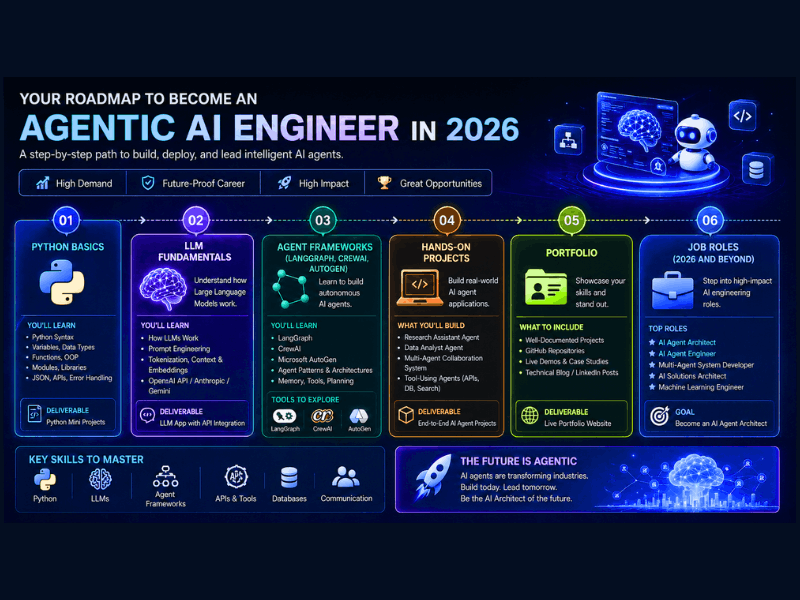
Agentic AI Engineer Roadmap
Contrary to what most would believe, beginning from scratch can make this easier than one thinks.
While I believed in the past that it required extensive mathematical prowess or advanced knowledge on AI technology, this isn’t always the case.
To begin, one needs to get familiarized with some of the basic principles, such as Python, APIs, and generally how AI works.
At this point, your goal should be to study the behavior and responses of large language models to structured data input.
This helps you learn the thinking of agents before you begin working on them.
The following task would be investigating into the world of agent frameworks and carrying out experiments in small projects.
It should start from something very basic such as building agents for summarizing information or doing repetitive tasks. This is where I started too, which made me feel less afraid.
Now that you have gained some confidence, you should proceed to more complicated workflows that involve several stages and tools.
That’s when you begin thinking not about programming but designing systems which can operate autonomously.
Then, start building a portfolio consisting of 2-3 decent projects aimed at problem-solving.
They become more important than any certificate once you start applying for jobs.
Finally, you need to start applying for internships and entry-level jobs.
This process is not about hurrying but about creating things constantly and gradually improving.
Conclusion: Final Verdict
From my experience in taking several courses and conducting personal experiments, I can assert with certainty that these courses have value but only when applied properly.
It is not the certificate that matters but the Hands-on Agentic Projects that you work on throughout the course.
It is these hands-on exercises that help you develop the necessary skills and become more confident.
A good Curriculum of Agentic AI program will concentrate on real systems rather than theory or videos.
If the course does not compel you to create, it will not be worthwhile for you. Moreover, do not focus too much on the Accreditation of AI certificates.
It can help, but it is not the determining factor when someone evaluates your profile.
The important aspect is whether you can apply solutions to real-world problems with the help of agent-based approaches.
The other factor that proved beneficial to me is enrolling into a course that gives you career support after certification, particularly if you are new in this area.
It will definitely prevent you from getting lost in the future.
When you really grasp the idea of How Agentic AI Certification Courses Work, you will realize that it is only the beginning.
My honest advice—pick one good course, build at least two strong projects, and start applying your skills as early as possible.
That’s where the real growth begins.
FAQ Section
1. Do I need coding for Agentic AI?
Yes, but only basic programming knowledge will be sufficient for that. Basic requirements are Python programming, API usage, and logic building.
Advanced programming skills are not necessary for that. One needs to concentrate more on workflows and agents’ interaction with various applications.
2. How long do these courses take?
It all comes down to depth and presentation. Most courses will last from 3 to 6 months provided you are dedicated.
Self-study courses tend to be faster, although instructor-led ones usually offer more structure and guidance.
3. Are certifications really valuable?
However, they help to some extent only. Most recruiters will be more interested in your project work and practical experience.
If you have both a certification and an impressive portfolio, you increase your odds considerably.
4. How Agentic AI Certification Courses Work
Such courses are designed to teach about agent procedures, tooling, and practical automation.
Learning occurs through system implementation rather than merely through classroom lectures.
Typically, such courses consist of theoretical instruction, tool usage, and practical projects that emulate actual business scenarios.
5. Which course is best for Agentic AI?
There is no universal optimal program for all.
Choose the courses that are innovative, incorporate actual projects, and have good community relations.
Programs which include modules such as LangGraph or AutoGen, as well as mentoring, are usually more realistic and career-oriented.
5 thoughts on “How Agentic AI Certification Courses Work & Are They Worth It? (2026 Guide)”