

If you’re wondering how to learn AI skills for beginners, you’re not alone. In 2026, AI is no longer just a tech trend—it’s becoming a must-have skill across industries.
From automating your tasks, producing content, to increasing productivity, AI will determine how you earn, manage your business, and further your career. The most amazing thing is that no prior programming skills are necessary.
Even now, when I’m thinking back on my time when I started learning AI, I remember it being very confusing because there was so much information to take in at once.
But as soon as I walked through the steps of learning AI, things became very straightforward. And that’s precisely what we’ll be doing in this article.
Let’s walk through a complete, beginner-friendly roadmap.
Why 2026 is the Best Time to Learn AI
To be completely honest, no other time has been more ideal than 2026 for diving headfirst into AI. Everything is moving really fast now. AI seemed like something nice-to-have last year.
It’s becoming a necessity today. As a student, a freelancer, or a person employed at an organization, having AI skills is slowly becoming something that could be considered a future-proof career choice.
I have personally noticed how my peers have managed to complete their tasks twice as fast with the help of AI technology.
The really intriguing thing about the Agentic AI Roadmap 2026 is that it is playing out right before our eyes. The function of artificial intelligence has evolved from simply giving responses to taking actions and handling tasks similar to a junior employee.
This has shifted the way we function entirely. It is not simply about using technology; it’s about working alongside it.
Another thing I’ve personally noticed is the rise of the AI-Native workflow for beginners. They have begun forming a habit of working with AI right from the start.
Rather than performing tasks by themselves, they start thinking about automating everything. It’s like shifting from being pedestrians to becoming cyclists overnight. There’s no turning back once you get accustomed to it.
Step 1: Build AI Foundations
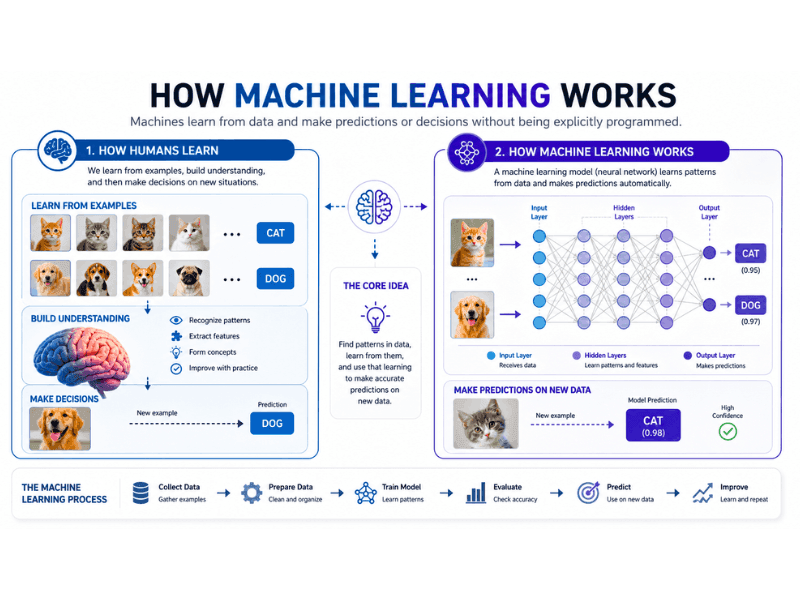
But before you dive into all sorts of complex things or automation, I always advise newcomers to take their time and form some basics first. This is when everyone gets anxious, but trust me, this is the part that will make everything simple for you afterwards.
I know, from my experience, that I used to try to skip this step when I was starting out, but that just made everything even more confusing. Only after I came back to the basics did everything start becoming clear.
The process of AI learning can be likened to learning how to drive a car. It is not by learning on a highway that one learns how to drive but starts by understanding how the engine operates and how he controls the car.
If you’re serious about how to learn AI skills for beginners, this foundation will save you a lot of frustration later. You don’t need to become a coder here, just aim for clarity and real understanding.
Understanding Basics
The idea of fundamentals of Machine Learning initially came across as very daunting for me. However, after thinking through the concept carefully, it becomes clear that it simply implies learning through examples rather than through rules.
To give an illustration of how it works, when several images of cats are shown, the machine figures out the patterns on its own. This is pretty much the way we learn ourselves.
Finally, there’s Data literacy for AI, something that even beginners often overlook. I definitely did. If your data is messy, the results will be too, regardless of how advanced the AI technology may be.
Lastly, NLP basics can give you insights into the process of how AI understands human language and how you can use it. This comes especially handy when you start working on your prompt or even creating your own AI.
Generative AI vs Traditional Software
The most dramatic change that I have observed in the use of AI is how much they differ from regular software. The difference is in the rigidity of regular software. For instance, you press the button and it performs one specific action.
Generative AI for beginners 2026 is a totally different experience compared to other AI. Instead of issuing instructions through technical terminologies, you would be able to give instructions normally, and these would be transformed into something completely different. It could be in text form, graphical, or even thought forms.
I remember one such time when I utilized AI for preparing the first draft of my blog post. Instead of starting off blank, I had been able to prepare a somewhat good draft in no time at all. It is through such use of AI for productivity that one is able to see the power of AI.
Traditional tools make you do the work step by step. AI works more like a creative partner. Once you get used to that shift, it changes how you approach almost every task.
Step 2: Learn Prompt Engineering (Core Skill)
“If AI is strong, prompts are the things that truly enable its strength.” It took me some time to understand this point, and when I did, I realized that my problem was with how I asked questions, not the software I used.

Creating Content with AI
As soon as I started utilizing Advanced Prompt Engineering, I noticed an instant increase in the quality of my output. This meant that rather than issuing vague instructions, I would craft precise prompts filled with context, tone, and examples.
With Multimodal AI, one can now create text, images, and short videos using just an idea. I once used Multimodal AI to write a blog post prompt and then created corresponding images based on that idea, which saved me lots of time.
The key here is to think about how you would communicate with an actual human assistant. Be clear and provide guidance in increments, as this allowed me to grasp the true process behind using AI in the creative process.
Automation & Prompt Chaining
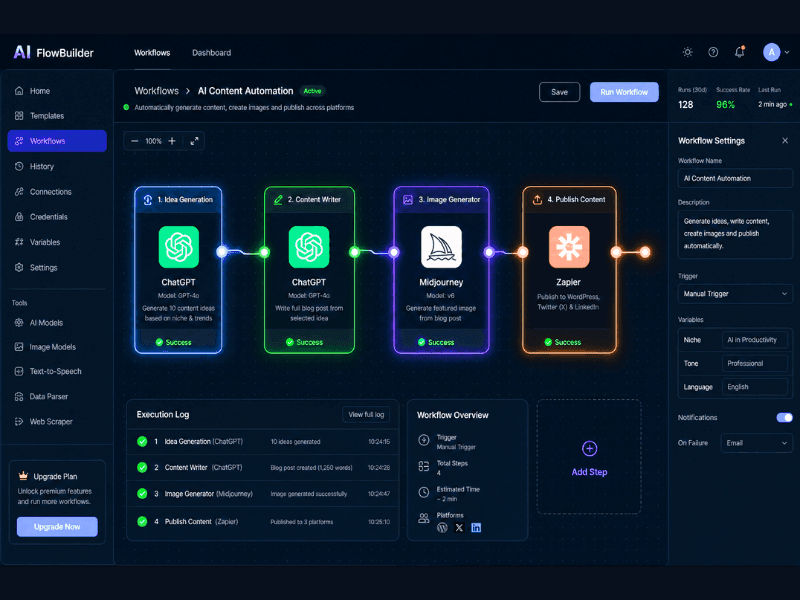
Here lies the essence of fun. You do not write prompts one by one but link different stages. This phenomenon is known as AI tool stacking and completely alters how the process of work takes place.
As an example, I have created a system where one prompt will create an idea for the blog post, then another prompt will expand on the idea, and finally another prompt will format it for posting.
This is when you begin chaining prompts like this, and AI goes from being a mere tool to being a part of your entire workflow. If you’re exploring how to learn AI skills for beginners, this is the stage where everything begins to feel practical and powerful at the same time.
Step 3: Agentic AI Revolution
AI is not merely providing answers anymore. It is beginning to perform actions, make decisions, and accomplish tasks independently. The first time I encountered this development, it truly seemed like collaborating with an apprentice as opposed to using a tool.

What is Agentic AI?
Autonomous AI agents concept is quite straightforward yet effective. The only thing that one should do is to set up a task for AI and let it come up with ways to fulfill it. It is exactly this aspect that distinguishes this stage from other types of AI application.
When I first tried this out, I had an AI do some research on a topic, create an outline for a blog, and write content for it. It didn’t just answer once; it completed the process systematically. This is the Agentic Leap for beginners, when AI becomes autonomous.
It is different in terms of your perception on work. Rather than handling everything personally, you delegate and supervise. It takes some time getting used to it, but when you do, you will find it very effective and even addictive.
Build Your AI Assistant (No-Code)
And that’s the best thing – you don’t need any coding skills to create your own assistant! The moment I tried out some basic tools and discovered that I could automate my work routines without coding, I became a No-code AI developer.
Small systems such as email responders, content schedulers, or even personal research assistants are easily created. I developed a simple system that gathers ideas and develops drafts. While not flawless, it has proven time-saving each day.
These small setups slowly turn into AI-Native habits for 2026, where you rely on AI naturally in your routine. If you’re serious about how to learn AI skills for beginners, this is the stage where everything starts feeling real and useful.
Step 4: Tools & Real Projects
It’s okay to learn about concepts, but things don’t click until you apply your knowledge practically by creating little projects. My learning was most effective after I stopped watching tutorials and began applying my own ideas.
Essential AI Tools
In response to this question, my suggestion is to concentrate on mastering a handful of Top AI tools before going for others. I was too ambitious myself in my beginnings and started working on different tools without learning anything properly.
Begin with basic things. Have one application for writing, another one for images, and probably a third one for automation. This is all that you need initially. Personally, I started from content creation and gradually expanded my toolset.
Eventually, you will realize how each of them can work with the others. And here is where AI-based Digital Assembly Lines play their role: there is one tool responsible for generating thoughts, the other – for developing them and yet another one – for publishing them.
Build AI Apps Without Coding
One of the most surprising facts that I discovered in 2026 is that you can learn how to use AI without programming. Now, even a person who does not know how to write code can make some apps using artificial intelligence.
However, when I tried developing a chatbot based on my own notes, the results were surprisingly successful. It is here that RAG is relevant. It provides the ability for AI to derive answers from your personal information rather than guessing at random.
As you embark on the journey to acquire AI skills for beginners, this stage brings everything into practice. It’s no longer about studying but making something tangible out of it that you could possibly use or even add to your portfolio.
Step 5: Courses & Career Path
After learning the techniques and building some simple projects, it is time to apply all that knowledge for real use. I did not consider the employment part initially, but later I came to know about the importance of direction.
Best Certifications
Once I started researching about different classes, I got very confused since there were a lot of options, and let’s be honest, they’re not all worth the hassle. The thing that worked for me was to concentrate on gaining knowledge rather than accumulating certificates.
Look for programs that offer hands-on work along with an AI certification 2026. It adds some credibility, especially if you’re just starting out. I personally tried a couple of Best free AI courses for beginners, and some of them were surprisingly good.
What matters isn’t the platform, but what you develop during your studies. If the course enables you to do real work, it is worthwhile. Otherwise, you will likely forget everything you have learned within a week. This is one lesson that I have learned from experience.
Build Portfolio & Get Job
However, if you are dedicated to learning How to start a career in AI from scratch in 2026, nothing will be more important than your portfolio. No one is interested in how many courses you have taken if you cannot present practical work.
I began with simple AI applications such as content generation and automation tasks. The programs were not always accurate, but they proved that I knew what I was doing. This made all the difference when publishing them to the web.
Consistency is important in this case. Continue to develop, continue to improve, and continue to share. In case you are on the road to learn AI skills for beginners, this is the point where effort pays off.

AI Ethics & Responsible Use
Initially, when I began to use AI technology extensively, I did not give much thought to responsibility.
Instead, I concentrated on efficiency and efficacy. However, it soon became apparent that neglecting the ethical dimensions of artificial intelligence could lead to serious issues.
There were instances where AI came up with absolutely wrong answers with great certainty. That is when I realized the significance of verifying results rather than accepting them at face value. If you’re serious about how to learn AI skills for beginners, this mindset matters from day one.
A topic that people frequently disregard is GEO fundamentals, which revolve around ensuring that the generated AI content is useful, understandable, and authentic for both searches and users.
As for my relationship with AI, I now regard it as an assistant that provides helpful insights and support, but never as an authority whose decisions will always be followed.
Conclusion
On hindsight, AI seemed complicated at the beginning but then things became easy as soon as I found a proper way. The most important thing happened after I stopped thinking about what to do and started experimenting.
If you’re wondering how to learn AI skills for beginners, the answer is not in watching endless tutorials. It’s in doing. Try writing prompts, build simple workflows, and test ideas even if they’re not perfect. That’s how real understanding develops over time.
AI isn’t meant to be a replacement for your hard work; it’s simply there to help improve your processes. Take things one step at a time, maintain consistency, and learn from your errors. That is what has always worked for me.
FAQ Section
1. Is AI hard to learn for beginners?
Absolutely not. In the current age, if anyone wants to start working with AI, there is no need to have much information regarding codes and math. Rather than that, it is recommended that one should focus on learning basics like machine learning and automation.
2. Can I learn AI without coding in 2026?
Yes, learning AI without any coding is possible for you in 2026. The use of automation techniques will let you create chatbots, workflows, and content generation applications. Nowadays, many learners tend to concentrate on AI tools, prompt engineering, and practical application rather than coding.
3. How long does it take to learn AI?
It all depends on you and how consistent you are. Basic skills required for working with AI such as prompt writing and using tools can be acquired within 30 to 60 days. However, advanced skills including automating and creating projects will require a few months.
4. How to learn AI skills for beginners?
Begin by studying fundamental concepts such as data fundamentals and machine learning, and later work your way up to prompt engineering and artificial intelligence tools. Exercise your skills on a regular basis through practical application in tasks such as writing or automation.
5 thoughts on “How to Learn AI Skills for Beginners: A Complete Roadmap in 2026 (No Experience Needed)”