
Welcome
If you’re searching what are the best AI courses for product managers, you’re likely trying to upgrade your skills, stay competitive, and understand how AI is reshaping modern product management. Today, AI is not just a “nice to have”—it’s becoming a core requirement for PMs across industries.
The norms of product strategy are being rewritten by AI-driven products, GenAI features, no-code AI tools, and machine learning-based decision-making. Product managers today need to be more knowledgeable about AI Product Development Lifecycle (PDLC), prompt engineering, data literacy, AI ethics, and working with data science teams.
The best AI courses for product managers, the most important talents, and the certifications that can help you develop future-ready product management skills are all included in this 2025 guide.

What Are The Best AI Courses For Product Managers?
If you’re wondering what are the best AI courses for product managers, the answer depends on your career goals, AI maturity level, and product focus. Due to the growth of generative AI applications, real-world AI projects, no-code AI tools, and AI-powered business choices, the need for PMs with AI expertise is skyrocketing in 2025.
Businesses increasingly require product managers to be knowledgeable with cloud computing platforms, AI ethics, data literacy, model validation, and the AI Product Development Lifecycle (PDLC).
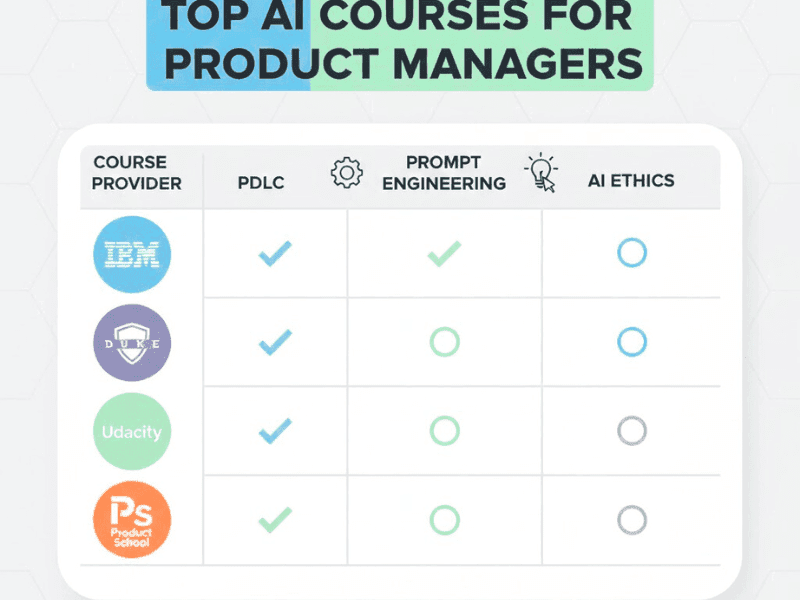
PMs can acquire future-ready product management skills by enrolling in AI-focused programs such as the IBM AI Product Manager Professional Certificate, Duke AI Product Management (Coursera), Udacity AI Product Manager Nanodegree, and AI Product Certification (AIPCTM)-Product School. These courses go deeply into neural networks, AI-driven roadmap planning, MLOps principles, machine learning, and cross-functional cooperation with data scientists.
When choosing the best AI courses for product managers, look for ones that offer practical frameworks for AI-powered user experience design, multidisciplinary communication training, GenAI skills for product managers, and hands-on labs. Give top priority to courses that teach stakeholder management, model drift monitoring, and AI ethics—skills that are widely sought after by contemporary AI-driven businesses.
Why AI Courses Are Essential for Product Managers
Product managers today need to know how AI models operate, how data moves through systems, and how to ethically develop AI-powered features, which makes AI courses essential. PMs now have to oversee AI product lifecycles, validate models, create AI-powered user experiences, and manage cross-functional teams due to the growth of generative AI applications.
PMs find it difficult to work with data scientists, make AI-powered business choices, or convert technical insights into product strategy without specialized training. PMs may learn how to use no-code AI tools, comprehend machine learning principles, create AI-driven roadmaps, and manage risks like bias, fairness, and model drift with the use of AI courses. In the end, AI expertise leads to improved creativity, quicker decision-making, and product management leadership that is prepared for the future.
Which Skills Are Most in Demand Now?
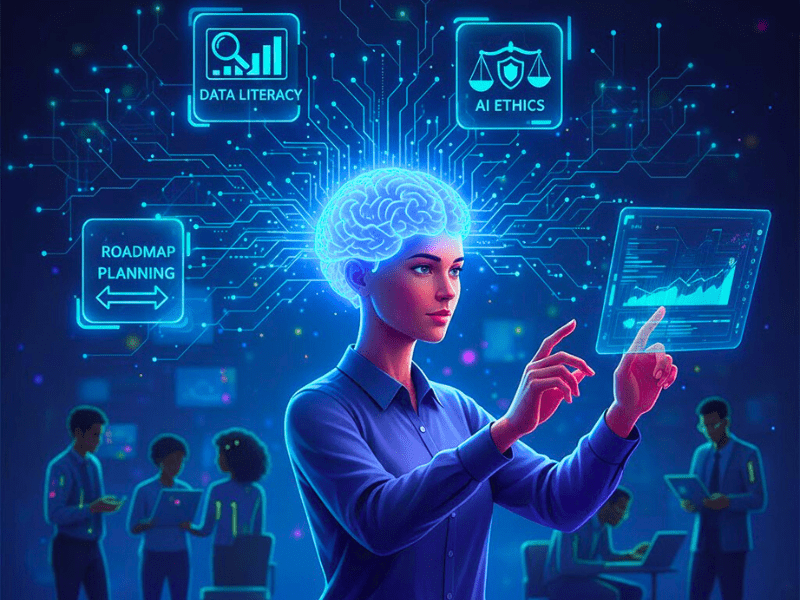
The following are the most sought-after competencies for AI product managers:
Data literacy & data strategy
AI Product Development Lifecycle (PDLC)
Prompt engineering for GenAI tools
AI ethics & responsible AI
Model validation & performance testing
AI-powered UX design
AI-driven roadmap planning
Collaboration with data scientists
Understanding neural networks & machine learning fundamentals
MLOps basics & cloud platforms
PMs are also required to oversee actual AI projects, prioritize tasks using AI technologies, and convert technical ideas into useful business concepts. These abilities guarantee PMs stay competitive, creative, and prepared for next-generation product jobs as AI career development soars.
Top AI Course Platforms & Certifications
When evaluating what are the best AI courses for product managers, it’s important to understand which platforms offer the strongest mix of credibility, hands-on learning, and AI-focused product frameworks. Employers will give preference to PMs who hold certificates in data literacy, model validation, generative AI applications, and the AI Product Development Lifecycle (PDLC) in 2025.
Strategic product management is combined with technical AI foundations such as neural networks, machine learning fundamentals, MLOps basics, and cloud computing platforms in courses offered by IBM, Duke, Udacity, and Product School.
Additionally, each certification focuses on multidisciplinary communication, AI-powered business choices, real-world AI initiatives, and teamwork with data scientists—skills PMs need in a market that prioritizes AI.
Therefore, when selecting the best AI courses for product managers, pay particular attention to courses that cover AI-driven roadmap planning, responsible AI frameworks, and GenAI capabilities. These courses assist PMs in developing into future-ready leaders who can oversee no-code AI products and AI-powered user experiences.
Lastly, the majority of the best programs include project-based evaluations, training in stakeholder management, and exposure to model drift, testing, and AI ethics, which makes them extremely beneficial for anyone looking to advance their career in AI.
IBM AI Product Manager Professional Certificate
The IBM AI Product Manager Professional Certificate is one of the most complete answers to what are the best AI courses for product managers. It is intended for PMs who wish to get practical experience with data literacy, responsible AI, and the AI Product Development Lifecycle (PDLC). Additionally, the course covers model validation, AI ethics, generative AI applications, and practical AI projects.
It is perfect for novices and mid-level PMs since it provides hands-on experience with no-code AI tools, neural network principles, cloud computing platforms, and AI-powered business choices. This certification is widely regarded in international tech businesses due to IBM’s trustworthiness.
Additionally, you gain knowledge of cross-functional cooperation, AI-driven roadmap planning, and improved communication with data scientists. This certification is very beneficial to anyone who wants to develop future-ready product management skills.
Duke AI Product Management Specialization – Coursera
When it comes to the best AI courses for product managers, Duke’s Coursera specialization is a formidable competitor. It combines useful PM frameworks with depth at the academic level. Along with key PM competencies like stakeholder management and transdisciplinary communication, you also master the foundations of machine learning, neural networks, generative AI patterns, and cloud platforms.
Real-world AI initiatives, AI-powered user experience design, and how to convert technical insights into business strategy are all highlighted in this seminar. Additionally, PMs learn about ethical AI, testing, model drift, and working with data scientists.
PMs are prepared to manage AI features, assess model performance, and create AI-driven product roadmaps thanks to its organized curriculum. This accreditation has great authority because of Duke’s well-known brand, particularly for PMs who want to take on leadership positions in AI product development.
Product School – AIPC™ (AI Product Certification)
Product managers’ GenAI abilities, AI strategy, PDLC, and practical AI feature design are all covered by the AIPC certification. Great for accelerating one’s career.
Generative AI & Prompt Engineering Courses
In 2025, Generative AI training has become one of the most important components when choosing what are the best AI courses for product managers. PMs are now required to prioritize GenAI features, create AI-powered user experiences, and oversee actual AI projects from conception to implementation.
Because of this, courses on data strategy, rapid engineering, AI Product Development Lifecycle (PDLC), generative AI applications, and responsible AI are becoming crucial.
These courses teach PMs how to work with data scientists, design AI-driven roadmap plans, assess AI-powered business choices, and incorporate no-code AI solutions. When evaluating what are the best AI courses for product managers, pick one that covers prompt patterns, neural network fundamentals, model validation, AI ethics, and interdisciplinary communication.
Additionally, PMs that receive generative AI training are better equipped to manage user data, spot model drift problems, and create product management workflows that are ready for the future. These courses guarantee that you can lead AI-first product efforts with assurance in rapidly changing tech settings.
Generative AI for Product Managers

PMs can discover how GenAI influences corporate strategy, user experiences, and product decisions by taking a solid Generative AI course. In addition to gaining practical experience with AI-driven user experience design, you are exposed to text, picture, and multi-modal AI models.
The top GenAI courses teach PMs how to implement real-world AI projects, assess model output quality, and employ no-code AI tools for quick prototyping. Additionally, you learn about neural networks, cloud computing platforms, data literacy, and ethical issues like prejudice and fairness.
PMs planning AI-driven roadmaps, AI-powered business decisions, and next-generation product breakthroughs need this training.
Prompt Engineering for PMs – Why is it important?
Because prompt engineering immediately affects productivity, feature quality, and communication with AI systems, it is now regarded as a fundamental talent for contemporary PMs. PMs who comprehend prompts are better able to work with data scientists and LLM engineers, quickly prototype features, and improve AI outputs.
Prompt patterns, contextual framing, chain-of-thought design, and assessment methods are all taught in a quality prompt engineering course. Additionally, it aids PMs in comprehending model constraints, model drift behavior, and how to convert business objectives into technical AI inputs.
Prompt engineering supports AI roadmap planning, AI-powered user experience design, and GenAI feature ideation making it a must-have skill when determining what are the best AI courses for product managers. It elevates decision-making and boosts AI career growth significantly.
Core Skills You Will Learn From AI Courses
A variety of technical and strategic skills are taught in every top AI program to assist PMs comprehend how AI products are developed, assessed, and enhanced. When choosing what are the best AI courses for product managers, it’s important to ensure the curriculum covers the core building blocks of AI product development: PDLC, data literacy, model validation, responsible AI, and AI roadmap planning.
These abilities enable PMs to cooperate with data scientists, comprehend the principles of neural networks and machine learning, assess model drift, and make more informed business decisions using AI. The best aspect is that AI courses give PMs the confidence to deal with cloud computing platforms, MLOps fundamentals, and real-world AI projects by combining technical foundations and product strategy.
These are the most crucial abilities you will acquire, abilities that characterize future-ready product management leadership.
AI Product Development Lifecycle (PDLC)
AI courses teach you how to oversee an AI product’s whole lifetime, including data preparation, model training, testing, deployment, and monitoring. You discover how to scope AI features, how to work with cross-functional teams to deliver AI-driven features, and how Generative AI applications fit into product strategy.
Data Literacy & Data Strategy
You acquire the skills necessary to analyze data, comprehend dataset quality, assess model performance indicators, and collaborate directly with data engineers. PMs who are data literate are more equipped to prioritize features and make AI-powered business choices.
Responsible AI & Ethics
You gain knowledge on how to recognize biases, maintain equity, adhere to governance structures, and use responsible AI principles. For PMs overseeing models deployed at scale, this is crucial.
Model Validation & Testing
AI courses teach you how to assess neural networks, identify model drift, validate model performance, and collaborate with data scientists on MLOps procedures.
AI Roadmap Planning
You’ll learn how to prioritize AI features, plan long-term GenAI initiatives, and integrate no code AI tools into strategic product decisions perfect for anyone exploring what are the best AI courses for product managers in 2025.
Cross-Functional Team Collaboration
One of the most crucial skills PMs get from AI courses is strong cross-functional teamwork. When evaluating what are the best AI courses for product managers, choose programs that teach communication frameworks, interdisciplinary collaboration, and techniques for translating complex AI concepts into practical product insights.
PMs can learn how to collaborate with data scientists, ML developers, UX teams, and business stakeholders more successfully by taking AI courses. Additionally, you acquire expertise in managing model validation conversations, comprehending neural networks, seeing model drift, and assisting with AI-driven roadmap choices. This aids PMs in leading practical AI initiatives with assurance and clarity, which are essential components of product management that is prepared for the future.
How to Collaborate Effectively with Data Scientists
It’s important to comprehend the tools, methods, and expectations of data scientists while working with them. PMs learn how to talk about datasets, model specifications, performance indicators, and machine learning principles in AI courses. Collaboration becomes easier and more effective as a result.
Additionally, you learn how to design AI-powered business decisions, coordinate on Generative AI applications, comprehend model drift restrictions, and ask the proper questions. This skill is crucial when deciding what are the best AI courses for product managers, because real-world AI projects depend heavily on teamwork, clarity, and technical awareness.
Translating Technical Language into Business Language
The capacity to translate technical AI details into obvious business benefit is a crucial talent that PMs acquire through AI training. PMs have to interpret model validation results, MLOps considerations, and neural network behavior into useful insights for executives.
AI courses provide frameworks for concisely presenting AI roadmap planning, outlining data strategy requirements, and streamlining explanations of cloud platforms. This aids stakeholders in comprehending the opportunities, advantages, and risks associated with generative AI projects.
This communication skill becomes a major advantage for PMs exploring what are the best AI courses for product managers, because it strengthens leadership impact across the entire organization.
Technical Foundations Every PM Should Know
Modern PMs must understand:
Machine learning fundamentals
How neural networks work
MLOps basics for deployment
Cloud computing platforms (AWS, GCP, Azure)
Model drift and retraining cycles
These aren’t coding skills—they are strategic knowledge every AI PM needs.
Conclusion
Choosing what are the best AI courses for product managers ultimately depends on your career goals, your product domain, and how deeply you want to integrate AI into your workflow.
PMs have the competitive advantage they need in a market that is changing quickly thanks to today’s top programs, whether they are focused on generative AI, AI product strategy, machine learning fundamentals, or responsible AI.
These courses assist you in gaining practical skills that are critical to contemporary product management, such as data literacy, cross-functional teamwork, AI roadmap planning, and model evaluation.
As AI continues transforming product roles, PMs who take the time to evaluate what are the best AI courses for product managers gain a strong advantage. You may establish yourself as a future-ready leader who can create more intelligent, scalable, and customer-focused AI products by learning AI product management courses, certifications, and practical tools.

FAQ Section
1. How can AI be used in product management?
AI can enhance decision-making, automate processes, and produce more intelligent customer experiences in product management. AI tools assist PMs in shipping goods more quickly and effectively, from process automation and A/B testing optimization to user behavior analysis and predictive insights.
Understanding what are the best AI courses for product managers can also help PMs learn how to apply AI in roadmap planning, customer segmentation, and product strategy. PMs can work more effectively with data scientists and engineers to create intelligent features if they have a solid understanding of AI.
2. Will product managers survive AI?
Indeed, product managers will not only endure AI, but their function will also grow in significance. AI cannot take the place of customer-centric decision-making, empathy, storytelling, or strategic thinking. Rather, by automating tedious duties, AI increases a PM’s capacity.
Learning what are the best AI courses for product managers ensures PMs stay relevant by gaining essential skills like data literacy, model evaluation, and AI product strategy. Future-ready product teams will be led by PMs who embrace and adapt AI.
❓ 3. How much do AI product managers make?
Because of their unique talents, AI product managers are paid far more than typical PMs. They typically earn between $120,000 and $180,000 annually, with senior AI PMs at leading tech companies making over $200,000.
As PMs become more proficient in machine learning, generative AI, data systems, and AI product creation, these salaries rise. Candidates can stand out in high-paying positions by obtaining industry-reputable AI certifications and knowing what an AI product manager performs.
4. What does an AI product manager do?
Developing AI-powered solutions, coordinating data capabilities with business objectives, and guaranteeing ethical, responsible AI use are the main responsibilities of an AI product manager. To create models, verify results, and implement AI features, they collaborate closely with data scientists, ML engineers, and designers.
In addition, they establish success measures, evaluate user data, and guarantee model performance and transparency. PMs can successfully lead AI efforts by mastering these tasks with the help of AI product management courses.
5. What is the 30% rule in AI?
According to the 30% rule in AI, even little automation or AI-powered enhancements can increase workflow productivity by about 30%. This rule emphasizes how AI may speed up product development cycles, minimize human labor, and improve decision-making. This rule can be applied successfully by product managers who are knowledgeable with data processing, ethical issues, and the principles of AI. PMs may unleash these productivity improvements for teams and customers by learning through AI product management training.