
Overview: Why Business Leaders Need AI Skills in 2026
AI literacy has quietly become a leadership skill, the same way financial literacy did a generation ago. You don’t need to write a line of code to feel the shift. You need to know what these tools can and can’t do, and how to point them at real problems.
That’s exactly why so many people are searching for the best ai courses for business leaders free right now. Nobody wants to sit through a six-month technical bootcamp just to hold an intelligent conversation about AI strategy with their team.
The good news is that a non technical ai course for leaders can get you most of the way there. You’ll pick up enough AI literacy for executives to ask sharper questions, spot lazy AI-generated work, and make faster calls on where automation actually helps.
I’ve spent time working through several of these courses myself, and one thing stood out: the leaders who benefit most aren’t chasing certificates. They’re looking for a working mental model they can apply on Monday morning. That’s the lens I used to pick this list.

Quick Comparison: Top Free AI Courses for Leaders at a Glance
Before you dive in, here’s how to read this table. “Free course” means the video content and lessons cost nothing. “Free certificate” means you get a shareable credential without paying.
Several of these platforms let you learn for free but charge for the certificate — I’ve flagged those clearly so you’re never surprised at checkout.
| Course Name | Platform/Provider | Duration | Certificate/Badge | Best For |
|---|---|---|---|---|
| AI for Everyone | Coursera (DeepLearning.AI) | 6 hours | Free audit / Paid certificate | First-timers, total beginners |
| Generative AI Leader Professional Certificate | Coursera (Google Cloud) | 8 hours | Free audit / Paid certificate | Leaders wanting Gen AI depth |
| Generative AI courses (IBM SkillsBuild) | IBM SkillsBuild | 2–4 hours | Free course + free badge | Enterprise, governance-minded leaders |
| AI Business Professional / AI Transformation Leader | Microsoft Learn | 3–6 hours | Free learning path / Paid exam badge | Microsoft 365 shops |
| CS50’s Computer Science for Business Professionals | HarvardX / edX | 6 weeks | Free audit / Paid verified certificate | Leaders who want technical grounding |
| Elements of AI | University of Helsinki & MinnaLearn | ~30 hours | Free course + free certificate | Genuinely free, deep AI literacy |
| AI for Business Specialization | Coursera (Wharton) | ~44 hours | Free audit / Paid certificate | Founders and functional leaders |
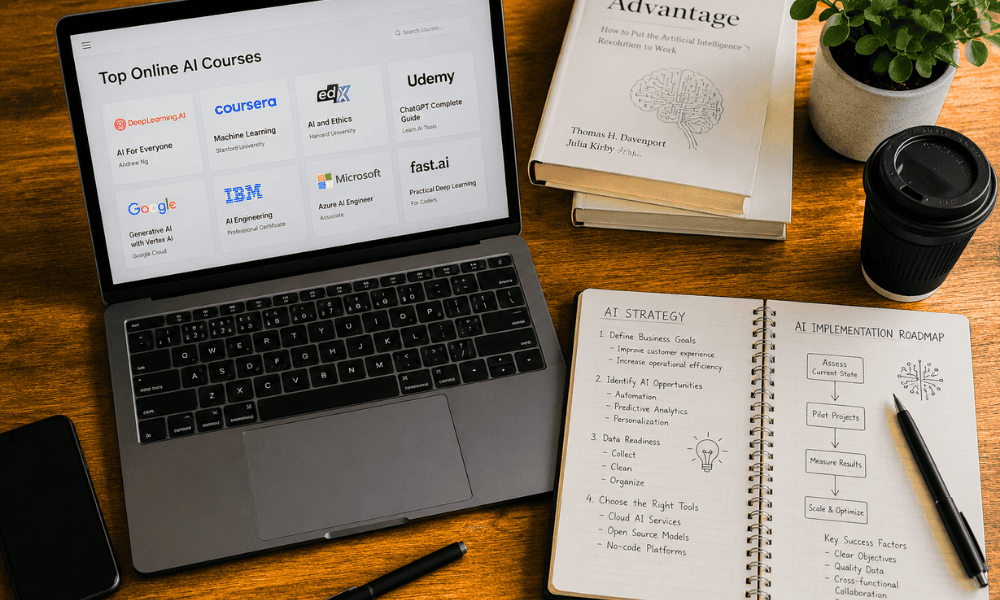
Once you’ve scanned the table, shortlist based on two things: how much time you actually have this month, and whether you need a certificate for LinkedIn or internal reporting. If a credential doesn’t matter to you, the free-audit options save real money.
7 Best AI Courses for Business Leaders in 2026
1. AI for Everyone by Andrew Ng
This is where most non-technical leaders should start. Andrew Ng built this course specifically for people who manage AI projects rather than build them, and it shows.
You’ll learn core AI terminology, how to spot a viable AI project, and how to work productively with technical teams without pretending to be one of them. It’s one of the more approachable AI courses for managers and executives free of jargon.
Business relevance: high — this is strategy-first, not tool-first. Difficulty: beginner.
Time commitment: about 6 hours across four weeks. Coding required: none.
Course content: Free (audit) Certificate: Paid — Coursera’s monthly subscription, roughly $49, is required to submit graded work and earn the shareable certificate.
What stands out about this course is how it reframes AI as a management problem, not a technical one. If I were choosing a first course, I’d start here simply because it sets the vocabulary you’ll need for everything else on this list.
One thing to know before starting: it’s intentionally light on hands-on practice. Pair it with something more applied if you want to actually touch the tools.
2. Google: Generative AI Training for Business Leaders
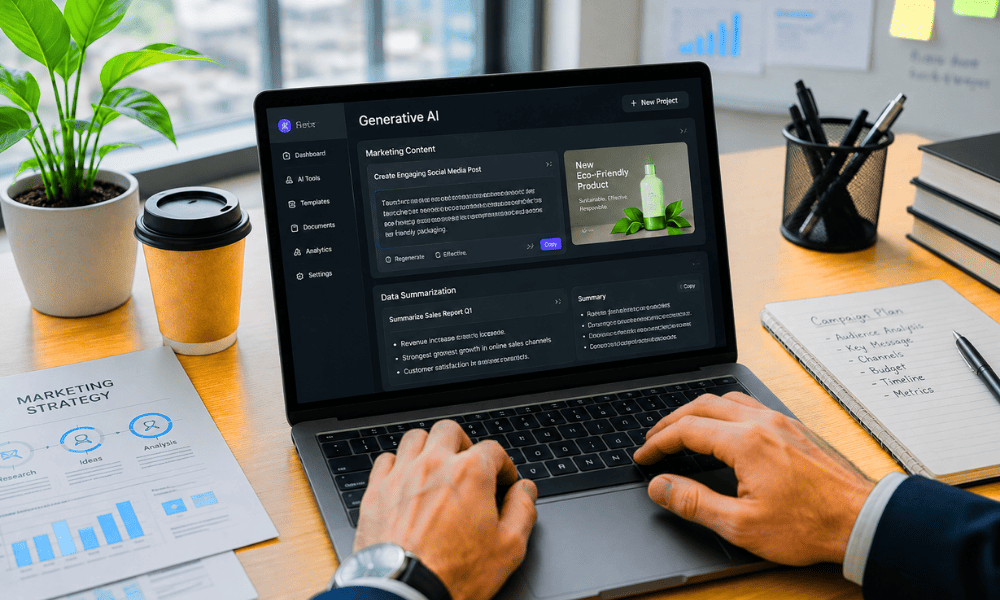
Google Cloud’s Generative AI Leader Professional Certificate is a five-course series built specifically around generative AI for executives, not engineers.
You’ll work through gen AI fundamentals, the “landscape” of models and platforms, and hands-on exercises using tools like Gemini and NotebookLM for research and summarization.
It’s a genuinely practical generative ai courses for business leaders free option once you get past the audit-vs-certificate distinction.
Business relevance: high, especially for productivity and responsible AI use. Difficulty: beginner, no technical background assumed.
Time commitment: roughly 8 hours. Coding required: none.
Course content: Free to enroll and work through Certificate: Coursera lists this as free to join, but earning the shareable certificate and sitting the optional Google Cloud certification exam typically requires a Coursera subscription or Coursera Plus — confirm current terms at signup, since Coursera’s free-vs-paid mix changes with promotions.
The part I’d pay the most attention to is the “Try It” labs. They’re short, but they’re the closest thing to actually using generative AI for a business task rather than just reading about it.
3. IBM: AI Training for Business and Enterprise Leaders
IBM SkillsBuild is IBM’s free learning platform, and it includes short, focused courses on generative AI, AI governance, and enterprise adoption aimed squarely at non-technical leaders.
What makes this option different is the governance angle. IBM leans into AI governance, data ethics, and organizational adoption more than most of the courses on this list — useful if you’re the one who’ll eventually answer for how AI gets used in your company.
Business relevance: high for anyone responsible for AI policy or vendor decisions. Difficulty: beginner to intermediate.
Time commitment: 2 to 4 hours per course, depending on the module you pick.
Coding required: none.
Course content: Free Certificate/badge: Free — IBM SkillsBuild issues digital credentials at no cost, which is one of the few genuinely no-strings-attached badges on this list.
One limitation to know: IBM’s catalog is broad, so it takes a few extra minutes to find the specific leadership-track module rather than the technical ones aimed at developers.
4. Microsoft: AI Training for Business Leaders and Managers
Microsoft Learn offers free, self-paced learning paths tied to its newer AI Business Professional and AI Transformation Leader credentials — built for people who use Microsoft 365 Copilot and Azure AI day to day rather than build with them.
The content covers Copilot in Word, Excel, and Teams, plus a leadership-focused track on recognizing AI opportunities, planning adoption, and managing the change process. It’s a strong pick if your company already runs on Microsoft 365.
Business relevance: very high for Microsoft-based organizations. Difficulty: beginner.
Time commitment: 3 to 6 hours for the core learning path.
Coding required: none.
Course content: Free — the Microsoft Learn modules themselves cost nothing. Certificate: Paid — sitting the official Applied Skills or certification exam (AB-730, AB-731) typically runs around $99, though Microsoft has run limited-time free-exam promotions, so it’s worth checking current offers before you pay.
For a busy manager, this matters because the skills map directly onto tools you’re probably already using. That’s rare among AI courses.
5. Harvard: CS50’s Computer Science for Business Professionals
If you want a Harvard name on your learning record along with genuine technical grounding, Harvard’s CS50 offers a course built specifically for business audiences rather than computer science majors.
Unlike a straight “AI for business” course, this one goes a little deeper into how computing and AI systems actually work, which some leaders find gives them more confidence in technical conversations with their own teams.
Business relevance: solid — less strategy-focused, more foundational.
Difficulty: beginner to intermediate.
Time commitment: about 6 weeks, self-paced.
Coding required: minimal — some light technical concepts, but no prior programming needed.
Course content: Free to audit through edX Certificate: A verified certificate through edX generally carries a fee; CS50’s flagship courses have offered free certificates of completion through Harvard’s own platform in the past, so check the current enrollment page for which track applies to this specific course before assuming either option.
Where beginners tend to struggle here is pacing — six weeks sounds generous until week three arrives.
6. Elements of AI — University of Helsinki & MinnaLearn
Elements of AI is the rare course on this list with no asterisks. It’s free to take, and the certificate is genuinely free too — no subscription, no paywall, no upsell.
Created by the University of Helsinki and MinnaLearn, it is intended for anyone and is focused on AI fundamentals, basics of machine learning, as well as society and business impact of AI, without assuming any previous knowledge of math and programming.
Business relevance: Good for training an entire team in the basics of AI literacy. Difficulty level: beginner.
Time commitment: around 30 hours, self-paced.
Coding required: none.
Course content: Free Certificate: Free — no payment required at any stage.
If I were rolling out a company-wide free ai certification for business leaders, this is the one I’d assign, purely because cost is never a barrier for any employee.
One limitation: at 30 hours, it’s a bigger time investment than most items on this list, so plan for a few weeks rather than a weekend.
7. Wharton: AI for Business Specialization
Wharton’s AI for Business Specialization on Coursera is the most business-application-heavy course here, covering artificial intelligence for business decision makers across marketing, finance, operations, and customer personalization.
Taught by Wharton faculty including Kartik Hosanagar and Kevin Werbach, it leans into AI strategy and governance more than pure tool use, which suits founders and functional leaders who need to build a business case, not just use a chatbot.
Business relevance: very high for AI applications in marketing and finance specifically. Difficulty: beginner to intermediate.
Time commitment: roughly 44 hours across four courses.
Coding required: none.
Course content: Free (audit) Certificate: Paid — Coursera’s subscription model applies here too, around $79/month or included with Coursera Plus.
This is one of the best free AI courses for founders who want function-specific examples rather than generic AI theory.
How Business Leaders Can Implement an AI Strategy in 2026

Finishing a course feels good. But honestly, that’s the easy part.
The harder part is turning what you learned into something your team actually uses. I’ve watched leaders finish a great course and then just… go back to old habits. Nothing changes.
So here’s a rough framework I’d actually follow, not a textbook version of one.
1. Start With a Business Problem
Don’t open with “we should use AI.” That’s backwards.
Open with a real, measurable pain point instead. Slow customer replies. Reports that eat up someone’s entire Friday. Marketing copy that takes three rounds of edits every single time.
Pick one of those. Then ask if AI genuinely helps, or if you’re just chasing a trend because everyone else is talking about it.
2. Choose the Right AI Use Case
Once you’ve named the problem, match it to a use case instead of guessing.
Some of the more common starting points I keep seeing work:
- Searching internal knowledge and summarizing long documents.
- Drafting first-response customer service replies.
- Speeding up marketing content and personalization.
- Forecasting demand with fewer manual spreadsheets.
- Automating repetitive, rules-based tasks.
Pick one use case first. Trying to fix five problems at once is usually how AI pilots quietly die.
3. Build AI Literacy Across the Team
Here’s a mistake I’d avoid: assuming only the “tech person” needs to understand AI.
Your managers don’t need to code anything. But they do need enough working knowledge to ask sharp questions and catch a wrong or made-up answer before it reaches a client.
This is really what an ai adoption strategy for enterprise leaders comes down to. It’s less about tools, more about judgment.
4. Introduce AI Governance
Before AI touches customer data or anything public-facing, get basic guardrails in place. Privacy rules. A quick security review. A process for catching hallucinations before they embarrass someone.
Bias checks matter here too, especially if AI is influencing hiring, pricing, or customer decisions. Keep a human in the loop for anything high-stakes.
This is where ai leadership and governance stops being a slide in a deck and starts being an actual policy. Good AI risk management isn’t glamorous, but it’s what separates a confident rollout from a messy one — and it matters even more once agentic AI starts taking actions on its own instead of just answering questions. Responsible AI isn’t a checkbox; it’s the thing that keeps your rollout from becoming a headline for the wrong reasons.
5. Measure AI ROI
Keep the metrics boring and honest. Hours saved. Cost per task. Any real shift in revenue or conversion. Whether customer satisfaction actually moved.
One thing I’d flag clearly: don’t promise your board guaranteed returns. Nobody can honestly promise that yet. Track the real numbers instead, and let them make the case for you.
Which AI Course Should You Choose Based on Your Role?
Your role shapes which course pays off fastest. A founder needs different depth than an HR leader or a product manager, so here’s how I’d match people to courses.
| Your Role | Recommended Course | Primary Outcome |
|---|---|---|
| Founder | AI for Everyone + Wharton AI for Business | AI strategy |
| HR Leader | Elements of AI | Workforce AI literacy |
| Marketing Leader | Wharton AI for Business Specialization | GenAI & personalization |
| Product Leader | Google Generative AI Leader Certificate | AI product thinking |
| Operations Leader | IBM SkillsBuild (Generative AI) | Automation & efficiency |
| Executive | Microsoft AI Transformation Leader path | AI decision-making |
Founders and executives usually need the broadest strategic view, so pairing a foundations course with a business-application course makes sense. Functional leaders, on the other hand, get more value from a course built around their specific domain.

Final Verdict: Which Free AI Course Should You Start With?
If you only pick one, start with AI for Everyone — it’s the shortest path to real AI literacy. For generative AI depth, Google’s Generative AI Leader path is hard to beat. For enterprise governance, go with IBM SkillsBuild.
For a genuinely free credential, Elements of AI wins outright. And for business-specific applications in marketing and finance, Wharton is the strongest fit.
Whichever you choose from this list of the best ai courses for business leaders free, the real advantage doesn’t come from bookmarking all seven. It comes from finishing one.
Pick the course that matches your role, block out the time this week, and actually complete it — that’s worth more than a folder of half-finished tabs.
Frequently Asked Questions About Free AI Courses for Business Leaders
1. Can Business Leaders Learn AI Without Coding Experience?
Yes. Every course on this list is a non technical AI course for leaders — none require prior programming, and most explicitly say so in their course descriptions.
2. Which Free AI Course Is Best for Getting a Free Certificate?
Elements of AI and IBM SkillsBuild are your safest bets for a genuinely free credential. Most Coursera-hosted courses let you complete the material for free but charge a subscription fee for the certificate itself, so check the fine print before assuming a badge is included.
3. How Can Managers Use AI to Increase Business ROI in 2026?
Concentrate on measurable successes such as automated report writing, accelerated first draft copywriting, faster customer service response, and more effective decision support through AI-driven forecasts. Successes that are small and measurable grow faster than a major AI upgrade.
4. Is Andrew Ng’s AI for Everyone Completely Free?
The course content is free to audit. The graded assignments and shareable certificate require Coursera’s paid subscription, so it’s not a fully free certificate — just a free learning experience.
5. What Is the Best AI Course for Founders?
For best free AI courses for founders, I’d point to AI for Everyone for the fundamentals, then Wharton’s AI for Business Specialization once you’re ready to apply AI thinking to marketing, finance, and operations decisions.
6. Do Business Executives Need to Learn Prompt Engineering?
Not in the sense of becoming an expert prompt engineer. What matters more is understanding how to communicate clearly with AI systems — giving context, being specific, and knowing how to evaluate what comes back. That’s a lighter skill than executive AI prompt engineering courses sometimes make it sound.