
Introduction to Agentic AI for Small Business
Running a small business in 2026 is very different from running one five years ago.
Customers need immediate responses, competition is quicker, and manual processes slow everything down.
This is where Agentic AI Frameworks for Small Business (2026) are becoming a game-changer.
Autonomous AI agents that can carry out tasks, make choices, and finish processes automatically are referred to as “agentic AI.”
Instead of simply answering questions like a chatbot, these AI agents can plan tasks, use tools, call APIs, and complete multi-step workflows.
In simple terms, think of an AI agent as a digital employee.
It can research information, reply to customers, generate leads, write emails, manage tasks, and even analyze business data.
Large language models, such as GPT-based systems, are the foundation of contemporary LLM-powered agents, which can interface with marketing software, analytics platforms, and CRM systems.
This technique is quite effective for small teams with few employees.
Multiple employees’ tasks can be completed by a single AI workflow automation system, saving time and lowering operating expenses.
Research shows that multi-agent frameworks like AutoGen, CrewAI, and LangGraph are rapidly becoming the foundation of AI automation platforms.
These frameworks allow businesses to orchestrate several AI agents working together as a coordinated team.
And that is exactly why Agentic AI Frameworks for Small Business (2026) are becoming one of the most important automation technologies for startups and small companies today.
What Are Agentic AI Frameworks?

When I first started testing AI automation tools for small companies, I realized something interesting very quickly.
Most tools could answer questions, but they could not actually complete tasks independently.
That’s where Agentic AI Frameworks for Small Business (2026) become powerful and practical.
These frameworks enable AI systems to act less like basic assistants and more like digital laborers.
To put it simply, an agentic framework is a system that facilitates the autonomous planning, thinking, and execution of tasks by several AI agents.
The framework manages communication, tools, decision-making, and workflow steps between agents.
Agentic AI Frameworks for Small Business (2026), for instance, might be used by a small online retailer to investigate rivals.
Another AI agent might write marketing content, while another agent schedules campaigns automatically.
From my experience implementing automation tools, this kind of AI-powered workflow system saves massive time.
Instead of hiring more staff, small teams can scale operations using Agentic AI Frameworks for Small Business (2026).
Simply put, these frameworks transform AI from a tool that answers questions into a system that completes business workflows.
How Agentic AI Agents Work
I discovered that structured workflows were the true power of early automation agents when I experimented with them.
They employ a rational procedure known as task orchestration in place of haphazard reactions.
The agent in AI workflow automation initially comprehends the task’s objective.
The objective is then divided into manageable steps and carried out one at a time.
An AI marketing agent might, for instance, conduct topic research, create blog outlines, compose content, and plan publication.
Each step is automatically managed through task orchestration and smart AI workflow automation.
Agentic AI Frameworks for Small Business (2026) are becoming indispensable tools because of this methodical approach.
They enable AI systems to function as well-coordinated virtual teams.
Agentic AI vs Traditional Chatbots: Which is better for business
A lot of entrepreneurs still believe that AI automation entails adding a chatbot to their website.
However, the two systems differ greatly from one another.
In the debate Agentic AI vs Traditional Chatbots: Which is better for business, the capabilities are completely different.
Conventional chatbots mostly use simple rule-based discussions and prewritten responses.
Agentic AI, however, can analyze problems, plan tasks, and complete workflows automatically.
For instance, an AI agent can create reports or handle leads in addition to responding to client inquiries.
According to my own testing, conventional chatbots respond to simple inquiries like receptionists.
Meanwhile, Agentic AI Frameworks for Small Business (2026) act more like intelligent employees handling real business operations.
Benefits of Autonomous AI Agents for Workflow Automation
The technology wasn’t the biggest surprise when I first integrated automation agents into a small marketing operation.
It was the speed at which routine duties vanished from day-to-day activities.
That experience helped me clearly understand the real Benefits of Autonomous AI Agents for workflow automation in modern businesses.
Instead of acting like simple tools, these AI agents function more like digital team members.
They analyze tasks, make decisions, and execute workflows automatically using AI workflow automation systems and intelligent task orchestration models.
This is exactly why many startups are adopting Agentic AI Frameworks for Small Business (2026) much faster than expected.
Once AI agents start handling repetitive operations, business owners can finally focus on growth strategies and customer relationships.
After evaluating autonomous AI systems, I have directly observed some of the most useful benefits listed below.
Key Benefits
- Time Saving
AI agents are capable of operating automated processes nonstop without getting tired or taking breaks.
Autonomous systems significantly lessen the manual workload for small teams in a variety of tasks, including data processing, report preparation, and research. - Cost Reduction
Expenses for businesses can rise rapidly when more workers are hired for repetitive tasks.
Businesses can scale operations and effectively manage budgets with AI-powered business automation. - Customer Support Automation
Through chat platforms, email automation, and ticket classification, AI agents can provide prompt answers to frequently asked client questions.
This increases customer satisfaction and response times without hiring more support personnel. - Lead Generation Automation
These days, AI bots are capable of conducting database searches, analyzing prospects, gathering contact details, and automatically creating customized outreach messages.
Sales pipelines become more scalable and consistent as a result. - Reducing Operational Costs with AI
Operational efficiency is one of the most significant benefits.
Businesses can drastically cut operational overhead without sacrificing efficiency when activities like marketing research, reporting, and customer interactions are automated.
Best Multi-Agent AI Frameworks 2026
I discovered that different AI platforms operate differently when I began looking at automation solutions for small enterprises.
While some technologies are limited to text generation, others are capable of managing several agents and executing workflows.
In order to create more intelligent automation systems, a lot of developers and entrepreneurs are currently looking for the Best Multi-Agent AI Frameworks 2026.
These frameworks enable several AI agents to organize activities, communicate, and finish business workflows without continual supervision.
According to my testing expertise, the kind of automation a company need will determine which framework is best.
While some platforms are more suited for marketing, operations, or internal workflow management, others concentrate on research automation.
Many modern Agentic AI Frameworks for Small Business (2026) are designed to help even small teams run powerful AI workflows.
Businesses can easily automate operations by deploying ready-to-use agent frameworks rather than creating sophisticated systems from start.
The most widely used frameworks for AI automation solutions for small company workflows are listed below.
AutoGPT Framework
It was like witnessing AI operate on its own for the first time when I tested AutoGPT.
The system may understand objectives and generate its own task sequence rather than waiting for cues.
AutoGPT is renowned for its sophisticated task orchestration system and robust automation capabilities.
It can search the internet for information, divide a big goal into smaller jobs, and provide results gradually.
Many developers use it inside Agentic AI Frameworks for Small Business (2026) for research automation, reporting workflows, and content pipelines.
AutoGPT is frequently one of the first frameworks used by entrepreneurs seeking autonomous agents operating in the background.
CrewAI for Business Automation
Because CrewAI emphasizes agent collaboration, it feels distinct from many other automation frameworks.
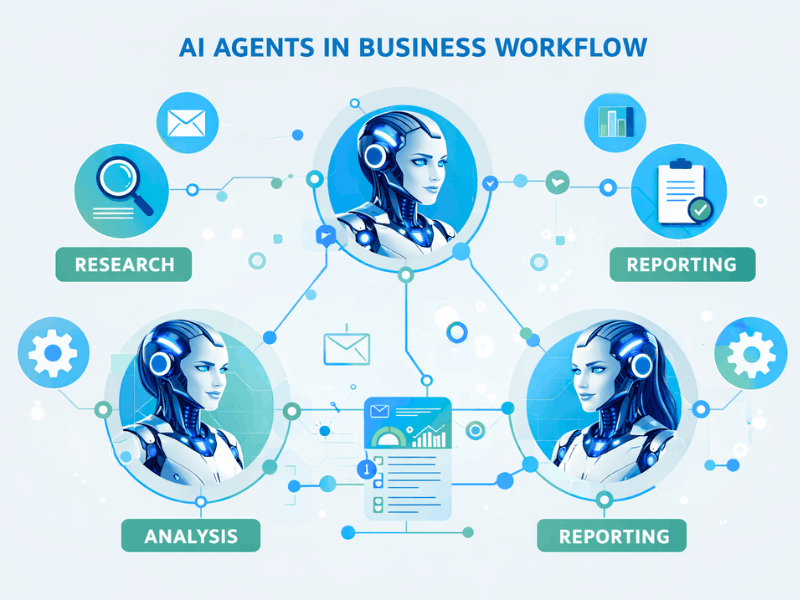
Several specialized agents work together like a tiny digital team rather than a single AI handling everything.
For instance, one agent might gather data, another might analyze it, and still another might create the final report.
CrewAI is quite helpful for organized business procedures because of its multi-agent collaboration paradigm.
Based on my personal testing, CrewAI is very effective for jobs involving marketing automation and research.
That is why many developers include it when building Agentic AI Frameworks for Small Business (2026) solutions.
Microsoft AutoGen Platform
Microsoft AutoGen is intended for creating sophisticated AI systems with constant communication between several agents.
During workflows, it enables agents to communicate, work together to solve issues, and even ask for human input.
Because of this, AutoGen is particularly helpful for developing enterprise-level AI agents for small teams.
Complex automation systems that manage planning, reporting, and analysis can be developed even by startups.
Many organizations experimenting with Agentic AI Frameworks for Small Business (2026) are now exploring AutoGen because of its flexibility.
It offers robust control over agent interactions, which is crucial for dependable business automation systems.
LangGraph / LangChain Agent Systems
Structured AI workflow systems are increasingly being built with LangGraph and LangChain.
These systems use sophisticated LLM-powered agents to assist developers in creating automation workflows.
Their capacity to link language models with external tools, databases, and APIs is what gives them their strength.
This enables agents to perform operations across many business systems, produce insights, and evaluate data.
Many developers now rely on LangGraph when building complex Agentic AI Frameworks for Small Business (2026) automation workflows.
These frameworks offer flexibility and robust workflow control for companies contemplating long-term AI automation projects.
LangGraph and LangChain are becoming extremely popular for building structured AI workflow systems. (break)
These platforms help developers design automation pipelines using advanced LLM-powered agents. (break)
Comparison Table of Top Agentic AI Frameworks
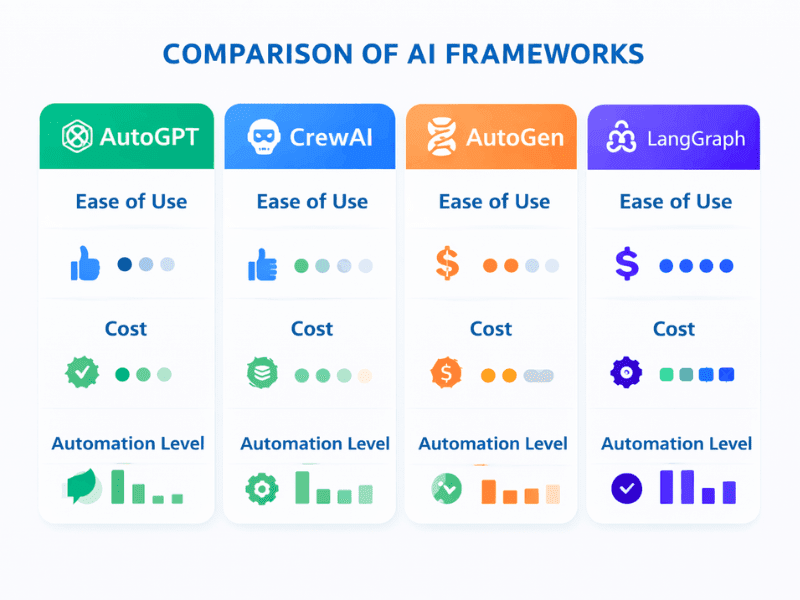
Choosing the right Agentic AI Frameworks for Small Business (2026) depends on your needs.
Here’s a simple comparison.
| Framework | Ease of Use | Cost | Automation Level | Best For |
|---|---|---|---|---|
| AutoGPT | Medium | Low | High | Autonomous tasks |
| CrewAI | Easy | Low | High | Team collaboration |
| Microsoft AutoGen | Medium | Medium | High | Enterprise workflows |
| LangGraph | Advanced | Medium | Very High | Complex workflows |
Because CrewAI and AutoGPT are simpler to implement, many small enterprises begin with them.
Because of their sophisticated automation features, larger businesses frequently favor LangGraph or AutoGen.
Affordable Agentic AI Solutions for Startups
The first thing that comes to mind for many founders when they hear about AI automation is typically expensive and complicated technology.
However, based on my own testing experience, it is actually significantly less expensive to start automation now than most people think.
Many modern tools now offer Affordable Agentic AI solutions for startups that require very little technical setup.
Without employing sizable technical teams, even small businesses with tight budgets can test low-cost AI agent deployment for 2026.
This is exactly why Agentic AI Frameworks for Small Business (2026) are becoming popular among early-stage startups.
Founders can use cloud AI models, open-source frameworks, and straightforward automated workflows rather than creating complicated software from scratch.
In fact, I have witnessed small online firms use lightweight AI systems to automate chores like content creation, lead research, and customer answers.
Here are some doable strategies for startups to begin automation without investing a lot of money.
- Start with open-source AI frameworks
Startups can create automated workflows without costly software licensing thanks to platforms like CrewAI, LangChain, and AutoGPT. - Use cloud-based AI APIs
Startups can link agents to cloud AI services and simply pay for actual consumption rather than hosting massive models. - Automate one process first
Before implementing automation throughout the entire company, start with a small workflow like lead generation or customer care. - Combine AI with workflow tools
Using simple automation platforms together with Agentic AI Frameworks for Small Business (2026) helps create scalable business workflows. - Test and optimize gradually
Efficiency can be greatly increased with minor automation workflow enhancements without raising infrastructure expenses.
No-Code Agentic AI Platforms for Non-Tech Owners
Not all small business owners are adept at creating intricate software systems or programming code.
In reality, the owner’s main concern was technology when I first assisted a tiny internet store in investigating automation.
Although the concept of AI assisting their company appealed to them, the technical aspect seemed daunting.
That is where No-code Agentic AI platforms for non-tech owners become extremely useful.
These tools are made to enable non-programmers to develop automation.
Users create workflows with visual blocks, straightforward triggers, and simple integrations rather than writing scripts.
For instance, a business owner can design a process in which an AI response is automatically triggered by a consumer question.
Leads from a website form could be gathered by another workflow and stored in a CRM system.
Simple drag-and-drop interfaces can be used to create all of this.
No-code platforms eliminate the largest obstacle to AI adoption, based on my personal experience evaluating basic automation products.
They free up entrepreneurs to concentrate on finding solutions to business issues rather than battling with technological setup.
Many of these platforms also connect with modern Agentic AI Frameworks for Small Business (2026) behind the scenes.
That means users are actually using powerful AI workflow automation systems even if they never see the complex code running underneath.
This method makes AI far more useful for small teams, freelancers, and entrepreneurs.
Business owners can try automation on their own rather than immediately employing developers.
Simple workflows like data categorization, marketing follow-ups, and automated responses can develop into potent AI-driven business systems over time.
How to Implement Agentic AI in a Small Business (Step-by-Step Guide)
When I first explored automation for a small online project, the biggest challenge was figuring out How to implement Agentic AI in a small business without overcomplicating everything.
Many owners think they must automate the entire company immediately, but in reality small steps usually work better.
Finding repetitious jobs that take up daily time is the first thing I advise.
Customer emails, lead research, report preparation, and straightforward marketing workflows with known trends are a few examples.
Once these tasks are clear, the next step is choosing simple AI automation tools for small business that support workflow integration.
Many startups now experiment with Agentic AI Frameworks for Small Business (2026) to build lightweight automation systems gradually.
Start with a single AI workflow automation process rather than developing intricate infrastructure.
For example, you can automate lead collection, email responses, or customer support routing using autonomous AI agents.
After testing the workflow, observe how the AI performs in real situations and adjust the process.
Small improvements in AI task orchestration often make automation more accurate and reliable over time.
In my experience, businesses that implement automation slowly understand the technology better.
This step-by-step approach turns simple workflows into powerful smart AI business systems without overwhelming the team.
Step-by-Step Guide to Setting Up AI Agents in 2026
I discovered that the setup procedure is actually easier than many people believe when I initially explored with AI agents for a small workflow project.
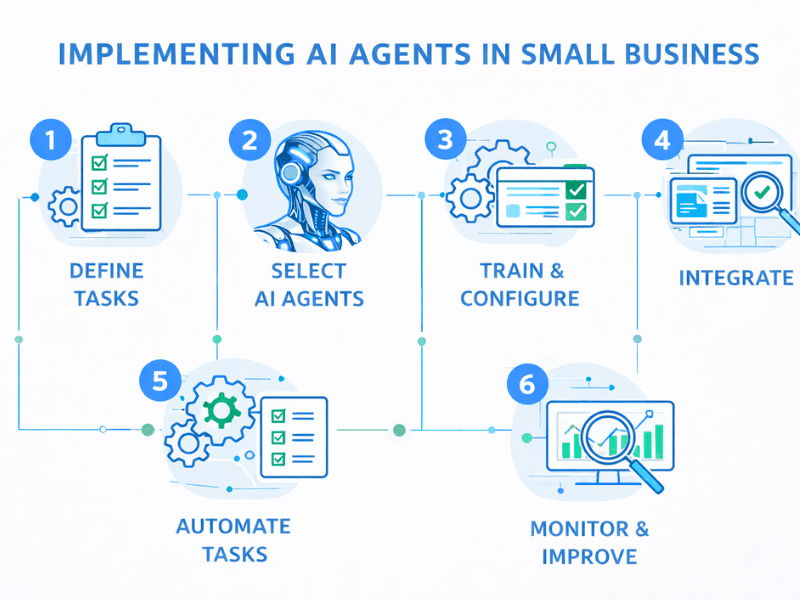
Rather than attempting to automate everything at once, the idea is to adhere to a defined, practical sequence.
Here is a simple approach many businesses are using in 2026:
- Define a clear task– Start with a single task, such as creating reports, conducting lead research, or responding to emails.
- Choose an AI framework – To create the agent, use a platform like CrewAI, AutoGPT, or LangChain.
- Connect tools and data sources – Integrate databases, CRM programs, or APIs that the agent will utilize.
- Create a workflow – Create a step-by-step plan for the agent’s task processing.
- Test and monitor results – Run the agent, verify accuracy, and gradually enhance the workflow.
Following these steps helps small teams gradually build reliable AI automation systems.
AI Agents for Small Business Lead Generation
When I was helping a friend run marketing for his small online service, we spent hours searching LinkedIn and websites for potential clients.
That repetitive work made me realize how useful AI Agents for small business lead generation could actually be for small teams.
An AI agent can find suitable prospects by scanning websites, directories, and social media platforms rather than manually looking through profiles every night.
After that, the system may compile contact information, business facts, and industry data into a straightforward list that is prepared for outreach.
Some modern tools built on Agentic AI Frameworks for Small Business (2026) even prepare personalized introduction emails automatically.
An agent might, for instance, investigate a business’s offerings, examine their website, and create a message that seems more pertinent.
In real situations this saves a surprising amount of time for small businesses.
Instead of spending evenings searching for leads, owners can focus on conversations and building genuine customer relationships.
Automating Customer Support with Agentic AI Frameworks
I talked to a small business owner a while back who was having trouble responding to dozens of messages from customers every day.
Questions about orders, emails, and online conversations continued to come in more quickly than the crew could reasonably reply.
I became aware of the value of automation in routine support tasks as a result of that circumstance.
With Agentic AI Frameworks for Small Business (2026), companies can automate many routine support activities without removing the human touch.
AI agents, for example, can handle chat assistance by providing prompt answers to frequently asked inquiries like orders, shipment updates, or product details.
Instead of having to wait hours for a response, customers frequently obtain helpful responses in a matter of seconds.
Another useful application is in ticket systems, where incoming requests are automatically classified according to issue kind or urgency.
While AI handles routine queries, support workers can concentrate on complex issues.
AI agents can also update CRM workflows by recording conversations, tagging customer issues, and storing interaction history automatically.
This lessens manual labor and aids small teams in maintaining a constant level of customer care, based on my own observations.
Future of AI Agents in Small Scale Industries
A few years ago most small businesses only used basic software tools for accounting or email marketing.
However, I’ve noticed that a lot of founders are now interested in automation and clever AI assistants.
That shift is why the Future of AI Agents in small scale industries looks very different from traditional business operations.
Between 2026 and 2030, more small companies will rely on autonomous systems for research, marketing, and workflow management.
Instead of hiring large teams immediately, businesses may use AI agents to handle repetitive operations quietly in the background.
Tasks like customer replies, sales outreach, and data analysis could run automatically through smart AI workflows.
Many experts believe Agentic AI Frameworks for Small Business (2026) will become the foundation of these systems.
From what I have personally observed, early adopters are already gaining speed and efficiency advantages.

Final Thoughts
I honestly believed that AI would only be accessible to big businesses when I first began looking at automation solutions.
However, it became evident after testing several systems that small firms can also profit from this technology.
Throughout this guide, we looked at how Agentic AI Frameworks for Small Business (2026) help companies automate everyday operations more easily.
Instead of spending hours on repetitive work, owners can rely on practical AI workflow automation systems.
These systems use autonomous AI agents that can manage tasks like research, customer replies, and marketing workflows quietly in the background.
Different agents can even work together to finish more complex business operations with the right AI task orchestration.
To make their daily operations easier, a lot of entrepreneurs are already experimenting with AI automation tools for small businesses.
Over time, these tools create efficient AI powered business automation that reduces workload and improves productivity.
If you are running a startup or small company, starting small with smart AI workflows can make a real difference.
Exploring Agentic AI Frameworks for Small Business (2026) today may help build a smarter and more efficient business tomorrow.
FAQ Section – People Also Ask
1. What is an Agentic AI framework?
A platform that enables developers or companies to build autonomous AI agents that can carry out tasks and carry out workflows autonomously is known as an agentic AI framework.
2. Are AI agents expensive for small businesses?
No more.
Since several frameworks, such as CrewAI and AutoGPT, are open-source, small businesses may afford AI automation solutions.
3. Which Agentic AI platform is best in 2026?
Some of the most popular platforms include:
LangGraph.
- AutoGPT
- CrewAI
- Microsoft AutoGen
4. Can AI agents run an entire business?
AI agents can automate many workflows, but human oversight is still important for strategy and decision-making.
5. Do you need coding skills to use Agentic AI?
Not always.
Many No-code Agentic AI platforms for non-tech owners now allow visual workflow creation.
3 thoughts on “Agentic AI Frameworks for Small Business (2026): Best Platforms to Automate Your Business”