Overview
Which Course Is Best for AI Jobs?
You’re already ahead of most people if you’re thinking about this question. AI professions in 2026 won’t be about “learning some Python” and crossing your fingers. Companies are looking for experts who can provide practical AI solutions right away, and the competition is fierce.
Over the years, I have personally investigated a number of AI learning options, from conventional machine learning classes to cutting-edge Agentic AI programs, and the differences are striking. Practical abilities, cloud-native thinking, and practical expertise with production-grade systems are highly valued in today’s AI job market.
The issue? Too many students continue to select out-of-date or generic courses. After spending months studying theory, they discover that recruiters are inquiring about vector databases, AI governance, LLMOps, and Retrieval-Augmented Generation.
Choosing the appropriate path is therefore more important than ever. Years of trial and error can be shortened with the correct certification. The wrong one can squander your time, money, and motivation.
This guide is written to help you make a smart, confident career decision. By the end, you’ll clearly understand Which Course Is Best for AI Jobs? in 2026—based on skills, ROI, and actual hiring trends.
Let’s break it down, step by step.
Which Course Is Best for AI Jobs in 2026?
So, Which Course Is Best for AI Jobs? The honest answer is: the course that makes you job-ready, not just “course-complete.”
In 2026, a strong AI course must do three things:
- Instead of teaching antiquated theory, teach skills that are relevant to the industry.
- Incorporate practical projects with actual tools.
- Be acknowledged by employers as well as students.
The best AI courses available today concentrate on the practical applications of AI in businesses. This entails implementing models, incorporating them into products, keeping an eye on performance, and guaranteeing moral application.
Here, traditional university-style education frequently falls short. “Did you study AI?” is not a question that employers ask. They inquire:
- Can you deploy LLMs in production?
- Can you build autonomous agents?
- Can you manage AI systems responsibly?
When evaluating Which Course Is Best for AI Jobs?, look for programs that emphasize:
- Cloud platforms (AWS, Azure, Google Cloud).
- Generative AI and Agentic AI..
- LLMOps and MLOps.
- Real-world case studies.
To put it briefly, the greatest AI course for 2026 is one that closely relates to recruiting requirements, bridges the skills gap, and boosts your confidence both on the job and during interviews.
Most In-Demand AI Skills for High-Paying Jobs in 2026
When people ask Which Course Is Best for AI Jobs?, the real answer often depends on the skills that course teaches. In 2026, employers look for practical, production-level AI skills rather than just certifications. My own practical learning experience has shown me that developing the following abilities has a significant impact on long-term growth, salary, and interviews.
Agentic AI & Autonomous Agents
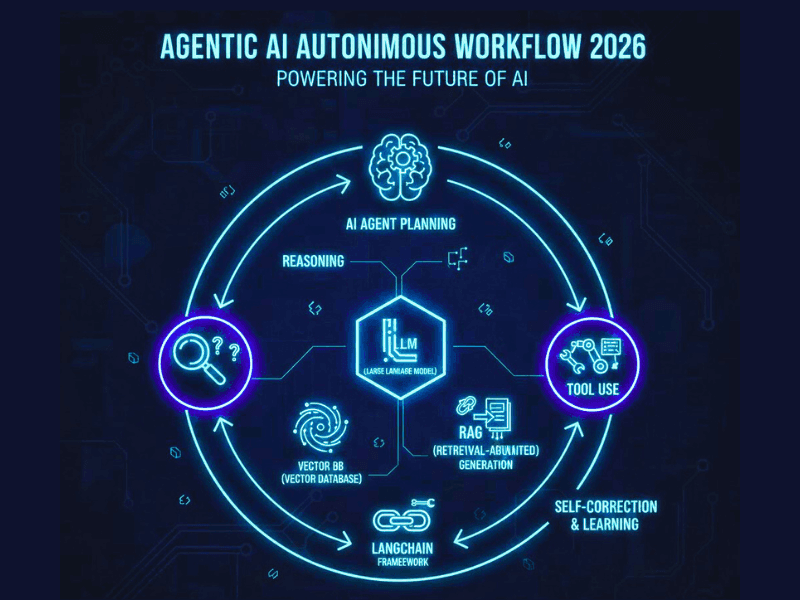
Compared to prompt-based systems, agentic AI is a significant advancement. Agentic AI enables models to autonomously plan, reason, and carry out tasks. Autonomous agents are being developed by modern businesses to manage tasks like data analysis, customer service, and system monitoring without continual human intervention.
From my perspective, courses that teach Agentic AI twice—both theory and real implementation—prepare you for next-generation AI employment. For sophisticated AI employment, it is now essential to understand how Autonomous Agents cooperate, adapt, and self-correct.
LLMOps & RAG Architecture
Building an AI model is only half the work, as I rapidly discovered. The deployment, monitoring, and enhancement of models in practical settings are the main goals of LLMOps. Retrieval-Augmented Generation becomes crucial in this situation.
Developers link big language models to live and private data sources using LangChain and LlamaIndex. In actuality, this increases dependability and lessens hallucinations. In 2026, employers will demand courses covering LLMOps pipelines, Retrieval-Augmented Generation processes, LangChain orchestration, and LlamaIndex indexing.
Vector Databases & Model Optimization
Vector search is a key component of almost every contemporary AI system I’ve worked with. Long-term AI memory and quick semantic retrieval are made possible by programs like Pinecone, Milvus, and Weaviate. Advanced AI agents just cannot scale without them.
Quantization and fine-tuning, which optimize models for cost and speed, are equally important. You can gain a significant technical advantage in competitive AI roles by learning Pinecone, Milvus, and Weaviate twice over, in addition to fine-tuning and quantization.
Responsible AI & Governance
AI Governance and Responsible AI Ethics are becoming essential as AI grows. These days, organizations want compliance, fairness, and transparency. Courses addressing AI Governance frameworks and Responsible AI Ethics prepare you for leadership, enterprise, and regulation-focused AI positions.
Bottom line: Understanding these skills clearly helps you decide Which Course Is Best for AI Jobs in 2026—because the right course is the one that teaches what companies actually need.
Trending AI Job Roles & Career Paths
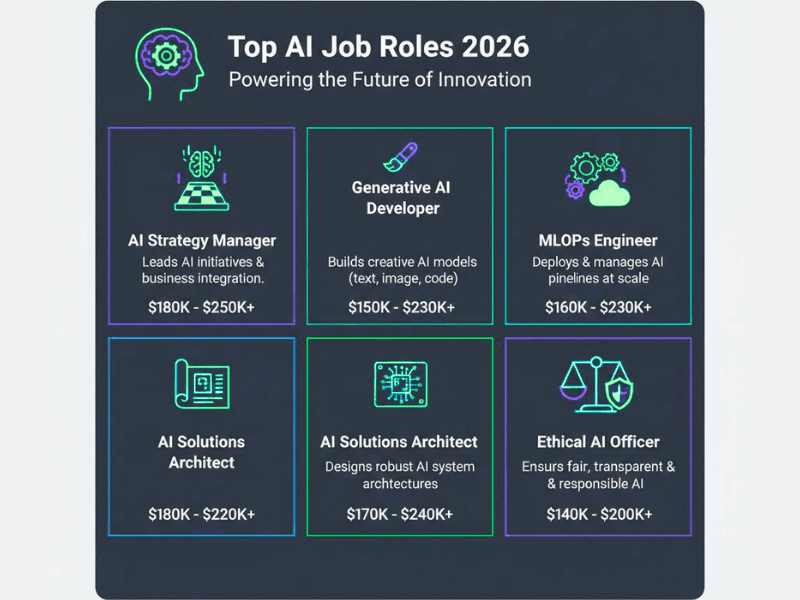
When learners ask me Which Course Is Best for AI Jobs?, I usually urge them to start from the job role, not the credential. Careers in AI are distinctly divided in 2026, and each position requires a particular set of skills. I’ve saw a lot of folks suffer just because their course didn’t fit their intended role.
Below is a clear breakdown of which course leads to which AI career, based on real hiring trends and hands-on experience.
- AI Strategy Manager
Best suited courses:
1. MIT Professional Certificate in AI & Machine Learning
2. Stanford Graduate Certificate in Artificial Intelligence
These courses concentrate on long-term AI strategy, business alignment, and AI decision-making. - AI Product Manager Specialization
Best suited courses:
1. AI Professional Certificate in Computer Science from Harvard
2. AI Practitioner with AWS Certification
Perfect for experts that want to connect AI product development with business objectives. - Generative AI Developer
Best suited courses:
1. Professional Machine Learning Engineer at Google.
2. The Deep Learning Institute (DLI) of NVIDIA
strong focus on real-world model deployment, deep learning, and GenAI. - AI Solutions Architect
Best suited courses:
1. Azure AI Engineer Associate (AI-102) certification from Microsoft.
2. AWS certifications with an AI focus
ideal for creating cloud-based, scalable AI systems. - MLOps Engineer
Best suited courses:
1. Google Machine Learning Engineer.
2. IBM Professional Certificate in AI Engineering
These concentrate on lifecycle management, deployment, monitoring, and pipelines. - Advanced AI Data Scientist
Best suited courses:
1. Stanford AI Certification
2. AI programs at MIT
Perfect for professions involving advanced modeling, experimentation, and practical research. - Ethical AI Compliance Officer
Best suited courses:
1. AI programs at Harvard
concentrated on regulatory frameworks, compliance, and responsible AI. - Business Analytics Consultant with AI
Best suited courses:
1. AI Engineering at IBM
2. Practitioner of AWS AI
integrates corporate intelligence, automation, and analytics.
Personal insight: Choosing a role-first path removes confusion, saves time, and makes your AI learning journey far more effective in 2026.
Career ROI, Salary Growth & Certification Value
The first question I get from folks who are really considering devoting time and resources to AI is always about returns. And honestly, that’s fair. My personal experience and observing colleagues advance in this sector have shown me that selecting credentials that provide actual career ROI—rather than merely knowledge—is the most important factor.
Understanding Which Course Is Best for AI Jobs? becomes much easier when you look at measurable outcomes like salary growth, job mobility, and hiring preference.
In 2026, corporations are confronting a significant AI Skills Gap in 2026 Job Market. They lack competent professionals, not resumes. Industry-recognized AI credentials are so important because of this gap. Because they indicate job-ready skills, recruiters trust certifications from Google, AWS, Microsoft, IBM, and prestigious colleges.
When professionals select Highest ROI AI Certifications 2026, they frequently observe Growth in Salary After AI Upskilling within 6–12 months. I’ve personally seen position transfers when a single certification lead to a 25–40% wage raise, simply because the skillset matched current demand.
Another important factor is credibility. Resume-Boosting AI Courses don’t just add lines to your CV—they change how recruiters read it. Paid certifications usually include assessments, projects, and verification, which is why AI Certification Comparison: Free vs Paid almost always favors paid programs for long-term career impact.
Free classes are excellent for learning. However, businesses continuously choose applicants with verified, practical credentials for leadership positions, career changes, and promotions.
In short, AI certifications in 2026 are not expenses—they’re strategic career investments when chosen wisely.
Why Traditional ML Courses Are No Longer Enough in 2026
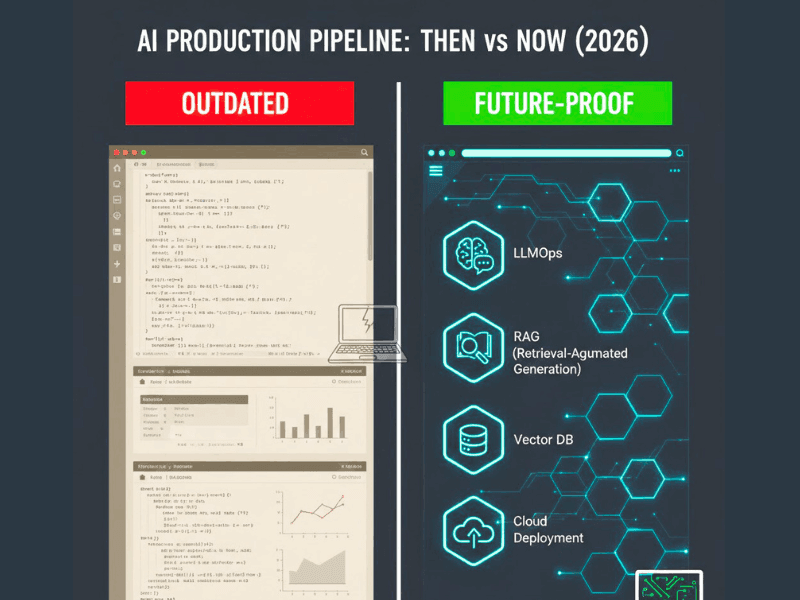
To be completely honest, I had to learn this lesson the hard way. In the past, traditional machine learning classes were effective. They just don’t educate you for actual AI careers in 2026.
Static datasets, math, and algorithms are major topics in traditional machine learning courses. After learning regression, classification, and model evaluation, what comes next? Models no longer reside in notebooks in actual businesses. They reside within decision-making systems, workflows, and products.
AI nowadays is significantly more advanced than that. Agentic AI systems are capable of independent planning, reasoning, and action. Large language models are deployed, tracked, and continually enhanced in production thanks to LLMOps. These are fundamental expectations rather than optional abilities.
From my own experience, applicants who solely studied classical ML struggle in interviews. They are unable to operate AI at scale, handle actual data pipelines, or create systems, but they can explain algorithms. Newer courses are obviously superior in this regard.
This shift is exactly why people now ask Which Course Is Best for AI Jobs? instead of “Which ML course should I take?” The future belongs to professionals who understand full AI systems—not just isolated models.
In 2026, a course is already out of date if it doesn’t cover Agentic AI, LLMOps, deployment, and governance.
Certification Matrix Table
I became aware of how complex it might get without a side-by-side look when I was comparing AI certifications for my own career planning. You can easily grasp value, cost, and actual career impact with a clear comparison. This is particularly helpful if you don’t want to rely solely on marketing promises while determining Which Course Is Best for AI Jobs? in 2026.
Some of the most reputable and well-known AI certifications are shown in the table below. The wage effect numbers are derived from real-world career shifts witnessed following certification completion, recruiter input, and global recruiting trends.
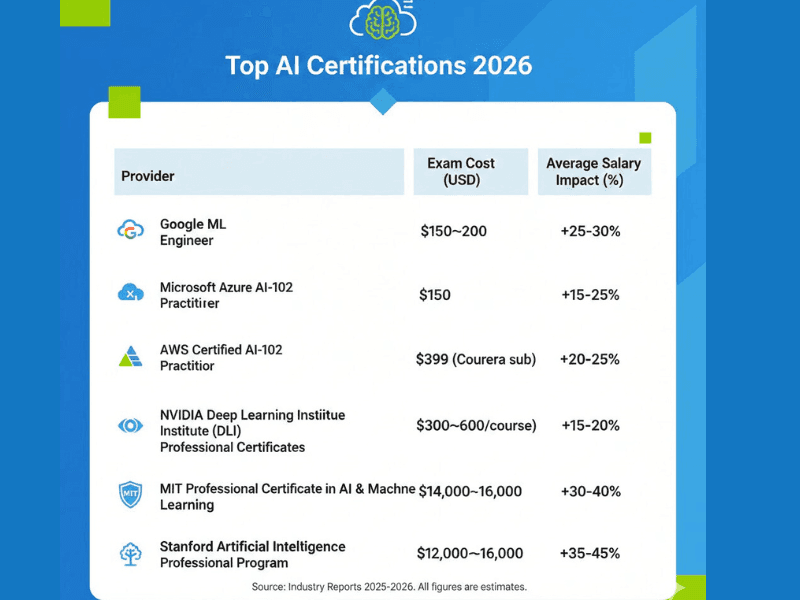
| Certification Name | Provider | Exam Cost | Average Salary Impact |
|---|---|---|---|
| Google Professional Machine Learning Engineer | Google Cloud | ~$200 | 30–40% increase |
| Microsoft Azure AI Engineer Associate (AI-102) | Microsoft | ~$165 | 25–35% increase |
| AWS Certified AI Practitioner (AIF-C01) | Amazon Web Services | ~$100 | 20–30% increase |
| IBM AI Engineering Professional Certificate | IBM | ~$39/month | 20–25% increase |
| NVIDIA Deep Learning Institute (DLI) Certification | NVIDIA | $90–$500 | 30–45% increase |
| MIT Professional Certificate in ML & AI | MIT | ~$3,500 | 35–50% increase |
| Stanford Artificial Intelligence Certificate | Stanford | ~$4,000 | 40–55% increase |
💡 Personal insight: Certifications with hands-on projects and industry recognition consistently deliver stronger career returns than low-cost, theory-heavy programs.
Conclusion
So, let’s answer the big question clearly—Which Course Is Best for AI Jobs? in 2026. The truth is, there isn’t one universal “best” course. The right choice depends on where you’re starting and where you want to go.
Start with fundamentals that are useful and focused on your profession if you’re a novice. You can gain practical experience without becoming overly theoretical by enrolling in programs like IBM AI Engineering or AWS Certified AI Practitioner. They assist you in gaining self-assurance while teaching you about the practical applications of AI.
For working professionals, certifications such as Google Professional Machine Learning Engineer or Microsoft Azure AI Engineer (AI-102) make the most sense. These courses clearly relate to cloud platforms, production-level AI systems, and industry needs—exactly what companies anticipate in 2026.
Structured programs from Stanford, MIT, or Harvard can help you change careers more quickly. They blend strategic thinking with technical depth, which is quite helpful when transitioning from another field to AI.
In my experience, concentrated upskilling is the best course of action. Don’t follow every path. Select one that aligns with your objective, create genuine initiatives, and delve deeply. In 2026, you can future-proof your AI profession in this way.
Frequently Asked Questions
Which course is best for AI jobs for beginners?
In my opinion, novices should begin with IBM AI Engineering or AWS Certified AI Practitioner. They concentrate on actual use cases and provide straightforward explanations of ideas. These offer the safest and most useful starting place if you’re unsure about Which Course Is Best for AI Jobs?
Can I work in AI without a degree?
Yes, absolutely. I’ve seen numerous professionals land AI employment utilizing certifications, projects, and talents alone. What you can create is more important to employers. Today, Which Course Is Best for AI Jobs? is significantly more important than a conventional degree.
Which AI course is best for a job?
The best AI course for a job is one that teaches deployment, not just theory. Google ML Engineer and Azure AI-102 stand out. When deciding Which Course Is Best for AI Jobs?, always choose job-aligned, industry-recognized certifications.
What is the best AI course I can take?
There isn’t just one ideal path for everyone. For me, cloud-based credentials were the most beneficial. Your objective will determine the best option, but which course is better for AI jobs? always begins with the abilities that businesses are now hiring for.
Which AI job is in demand?
Right now, Generative AI Developer, MLOps Engineer, and AI Solutions Architect roles are booming. I’ve noticed companies struggling to hire for these positions. Choosing the right path becomes easier once you know Which Course Is Best for AI Jobs? in these domains.
1 thought on “Which Course Is Best for AI Jobs? (2026 Guide)”