

Overview
It feels like AI job openings have popped up everywhere in recent times.
Go on LinkedIn, Telegram, Facebook groups, or even your Gmail, and you are likely to find someone advertising remote AI job openings.
A few months ago, I myself came across several ads which claimed that one can earn money simply by “talking to AI.”
While some offered flexibility in terms of work timings, others boasted of earning screenshots which seemed dubious.
This is precisely the reason why many people today have started to ask themselves this crucial question: Are AI Prompt Jobs Scams?
It is completely legitimate because there is an explosion of false remote jobs in 2026, particularly in the field of AI.
There are a lot of people who are looking for ways to earn extra money through work-from-home jobs, but most of them have been contacted through WhatsApp, LinkedIn scammers, and even Telegram groups.
Although some of the offers may appear genuine initially, in the end, they become scams that ask for payments and identity theft.
Nonetheless, all AI job opportunities are not scams.
There are legitimate firms that are actively looking for prompt writers, AI trainers, chatbot evaluators, and annotators.
It is here that things become difficult for normal jobseekers who have to distinguish between legitimate AI training jobs and online scams.
While doing my own research into the offers, I soon began to see a pattern emerge.
The fraudulent opportunities tended to center around “easy money,” whereas legitimate businesses were concerned with skills, tests, communication, and consistency.
So, Are AI Prompt Jobs Scams?
Some definitely are, but many legitimate prompt engineering jobs also exist if you know what warning signs to watch for.
This article will teach you how an AI prompt job scam works, how recruiting frauds take place, what real recruitment looks like, and how to search for legitimate AI jobs online while staying safe from fraud.

Is Prompt Writing a Legit Job?
Many still believe that AI prompt writing is nothing but a new fad on the internet.
Believe me, I was one of those who thought likewise upon seeing the remote AI jobs being posted on LinkedIn and Reddit.
But after studying actual platforms and discussing with those who have been working in this field for quite some time, I realized that prompt writing is a legitimate profession.
Real companies developing chatbots and automation technologies require real people to train their machines.
That is why the question “Is prompt writing a legit job?” continues to gain traction on the Internet.
Individuals wonder whether certain opportunities are genuine or part of a prompt engineer job scam targeting newcomers to the field.
The confusion gets even bigger when fake recruiters start promising unrealistic salaries with no skills required.
That naturally makes people wonder: Are AI Prompt Jobs Scams?
The truth is straightforward.
While some AI scams definitely do exist, there are also many legitimate AI prompt engineering jobs that exist simultaneously.
This is precisely why the distinction is so important today.
When I looked at several remote AI job postings myself, the legit firms always described the task clearly, tested communication skills, and never requested money upfront.
All the scams did was promise fast cash and appeal to emotions.
So yes, prompt writing is real.
But you still need to approach the industry carefully because scammers are hiding behind the AI trend everywhere right now.
What Does a Prompt Engineer Actually Do?

Prompt engineering is, in essence, making AI systems more capable of understanding human instructions.
Although it seems like something that comes out of a sci-fi movie, the job itself is quite mundane and repetitive.
One employee may craft prompts for chatbots.
Another employee may evaluate AI responses, correct inaccuracies, label datasets for ML algorithms, or grade AI output.
Many newcomers tend to assume that prompt engineers spend their whole days throwing out random prompts to ChatGPT.
This is not how actual AI engineering jobs operate.
Organizations favor job seekers who demonstrate qualities like analysis, attention to detail, and adherence to instructions.
The ability to write grammatically, conduct research, think creatively, exercise patience, and think critically turns out to be more valuable than technical know-how in many junior roles.
Some AI training specialists might have to evaluate inappropriate material, analyze chatbot responses, or rewrite responses that are ambiguous.
Human input is critical for creating smarter and safer AI models.
This is one of the key factors behind why leading tech companies continue to invest heavily in their AI teams globally.
Prompt Engineer Salary: Fake or Real?
“Prompt engineer salary fake or real” became a trending topic when content creators on social media began posting screenshots of enormous earnings from AI work.
Some of them may be true, but most are grossly exaggerated.
An AI prompt engineer with experience in dealing with such systems definitely makes big money.
Some full-time positions are said to earn more than $100,000 a year, particularly in technical AI firms.
However, starting remote positions pay much lower than what those viral video makers claim.
A decent hourly wage for AI jobs online varies from $15 to $40 an hour.
I found that the realistic income from these platforms is much more reasonable compared to what the TikTok fast-money schemes are telling us.
It actually solved yet another popular question asked by many on the internet: Are AI Prompt Jobs Scams?
The legitimate jobs always have very clear pay structure details.
The fraudulent jobs tend to offer too much money for very little effort.
Yes, prompt engineering salaries are certainly legitimate in most cases.
However, if someone offers you a lot of money instantly without experience, an interview, or even skills, then it is likely not legitimate.
Biggest Red Flags of Fake AI Prompt Jobs

What makes false AI job offers so scary is just how convincing they can be nowadays.
Not long ago, online scams could easily be spotted since the messages used to be very unprofessional.
However, now scammers are also relying on AI technology to generate well-formatted job offers and company correspondence.
That is one reason so many people keep searching: Are AI Prompt Jobs Scams?
The answer depends on whether you can recognize the warning signs early enough.
In my personal experience, when I checked out such offers, most of them followed an emotional sequence.
They offered big cash, quick decisions, and no hassle at all.
A real company does not hire like that.
Here is a list of the main red flags that recruiters will show when looking for remote AI jobs.
“No Experience Needed, Earn $500 a Day” Offers
It’s probably the most widespread one today.
You’ll get a very attractive offer like this:
- “Make $500 per day working from home”
- “Easy AI prompt writing jobs”
- “No need for an interview”
- “Only 1 hour of your time”
- “Instant enrollment”
To be honest, such offers play on emotions rather than qualifications.
They know that many students, freelancers, and remote workers badly need online money.
Even though real artificial intelligence firms hire beginners, they still screen for communication skills, attention to detail, and job quality.
Most real AI jobs require some form of pre-screening or assessment.
Promises of large pay without putting in any effort whatsoever are often indicative of No experience AI jobs scams.
Requests for Training Fees or Deposits
This is the most serious red flag of all.
No real employer would ever make an employee pay anything before he/she gets down to work.
Neither for training,
Nor for account registration,
Nor for software usage,
Nor for “security verification.”
All these are the hallmark traits of pay-to-work schemes.
I once evaluated a fake job posting that requested applicants to make a $50 advance before getting their assignments.
According to the recruiter, the money would be returned after the completion of the first task.
Run away from any company that wants you to pay up front.
A legitimate AI company will pay its employees for the work done.
It will never charge you for the privilege of working for it.
Poor Grammar and AI-Generated Messages
What is interesting about the practice of creating false job offers using AI is that most messages have a rather robotic tone.
This includes:
- Clumsy syntax
- Generic greetings
- Redundant language
- False urgency
- Unclear job descriptions
In some cases, the recruiter declines to answer obvious questions directly.
Instead, they insist on repeating the same marketing jargon.
From my own experience, I can say that many scam letters try to avoid mentioning actual duties.
They prefer keeping everything vague as they seek excitement.
Pressure to Act Fast
Scammers despise it when people spend time researching correctly.
This explains why many scam recruiters try to create artificial urgency.
Examples of pressure include:
- “Few positions available”
- “Apply now within 30 minutes”
- “Payment required immediately”
- “Sign up now or miss out on your spot”
Such emotional pressure makes people act without thinking.
This is why the phrase “Are AI Prompt Jobs Scams?” continues to trend online.
There are too many people who are being conned into believing they will miss out on something great without going through a proper job recruitment process.
A legitimate company knows that candidates need time to go through the contract and ask necessary questions.
AI Job Offers on WhatsApp and Telegram
One thing that I found out when doing research on remote AI jobs is the aggressive nature of scammers when using messaging applications.
There are many scammers operating via WhatsApp and Telegram rather than professional job hunting websites.
These AI jobs on WhatsApp or Telegram will typically begin with a random message from an anonymous number.
The recruiter will say that they found your profile somewhere on the Internet and that you are “perfect” for their simple AI task job.
At the start, the job seems innocent enough.
It could be rating chatbots’ answers, doing some tasks on your computer, or checking through some content that was created by an algorithm.
Sometimes, they even give you some money upfront just to gain your trust.
This is when the con becomes serious.
After completing a few jobs successfully, the recruiter will suddenly tell you that you need to pay to unlock premium assignments or earn more money.
They may refer to it as an account upgrade cost, recharge, or security deposit.
It is among the most common scam tasks for remote jobs that are prevalent nowadays.
The initial payment is a lure to convince victims that everything will be okay.
I actually examined screenshots from individuals who have been defrauded this way.
A majority of them reported that the fake recruiter would get quite friendly before anything else, even acting more like a friend than an employer.
It was all psychological manipulation.
A business doesn’t hire its employees solely via Telegram chat or WhatsApp contacts.
These are some red flags that shouldn’t be overlooked at all costs:
- Foreign international contact numbers
- Payment via cryptocurrency
- No official website of the company
- Money transfers to the employer
- Faked income reports
- No interviews at all
When it seems too good to be true, go with your gut feeling before providing any private information or paying anything.
Fake LinkedIn Recruiters and Identity Theft Risks
LinkedIn is still effective for hunting remote work opportunities, but the scammers have gotten very clever on LinkedIn in the past year.
There are many scams out there that appear nearly identical to legitimate recruiters from technology firms and artificial intelligence companies.
Fake LinkedIn recruiter scams always imitate every aspect of a professional job.
They use company logos, employee pictures, banners, job postings, and even the actual recruiter names to appear legitimate.
While investigating some of these questionable recruiter accounts personally, I found that many of them have well-constructed profiles but very peculiar behavior.
Some have very few connections.
Some post duplicate information without any interaction with co-workers.
The scary thing comes after this.
Once they gain your trust, these people will ask you for personal information while pretending to conduct an interview.
This is where the Identity Theft Scam during Remote Hiring gets scary for potential employees.
They can ask for:
- Passport photographs
- Aadhaar cards
- Bank details
- PAN number information
- Addresses
- Photos for selfie verification
Some fake recruiters even arrange mock interviews just to seem more believable before demanding the documents.
It makes the scam quite convincing on an emotional level.
I have encountered a scenario in which a freelancer uploaded his personal identification documents without checking whether the organization was legitimate.
After a couple of weeks, it was reported that false financial accounts had been created through the theft of personal data.
This type of fraud can quickly escalate beyond the ordinary internet scam.
This is one of the reasons why many people have searched online asking, “Are AI Prompt Jobs Scams?” This is understandable since scam artists now disguise themselves through legitimate-looking job postings using AI.
Below are a few easy methods to authenticate recruiters safely:
- Ensure that the recruiter is using the official company email address
- Visit the actual website of the company
- Perform thorough research on the recruitment background
- Ask for a video interview
- Do not share sensitive documents too early
A genuine company will appreciate the verification process on both ends and will never rush candidates.
Equipment Stipend Check Scam Explained
One of the most cunning scams in remote employment nowadays is the equipment stipend check scam for AI jobs.
The thing is that it seems very legitimate at first glance as opposed to other types of fraudulent offers.
This is how the scam operates in general.
An impostor recruiter informs you that you have been chosen for a job in either artificial intelligence training or prompt writing.
As soon as the initial interview ends, they tell you that the company is willing to pay for your laptop or headphones.
At this stage, most applicants are usually excited since they think this is an actual company investing in its employees.
This trust is precisely what con artists need.
The fraudulent firm will then issue a check or payment receipt and ask you to make a deposit.
Later on, they ask you to transfer some money to the “vendor” for purchasing approved equipment.
The problem surfaces a few days later.
The initial payment is found to be false, fraudulent, or a theft.
However, your refund was made using your own money.
In my experience, there have been numerous cases where victims reported being alerted to the scam only when contacted by their banks.
At that point, the recruiter was nowhere to be seen.
Here’s yet another reason why people continue to question online, “Are AI Prompt Jobs Scams?“
Nowadays, some scams mirror actual remote job recruitment procedures almost exactly to reduce the chances of being detected.
An authentic company will either send you equipment or reimburse purchases made from a legitimate payroll system.
They will not make you transfer money to third parties via hasty private chats.
Outlier AI, DataAnnotation, and Innodata — Legit or Scam?
People become confused about remote AI-based jobs because of the contradicting experiences that are reported by employees online.
Some report that they have actually earned money through these platforms, whereas others talk about irregularities in their job assignments.
This obviously creates questions such as “Outlier AI legit or scam?” before someone signs up.
After doing some thorough research on these companies, there was one thing that I noticed.
These are real companies associated with AI training, data annotation, and language model enhancement projects.
These are not fake websites designed just to scam deposits from the applicants.
However, this does not guarantee that everything would be ideal always.
The availability of work, opportunities, and income vary based on skills, geographical locations, and client demands.
However, there is a key difference between legitimate AI firms and fraudulent remote jobs schemes.
Legitimate employers will never request payment from candidates at any point during the process.
This alone goes some way to explaining why there are so many searches for “Are AI Prompt Jobs Scams?”
There are legitimate opportunities available, but scammers are always copying firm names to deceive newbies.
Outlier AI Legit or Scam?
It is clear that Outlier AI is a valid platform used to train AI models by Scale AI.
Many freelancers have claimed that they received actual payments for checking chatbot responses and prompt reviews.
During my research on community forums and worker experiences, most issues were not related to any fraud.
What caused the most annoyance were the irregularity of work opportunities, tough qualification exams, and late replies.
This is quite contrary to typical scams.
A real company can still have operational problems without being fake.
That distinction matters a lot in remote AI work today.
DataAnnotation Tech Reviews
DataAnnotation Tech is now considered one of the most popular platforms for training artificial intelligence online.
Many freelancers praise flexible hours and reasonable pay as opposed to conventional online microtasks.
The platform has been reported to hire workers to analyze AI generated content, compare chatbot answers, and improve language.
It appears that good writing abilities and a keen eye are more crucial than expertise in programming languages.
It was observed that people get suspicious once they fail the test or wait for weeks for approval.
This causes them to question whether the website is fake or not.
However, considering the findings from various sources, the platform itself seems to be genuine rather than being a fake recruiting site.
Innodata AI Training Jobs
Another example of an actual company involved in AI data processing and annotation services is Innodata.
The firm has been offering digital data services long before the rise of AI-related jobs on the internet.
Some of the tasks that remote employees do include:
- AI labeling
- Language review
- Data classification
- Prompt evaluation
- Content quality control
Just like other AI jobs, payments and projects can vary based on how much demand there is.
This is why many people are disappointed when they do not earn a consistent income every month.
This is yet another reason why people are still wondering, “Are AI Prompt Jobs Scams?“
The truth is that AI prompting is legitimate, but expectations on the internet are usually too high.
It is better to remain cautious without necessarily thinking everything is a scam.
How to Find Real Prompt Engineering Jobs
Hunting for actual AI jobs on the internet requires much more patience today compared to a few years back.
The number of remote AI job openings has skyrocketed, but so have fake recruiters and duplicate job postings.
Upon my initial research into the industry, it became evident that there were many individuals out there mindlessly applying for work based on advertisements on Telegram and social media platforms.
The more appropriate approach to take would be learning how one could actually earn real prompt engineering jobs from reliable websites and recruiting firms instead of simply trying to earn easy money through these viral job postings.
This is why questions like Are AI Prompt Jobs Scams? continue to be asked online.
These are legitimate jobs, but they come bundled with scams and fraudulent job postings.

Trusted Platforms to Use
The best places to find legitimate AI training jobs from home would be:
- Official company career sites
- LinkedIn job postings
- Indeed
- Popular freelance websites
- Reputable remote job boards
I have always trusted the official career sites of companies the most since fake recruiters can’t do anything about them.
There are actual AI writing jobs on freelance platforms such as Upwork as well.
However, you will have to be vigilant since there are many fake AI writing jobs on Upwork these days.
Some scamsters create fake client profiles and make false promises of hefty payments and then move the conversation out of the platform instantly.
That is one red flag you must not ignore.
How to Verify a Job Offer
Just one easy trick will keep you safe from most scams on the internet: do your homework.
When an AI job comes up:
- Google the company name followed by “scam”
- Check the LinkedIn profiles of recruiters
- Look at company email domains
- Seek out employee testimonials
- Ask for contracts
I must admit I always become suspicious when recruiters refuse to answer direct questions or are too aggressive about time limits.
Real companies provide explanations carefully rather than pushing candidates.
Questions to Ask Before Applying
A few good questions are all it takes to uncover fraudulent job opportunities.
Questions to ask include:
- What are your daily duties?
- How is payment handled?
- Is the training period compensated?
- Who supervises the project?
- What platform do you use to communicate?
Honest employers will respond politely without getting defensive.
This distinction is important because those who ask whether AI Prompt Jobs are scams aren’t facing a scam in the form of artificial intelligence.
They are facing a scam in the form of fake people.
Real AI Prompt Jobs vs Scam Offers
After reading many job ads related to artificial intelligence hiring, one thing became immediately apparent.
Professional companies act in a professional manner, whereas scam companies act like high-pressure salesmen, focusing on provoking an emotional response rather than the business at hand.
The distinction is much clearer when you examine both together.
Many people looking for information online ask, “Are AI Prompt Jobs Scams?” as many scams use the exact wording from legitimate companies.
The table below highlights the most obvious distinctions that I have managed to notice myself while looking through remote AI jobs, freelance work, and scammer recruiter messages.
| Real Job Offer | Scam Offer |
|---|---|
| Clear application process with forms, tests, or interviews | Instant hiring without proper screening |
| Communication through official company emails or verified platforms | Random WhatsApp, Telegram, or private chat messages |
| Realistic payment rates explained clearly | Huge income promises with little work |
| Requires writing, research, or AI evaluation skills | Claims “no skills needed” repeatedly |
| Provides contracts or onboarding documents | Avoids official paperwork completely |
| Structured interview process with questions about experience | Very rushed conversations with emotional pressure |
| No upfront fees or deposits required | Requests training fees, activation payments, or security deposits |
| Professional communication style | Robotic messages with fake urgency |
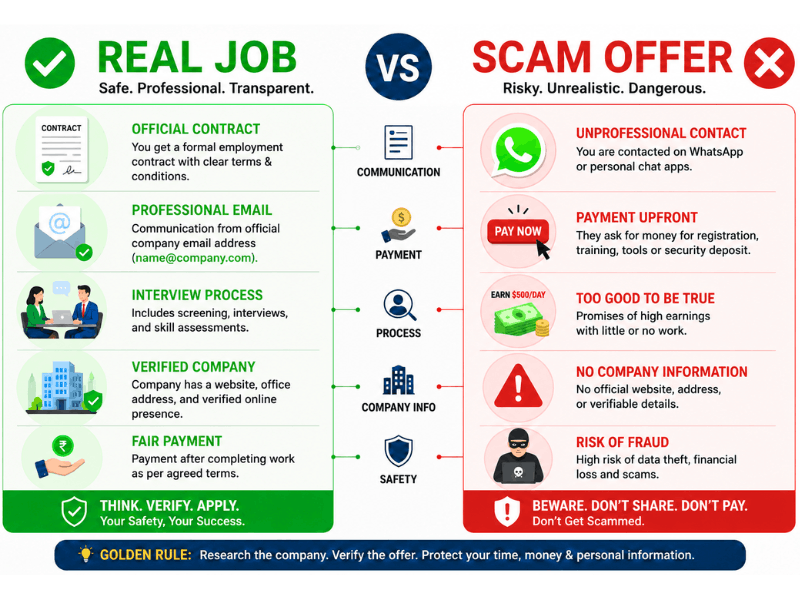
This analysis gives an honest answer to one of the main questions: “Are AI Prompt Jobs Scams?” Opportunities do exist, but scams depend on making impossible promises, using psychological pressure, and creating confusion for people without experience in remote jobs.
Conclusion
The online industry for AI jobs is expanding at an extremely rapid pace today, and this expansion is simultaneously generating opportunities and risks.
Following research on fraudulent recruiters, Telegram tasks, and online AI training platforms, one thing became very clear to me.
The issue does not lie with AI jobs.
The issue lies with the scammers who take advantage of the current AI craze to trick job hopefuls into believing that there is quick money-making work available.
This is why people keep asking, Are AI Prompt Jobs Scams?
Yes, some are definitely scams, particularly those that promise quick cash, no effort required, or fast employment without verification.
However, legitimate AI prompt writing and training jobs are available too.
The most effective strategy would be to take things slowly before believing anything offered by an online recruiter.
One must ensure that they confirm the websites of companies, investigate the profile of recruiters, read reviews about them, and never give out deposits, activation fees, or any personal financial information at the initial stages.
In all honesty, I believe that many individuals fall into such scams since the offers are too good when faced with financial difficulties.
The scammers know how to play with emotions perfectly.
There are still some genuine remote AI possibilities that can be pursued by those who are able to write, research, evaluate, and freelance properly.
If anything seems too fast, too simple, or too emotional, you should trust your gut instinct and do double checks on everything.
Frequently Asked Questions
1. Are AI prompt jobs scams?
Some AI prompt jobs are legitimate, but there are many fake recruiters who use AI-generated job listings for scams and remote job tasks. Be careful and always verify the authenticity of the recruiter. Never fall for the pay-to-work scam.
2. Is prompt writing a legit job?
Yes, prompt writing is indeed a legitimate job that relates to AI training, testing chatbots, and assessing content. There are many businesses that hire individuals to work on legitimate AI training jobs from their homes; however, there are also numerous false promises online.
3. Do real employers ask for money?
There is no valid reason for an employer to demand payments from the applicant for training, deposits, or activation purposes. This is one of the most common signs of an unscrupulous recruiter. The moment anyone demands payment from you, you know that it is a scam.
4. Can beginners get legitimate AI training jobs from home?
Of course, one can find real AI jobs for beginners from home, if one has good writing and research skills, as well as good communication skills. There are lots of legit AI crowd work jobs and AI labeling jobs that offer beginners easy tasks.
5. Is Outlier AI legit or scam?
It seems like Outlier AI is indeed an authentic AI training platform with remote annotation and prompt evaluation work. However, reviews are mostly inconsistent due to frequent shifts in work availability. Individuals who are inquiring about Are AI Prompt Jobs Scams? tend to mistake inconsistent work with scammers.