
The AI industry has evolved much quicker than anticipated.
Only a decade ago, many believed that having a career in AI necessitated complex knowledge of programming or an engineering degree.
However, in 2026, all of that would change dramatically.
AI Prompt Jobs for Beginners are making inroads as one of the easiest ways to get started in the digital workforce.
Companies are actively hiring people who can communicate clearly with AI tools like OpenAI ChatGPT, Anthropic Claude, and Google Google Gemini to improve AI-generated content, test chatbot responses, and guide Large Language Models effectively.
I still remember the first time I experimented with AI prompting.
I had zero coding experience, no tech degree, and honestly, I felt intimidated by all the “AI engineer” discussions online.
However, after I gained insight into how prompts operate, one thing was certain – programming skills alone won’t cut it for companies.
What else do they require? Individuals with an understanding of language, creativity, communication, and problem-solving skills.
And that’s why the new non-technical AI career path roadmap in 2026 is making headlines.
Freshers are getting in with remote jobs, prompt writing, chatbot testing, AI evaluations, and no-code jobs that one can learn from the comfort of their homes.
Are you unsure where to begin your journey towards a career in AI? This guide will take you through the process from start to finish.
Overview of AI-Prompt Jobs in 2026
AI prompt jobs for beginners have seen an unprecedented demand due to the widespread adoption of AI in most industries.
Companies leverage AI technology in their businesses to help with marketing, customer services, education, e-commerce, writing, coding, training, and many other tasks.
What is surprising about all these is that AI still requires human intervention.
Here’s when the novices take the stage.
Organizations employ people for Entry-level AI Jobs despite a lack of experience, as AI is not perfect either.
They have been known to hallucinate data, provide biased answers, fail to comprehend commands, or create subpar output.
Human experts can correct these errors.
The silver lining is that most of these positions don’t need programming abilities.
What employers are looking for are individuals who possess excellent communication skills, logical thinking, and know how to ask the right questions.
This is precisely why Freshers AI jobs have never been more approachable.
Upon venturing into these opportunities, I found out that newbies tend to do one thing wrong – complicate AI careers too much.
Sometimes, the simpler way works best. You can start your AI journey by playing around with ChatGPT, Claude, prompts, and AI-written texts.
Non-technical AI career roadmap 2026 gives much importance to practical skills than educational background.
At times, a portfolio with immediate samples works better than a certificate from college.
This development has provided immense opportunities to students, freelancers, housewives, and even career switchers from all over the world.
Why Entry-Level AI Jobs Without Experience Are Booming in 2026
AI is developing in such an unbelievably fast pace in 2026.
Just a couple of years back, most of the businesses were simply exploring AI technology.
Today, from startups to agencies to e-commerce firms, even small local businesses use AI on a regular basis for various content-related work.
This abrupt expansion is why there has been a tremendous need for Entry-level prompt engineer positions on remote work sites and start-up recruiting boards.
The surprising thing for me was the fact that most companies did not prioritize finding hardcore developers initially.
They needed individuals who could direct AI effectively, give clear prompts, and improve their responses.
That’s precisely why no-coding AI jobs for beginners have become so popular today.
The companies figured out one thing after trying such programs as ChatGPT and Claude for many months.
AI will continue to make weird errors.
It may sound too mechanical.
It may provide wrong data with complete assurance.
And in some cases, it won’t understand what customers want at all.
It’s here that human evaluators come into play.
Businesses currently employ novices who check out prompts, edit machine responses, sort out dialogues with chatbots, and smooth out the process.
In quite a few cases, communication expertise will outweigh coding skills since communication abilities will be critical for doing the job.
In recent times, there have been many startups that provide Remote prompt engineer positions for freshers based solely on having excellent English language skills, creativity, and some experience using AI tools.
No engineering qualifications.
No need for an advanced programming background.
This speaks volumes about the direction the market is taking.
The next interesting trend would be the remote recruitment process.
Companies are trying to cut expenses, which means that they favor having a globally distributed team rather than an expensive local AI staff.
In other words, there is an opportunity for people from all countries to start their career.
Going forward, I really believe that human-AI partnership jobs will become even more important than they are right now in the years following 2026.
While AI technology is rapidly advancing, businesses still require individuals who can think logically, empathize with their customers, and edit the work done by machines.
Top AI Prompt Engineering Jobs for Beginners (No Coding Required)
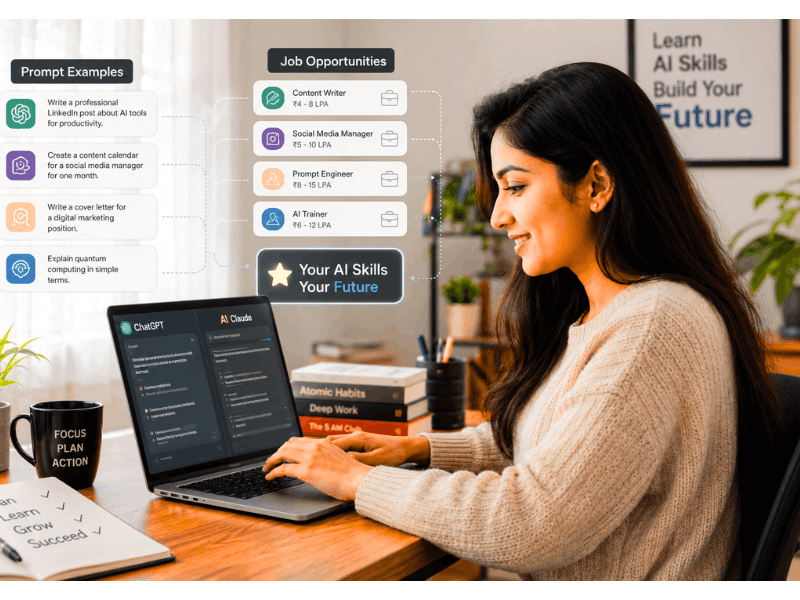
When I first began my investigation into careers within AI, I expected each one to necessitate some form of coding skills, machine learning expertise, or technical qualifications.
However, through several months of research, I came to learn that there are many companies seeking individuals capable of communicating with AI technologies and improving their performance.
This is why the demand for AI Prompt Jobs for Beginners is increasing rapidly in 2026.
Several remote companies now employ freshers in different jobs that involve artificial intelligence, chatbots, content assessment, and prompt optimization.
Some beginners earn their first pay by doing freelance jobs, while some are working remotely for startups.
Salary for entry level mostly depends on skills in communication, specializations, and quality portfolios.
For beginners, income mostly comes from hourly contracts first, then they get into better paying long term contracts.
The good thing about such work is that all the work can be done right at home through a laptop and Internet access.
AI Content Evaluator & Writing Assistant
Another simple way to begin in this field is to become an AI Content Evaluator or an AI Writing Assistant.
Such positions have been gaining popularity because companies today write large volumes of AI content on a daily basis.
However, pure AI content often does not come out perfectly.
Organizations need people that will refine the text, improve its clarity, fix grammar mistakes, and make the answers more natural.
For instance, an AI content creator novice will be tasked to review draft entries on a blog, rewrite AI-generated captions, ensure factual accuracy, and enhance prompts.
ChatGPT and Claude are popular examples of applications used for developing ideas, outlining pieces, writing product descriptions, and marketing materials.
I have actually tested such a workflow when I assisted an eCommerce seller with improving their product pages.
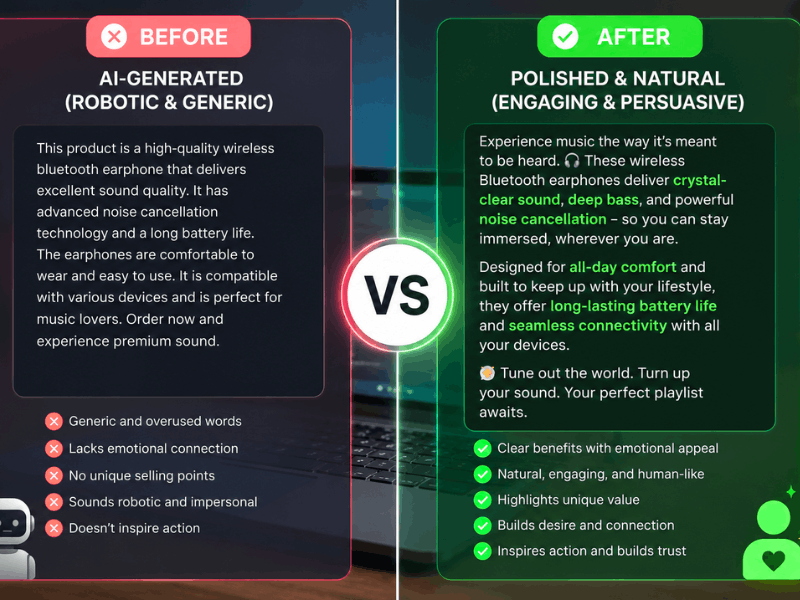
While the AI generated some good descriptions, they were filled with too much repetition and robotic sentences.
With some adjustments to prompts and manual rewriting, the content became much better.
Daily responsibilities often include:
- Editing AI text.
- Using more than one prompt output.
- Enhancing readability.
- Building reusable prompt templates.
- Maintaining tone consistency.
Most freelancers start small by doing article editing or prompt writing work, gradually increasing their rates as they build their portfolio.
This process is undoubtedly one of the most approachable ways to get into the AI field.
AI Data Annotator & Chatbot Operator
AI Data Annotator for starters and AI Chatbot Operator job are some other jobs gaining popularity in 2026.
One would be surprised to know that there is such an extent of human intervention required by AI systems.
The quality of chatbots falls down drastically without proper training data and feedback.
In these positions, newbies typically assist in organizing information, tagging conversations, checking up on chatbot responses, and correcting errors in responses.
Chatbot Trainer Jobs Entry Level for Improving AI Conversations with Real People in Customer Service and Sales Positions.
For one time, I tried to test a chatbot for my startup project, and let me say, the artificial intelligence was misinterpreting the intent of the customers more frequently than I could imagine.
The slightest modification of wording significantly affected the result.
It really showed me why businesses put great effort into human review.
Typical beginner workflow includes:
- Data annotation
- Checking AI chat sessions
- Correction of responses
- Classification of customer intent
- Chatbot training
- Highlighting of ambiguous output
All these tasks are often location independent, making them ideal opportunities for students and freshers.
Many organizations do not emphasize educational qualification as much as your ability to spot communication issues.
This type of work also teaches practical AI interaction skills naturally over time.
Many people eventually move from annotation tasks into advanced prompt optimization roles later in their careers.
Prompt Quality Analyst & Tester
A surprising aspect for me personally was the requirement for fast testers and AI reviewers.
Firms are even recruiting novices as Quality Analysts because there may be some errors made by AI systems in their responses.
They might even come up with lies and be wrong about certain aspects.
It is here that Output Quality Control becomes critical.
Organizations require individuals who can test prompts, evaluate output, and enhance AI responsiveness to ensure that there is quality content that will be given to their clients.
As an entry-level Output Quality Controller, one might spend hours evaluating chatbot replies and finding poor AI responses.
Such tasks as Hallucination detection, prompt testing, and bias mitigation are common at this job.
I recall the experience when I tried a customer service chat that had the bot constantly provide very polite yet utterly useless responses.
It was not about the program.
The problem lay in the lack of good prompts and context information.
After making changes to the prompts, there was a drastic difference in the quality of responses.
Common responsibilities usually involve:
- AI Prompt Evaluation
- Testing Different Prompts
- Spotting Misleading Information
- Consistency of Responses
- Better Conversations
- Tone and Accuracy Review
This field has turned out to be among the fastest-growing categories at AI Prompt Jobs for Beginners due to the fact that companies value trust and good customer relations.
The importance of professionals engaged in such activities can only grow alongside the increase in the use of AI technology around the world.
Core Skills You Need to Master (Even with Zero Experience)
Whenever individuals decide to venture into careers in AI, almost all of them get worried about programming.
I was one of those who once shared the same belief.
My perception about the field was that it involved learning complex programming languages to start making money on the internet.
However, after experiencing the industry, I realized that my opinion was far from accurate.
The skills required for most beginner tasks in AI involve effective communication, logic, creativity, and knowledge of the behaviors of AI when interacting.
This is why AI Prompt Jobs for Beginners are becoming available to students, freelancers, writers, marketers, and non-technical people in 2026.
One does not have to instantly become a software engineer.
The focus should rather be on knowing how to manage AI tools, improve outcomes, and learn about the effect of language on the result.
Having these skills makes advanced learning easy.
Understanding LLM Models & Tools
Beginners who want to explore the world of AI must first know about how LLM Models work today.
They are trained using massive amounts of text-based data and respond according to their pattern recognition and understanding. The better your instructions are, the better the output is.
From the very beginning when I began to practice, I was testing various AI tools every day just to get to know their behavior.
However, let me assure you that each of them acts differently.
ChatGPT is considered to be the simplest tool for starters.
It is easy to use and very convenient to write, brainstorm, compose summaries and talk with it.
Often it is used by newcomers at first.
Claude 3.5/4 is generally more precise and calm during long conversations.
This was something I have observed when it was handling larger documents.
Due to its longer memory, it can be used for analysis purposes too.
Gemini by Google is ideal when conducting research and carrying out tasks related to efficiency and productivity.
It also fits perfectly into the environment of Google tools that most remote workers use on a daily basis.
Next up, we have OpenAI Playground which is slightly advanced, but it becomes really useful when users learn the basics of prompting.
Users can explore different settings, behavior, and model control through the playground.
If you ask me which one you should start with, I always suggest starting with ChatGPT because its learning process is not very difficult. Once I am confident, then going forward with Claude and Playground becomes easier.
These tools are becoming essential for people entering modern AI-driven remote careers and digital workflow industries.
Basic Prompt Design Patterns
Understanding Prompt Design Patterns has revolutionized how I work with AI programs.
Before I had knowledge about prompt design, the results were always inconsistent and even frustrating at times.
Sometimes, I experienced situations whereby the AI program misinterpreted the prompts and produced useless answers.
One of the simplest concepts for beginners to understand is Zero-shot prompting.
For example:
“Write a friendly email for a skincare product launch.”
This AI aims to solve the problem right away based on general knowledge.
It is quite impressive how accurate this system is in solving easy tasks.
Next, there is Few-Shot Learning where examples are shown before asking for the outcome.
It helps greatly in increasing the accuracy of AI.
As far as my experience goes, I use this approach while creating descriptions for products.
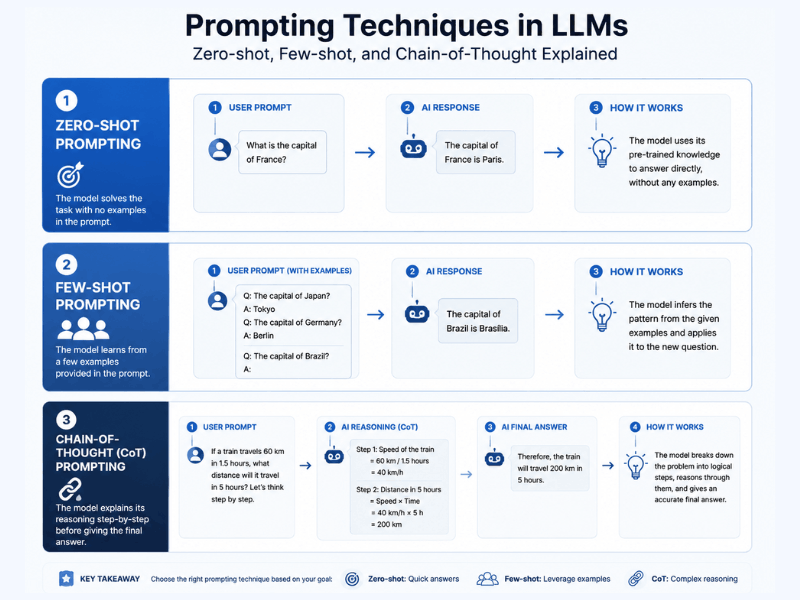
Another powerful method is Chain-of-Thought prompting.
Here, you encourage AI to think step-by-step before answering.
This becomes extremely useful for problem-solving, analysis, or structured reasoning tasks.
Example:
“Think through this problem step by step and then provide the answer.”
This minor tweak makes a lot of difference to the quality of your output.
I would advise creating reusable Prompt templates from the start.
It’s time-saving and helps keep your process streamlined.
Something as simple as this will do the trick:
- Role
- Goal
- Audience
- Tone
- Output Format
After learners get familiar with such patterns, working with AI will become more predictable and professional.
That is why, when beginners start working with AI Prompt Jobs for Beginners, they pay a lot of attention to prompt experiments.
Output Refinement & Bias Mitigation
One thing new users fail to understand right away is that AI can make things sound true even if they are totally false.
This I came to know after conducting tests on research abstracts created by AI.
These abstracts looked convincing at first but actually contained false information.
That is the reason why hallucination detection has turned out to be so crucial for any AI-related job.
Beginners must understand the way to verify their facts, analyze their answers, and never trust what was generated automatically.
The next issue to discuss is that of Bias Mitigation.
AI systems learn from data available on the internet, but even that data has biases, falsehoods, and stereotypes.
Occasionally, AI reproduces these problems unconsciously.
The role of human reviewers is essential for spotting and reducing such problems.
Technical concepts such as Tokenization should not be overlooked either.
When AI processes commands, it tokenizes languages into smaller chunks called tokens.
Larger prompts will require more tokens, which may affect efficiency and memory management.
Context windows are the other type; their main function is to control how many details the AI will be able to recall throughout the conversation.
A greater Context window value would help in performing better at long conversations.
Another setting I played around with was the Temperature parameter, since response behavior is greatly dependent on this setting.
Smaller values result in focused output while higher values lead to more creative answers.
Newcomers get better results through trial and error of prompts, improving their instructions, making requests clearer, and analyzing responses instead of jumping to conclusions too soon.
This practice distinguishes amateurs from professionals who work within the AI content industry.
Where to Find Remote AI Prompt Jobs in 2026?
Locating AI jobs in 2026 is surprisingly easier than you might expect for a newbie.
The difficulty doesn’t lie in the scarcity of jobs.
The more difficult issue is how to locate legitimate remote jobs as a newbie and where they actually exist.
Initially when I began my search, I lost time applying without knowing anything about the difference between platforms.
There are some sites that are great for working as freelancers, while there are others that are ideal for startups and remote jobs.
Today, many organizations actually recruit people for positions like AI content reviewing, chatbot testing, prompt writing, and workflow management.
This is one of the reasons why AI Prompt Jobs for Beginners are easier to get than ever before around the world.
Newbies, even with very little in their portfolio, can secure beginner-level projects by applying wisely.
Best Freelancing Platforms for Beginners
For beginners, freelance sites are undoubtedly the best choice to start with as they enable one to win small battles initially.
Many individuals earn their first income from artificial intelligence-related projects through entry-level AI gigs at Upwork and Fiverr.
When I started my first profile, the big mistake that I did was providing lots of services which were completely unrelated to each other.
The confusion among clients was evident from the beginning.
With specialization in prompt writing and AI assistance, things became easier for me.
In case you need to apply for a position of a Freelance AI Prompt Engineer, your portfolio has to be concise and focused. Choose something like this:
“AI Prompt Engineer for ChatGPT and Chatbot Workflows”
Include the following in your portfolio:
- Prompt Examples
- Results Before/After
- Improvements of AI content
- Chatbot Testing Screenshots
- Workflow Samples
Making intelligent applications is always better than making many applications.
Rather than making fifty general offers, one should make five specialized offers each day.
Efforts are easily noticed by clients.
Regarding prices, novices must never charge too high from the very beginning.
Personally, I believe that lower prices work to help earn testimonials sooner.
As soon as one earns testimonials and regular clients, they can increase their prices with ease.
At first sight, small projects for freelancers may seem insignificant.
However, in reality, many AI careers start from such small projects.
Tech Job Boards and Startup Networks
In addition to freelancing websites, startup job boards are another huge source of opportunities for AI-related remote jobs.
For example, I discovered some of the coolest jobs on AngelList/LinkedIn because of my experience with startup jobs in AI companies.
Founders are no longer seeking candidates with impeccable CVs.
They are looking for individuals who are quick learners, test AI software, refine the output, and keep up with the evolving processes.
There is a great scope for freshers joining the digital world in 2026.
Many remote AI jobs being hired for in 2026 are listed directly on LinkedIn rather than other job sites.
This is why LinkedIn optimization is very important.
Your profile should include skills such as:
- Prompt engineering
- Evaluation of AI generated content
- Chatbot testing
- Workflow Automation
- AI enabled writing
I also suggest that you post regular content made using AI to your profile.
Recruiters tend to rely on your skills when they see that you actively experiment.
For WFAI jobs, application strategy is quite important.
A generic application will not work in most cases.
For beginners, I usually suggest researching a little bit about the organization and mentioning some unique feature about their AI.
This personalization ensures that the applicants do not feel like bots sending out spam messages but feel like humans reaching out.
And trust me, this becomes immediately apparent to startups.
There is yet another reason why these platforms are so effective: Founders look for flexible workers, not just experienced programmers.
This allows tens of thousands of beginners entering the AI Prompt Jobs for Beginners industry.
How to Apply for AI Prompt Jobs as a Freshman (Step-by-Step)
Late to realize one thing is that the expectations of an organization are never to have someone know everything.
The fact is that most startup organizations know that freshers need time to learn.
It is rather their need to prove your ability to practice diligently, solve simple problems, and comprehend AI processes accurately.
Even a little portfolio based on actual experiments sounds much better than mere certificates.
This really made me think, as I invested several weeks in viewing tutorials, not doing any practical work.
However, after I started developing small prompts and showing my results online, things got better.
Simple AI testing or content refinement sample assignments can give beginners an edge in today’s remote job market.
The point here is that one should demonstrate skill rather than wait to develop expertise.
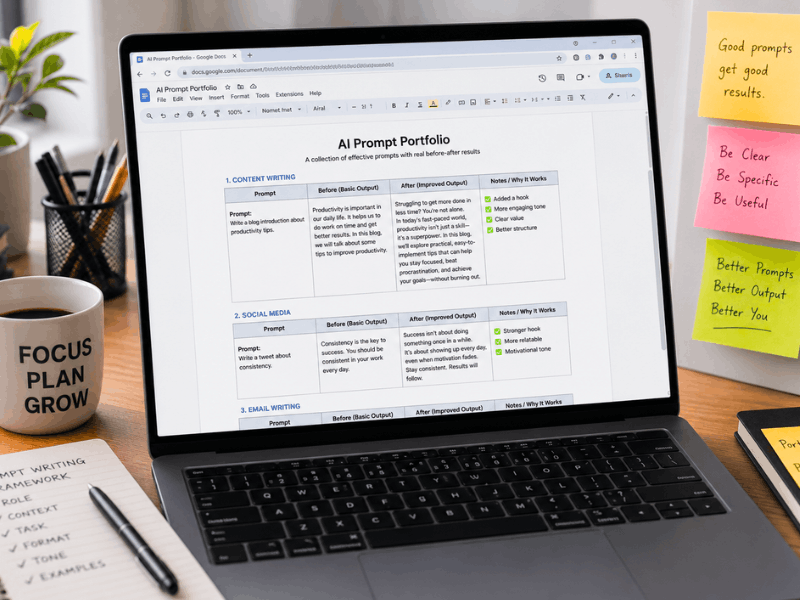
Step 1: Build a Prompt Portfolio/Library
“Prompt portfolio” may sound like a complex concept initially; however, in reality, it can be incredibly easy.
My first attempt to build a portfolio was done using Google Docs entirely by hand.
There is no special website involved.
No design software required either.
The idea here is to demonstrate how you use AI technology to generate results and continually improve them.
Recruiters expect you to prove your ability to apply critical thinking when creating AI prompts.
Portfolio Contents
- Prompts
- Outputs before and after improvement
- Improved responses by AI
- Screenshots of workflow
- Prompts for testing
- Refining content
It helped me personally because I decided to make collections based on niches rather than any examples I found.
This way, I could have my prompts sorted in such a manner as below:
- eCommerce prompts
- Writing blog posts prompts
- Support workflow prompts
- Social media content prompts
That right there made my project look so much more professional.
Showing before and after results is especially effective because the client can visibly see your success.
Having an example of an unpolished AI-generated text alongside an optimized one says more than any amount of explanation.
Google Docs is just fine when starting out since accessibility is more important than style in the early stages.
It is more impressive to be well thought out and organized rather than fancy and flashy.
Step 2: Optimize Your LinkedIn for AI Roles
Most newbies under-value LinkedIn.
My first impression was that recruiters on LinkedIn were only interested in people’s academic qualifications and experience.
However, once immersed in AI circles, it became clear that startups actually prefer curious individuals rather than professionals.
Your LinkedIn profile must convey what skills you are gaining and applying.
Poor titles like “Student” or “Freelancer” often get buried by the search algorithm.
Rather, employ strategic positioning like:
“Workflow Improvement Learner | AI Content Tester | ChatGPT Research Enthusiast”
Incorporating keywords related to AI into your profile will increase your chances of being seen.
Keywords such as prompt engineering, chatbot testing, AI workflow assistance, content evaluation, and automation studies make it easier for the recruiters to know your direction.
I would recommend creating and posting AI-related practice material on your profile, regardless of the number of viewers you may have.
This was my experience when I began sharing prompt experiments and comparing the output.
You could post things such as:
- Experimentation prompts
- Mistakes that your AI made and how you fixed them
- Screenshots from workflows
- Comparisons between tools
- Shortcase studies
It helps develop your branding automatically as a beginner.
People recognize you as someone who is really learning something as opposed to claiming they know everything at once.
Perfection has no bearing when it comes to LinkedIn.
Step 3: Apply for Micro-Tasking AI Projects
Actually, smaller projects happen to be one of the best ways of getting into the AI industry now.
Most beginners usually overlook micro-tasking jobs since the compensation offered is low.
However, small-scale projects provide much quicker workflow experience than all those online courses.
For myself, I got to know about prompt polishing, chatbot correction, and AI testing through micro-freelance gigs rather than endless hours of learning through tutorial videos.
Hands-on practice will give you a whole new perspective on things.
Micro-tasking offers the following options:
- AI Testing
- Responses Assessment
- Annotation Sites
- Data Labeling
- Prompt Review
- Chatbot Correction
Such work serves to boost the morale of newbies while making them money at the same time.
The psychological significance of this is obvious since receiving any kind of pay will make the whole experience seem much more legitimate.
A clever way for a newbie to earn is by taking on smaller contracts before trying to land bigger ones.
Indeed, many AI freelancers became successful by developing a portfolio of projects completed under such conditions.
Annotation and AI evaluation platforms also provide insight into real industry practices for beginners.
Here you learn how companies operate within their internal systems to train models and enhance their output.
Such knowledge becomes very useful in the future when seeking larger-scale opportunities or partnerships with startups.
Common Mistakes Beginners Make in AI Prompt Careers
An error I have seen repeatedly is new writers relying too heavily on AI prompts without even knowing why the prompts do what they do.
People tend to use random prompts found on YouTube or the Internet and think that just by doing that, they will get success.
Initially, I was making this same error too.
Although it seemed to be working initially, once clients started demanding modifications, I was in trouble because I did not know how it worked.
Another one is copying and pasting your resume.
In particular, some newbies upload screenshots straight from their ChatGPT conversations but do not include their contributions or any process.
Recruiters can spot this easily.
It would be more convincing to showcase how you edited the output, made the tone better, etc.
Many newbies tend to neglect prompt testing entirely.
They create one prompt, get the output, and that’s it.
However, prompt testing is quite essential for any real-life AI application.
Even slight alterations in wording can significantly affect the results.
That is why AI Prompt Jobs for Beginners encourage experiments over memorization.
Communicating is another underrated skill.
Some individuals concentrate only on tools and do not take into consideration the importance of clarity, patience, and way of explaining things.
Businesses generally value good communicators more than those who use complex AI jargon.
Unrealistic income expectations cause frustration early as well.
Social media tends to portray AI careers as an overnight way to make money.
The truth is that many people start small, working on little projects and building their portfolio.
The best solution would be to stick to it and test prompts constantly, making real-life examples and treating it as a career, not a shortcut.
Future of No-Coding AI Careers Beyond 2026
The future prospects of non-technical applications of AI are truly much grander than most individuals believe at present.
Most novices assume that the process of automation would eliminate human jobs, but from my observations within the sector, I have realized that the truth lies somewhere in between the extremes presented on social media platforms.
Undeniably, AI technology continues to get smarter each month.
Companies have been automating their work processes of content production, customer service, scheduling, and research much quicker than previously possible.
However, even the most advanced technologies find it difficult to analyze emotions, think critically, understand culture, and make creative decisions.
This is precisely where human cooperation becomes indispensable.
In my opinion, in the future, remote jobs would more or less involve leading the AI rather than competing with it head-on.
There is a rise in beginner jobs like AI workflow assistant, prompt review expert, AI conversational testing expert, automation support specialist, and chatbot review expert.
One reason that AI Prompt Jobs for Beginners will maintain its value in the future is that prompt creation itself relates to communication. As AI becomes more sophisticated, the ability to create effective prompts will only be increasingly important, not become less necessary.
Those who know how to effectively combine human decision-making capabilities with AI speed will likely have an upper hand after 2026.

Conclusion & Final Checklist
In my opinion, working in the field of AI starting from 2026 does not seem scary when one understands how this sphere operates.
First of all, I used to think that only programmers have enough skills to enter this business successfully.
However, after several attempts to learn prompt engineering and test artificial intelligence services, I understood that skills are much more important than formal education for beginners.
This is exactly why there is such an explosion happening in the world of AI Prompt Jobs for Beginners.
Companies require individuals who can direct AI technology effectively, refine outputs, critique chatbot responses, and converse effortlessly with modern AI technology.
The silver lining about Easy AI prompt jobs is that most of them require no prior experience in coding.
The important thing is having curiosity, being consistent, experimenting, and improving slowly over time.
I sincerely believe that the rate at which beginners improve will be a lot faster when they give up their search for perfection and focus on doing small, tangible projects.
A basic portfolio, experiments with AI everyday, and learning will offer more opportunities than tutorials alone.
Your Beginners’ roadmap must be more concerned with realistic growth one step at a time rather than immediate unrealistic income.
Though the industry is rapidly changing, there is ample scope for beginners who have patience and adaptability.
Final Checklist Before Applying
- Learn basic prompting daily
- Practice with ChatGPT and Claude on a regular basis
- Create a small collection of prompts
- Save before-and-after output samples
- Enhance your communication abilities
- Test prompts more than once
- Apply to small freelance jobs
- AI-optimize your LinkedIn profile
- Understand AI responses carefully
- Be consistent despite slow progress
One small job opportunity today will very well turn into a complete remote job in the future.
The ones who are succeeding in AI today are not necessarily the most vocal online experts.
They are the learners who keep practicing consistently week after week.
FAQs
1. Can beginners really get AI prompt jobs without coding?
Absolutely, most of the AI jobs that are currently available remotely require skills in communication, prompt writing, chatbot testing, and AI workflows but not coding.
Even beginners without any technical background may begin their learning journey using ChatGPT, Claude, and prompt-based assignments.
2. Which AI tools should freshers learn first in 2026?
Beginners should first begin by using ChatGPT as it is very easy for beginners.
Once you gain confidence, learning Claude, Google Gemini, and OpenAI Playground will help you learn how to test responses.
3. Where can beginners find remote AI jobs online?
Entry-level jobs for beginners in artificial intelligence could be secured through Upwork, Fiverr, LinkedIn, AngelList, and remote startup recruitment services.
A lot of organizations currently employ freelancers as AI reviewers, chatbot testers, prompt writers, and AI content assistants worldwide working from their homes.
4. How much can beginners earn from AI-related freelance work?
Income will be a function of skill, reliability, specialization, and quality of portfolio.
For newbies, income is usually derived from small-scale AI writing jobs, prompts testing, and chatbots, but it gradually increases as they gain experience and reviews.
5. Why are prompt engineering skills becoming valuable after 2026?
AI technology is advancing at a very fast pace; however, companies will always require people who can assist their AI systems efficiently.
Effective prompting techniques, communication, output optimization, and AI quality assurance skills will continue to matter for those interested in becoming digital professionals in the future.
1 thought on “How to Get AI Prompt Jobs for Beginners (Zero Experience Guide 2026)”