
What Is Open-Source AI Deployment?
Using free, transparent, community-driven technology to develop, refine, and introduce AI models without depending on pricey business platforms is known as open-source AI deployment. It provides startups with cost-effective deployment options, flexibility, and complete ownership. This section of the Open-Source AI Deployment Guide For Startups explains why contemporary founders are moving away from closed, expensive offerings and toward open-source ecosystems.
Fundamentally, open-source AI deployment builds scalable AI infrastructure using tools like Hugging Face, Docker, Kubernetes (K8s), MLflow, PyTorch, TensorFlow, ONNX, TensorRT, and OpenVINO. Increased inference speed, simple model versioning, and streamlined deployment processes are all made possible by these tools.
Key Characteristics of Open-Source AI Deployment:
100% transparency in model behavior, updates, and architecture
Cloud agnostic (run models anywhere—AWS, GCP, Azure, local server)
Low-cost AI infrastructure that avoids vendor lock-in
Faster deployment workflow because the open-source ecosystem evolves quickly
More control over security, inference optimization, and model serving
Supports MVP deployment faster and reduces long-term technical debt
All things considered, an Open-Source AI Deployment Guide For Startups serves as a model for creating dependable, scalable, and startup-friendly AI systems without going over budget.
Simple Explanation for Beginners
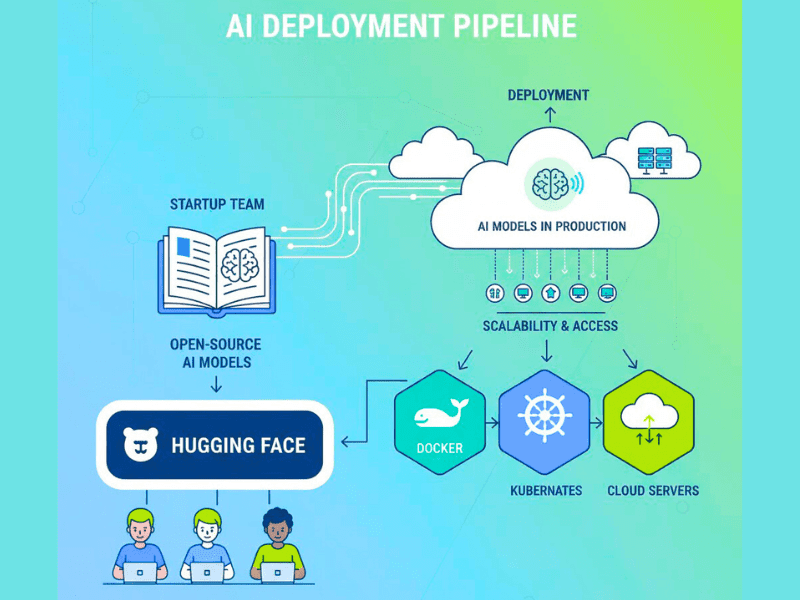
Deploying open-source AI is similar to creating your own unique AI configuration using free “building blocks” rather than purchasing pricey equipment. You can deploy AI anywhere you choose by combining open-source tools like PyTorch for model training, Hugging Face for pre-trained models, Docker for packaging, and Kubernetes for scaling.
In Simple Terms:
- Rather than being compelled to use a single cloud platform, you select your own tools.
- You can use your model on a laptop or in the cloud.
- Cost, performance, and scalability are all under your control.
- An international open-source environment is advantageous to you.
- No costly licensing or limitations
Startups may create AI infrastructure in a simple, step-by-step manner with the use of this approach.
Why Startups Prefer Open-Source
Open-source software is preferred by startups due to its speed, flexibility, and significant cost reductions. Open-source solutions, in contrast to closed cloud systems, are made for real-world scalability and change quickly.
Major Reasons Startups Choose Open-Source:
Cost-effective deployment with zero licensing fees
Cloud agnostic, ensuring easy migration and multi-cloud use
Better inference optimization with ONNX, TensorRT, and OpenVINO
Model versioning + tracking via MLflow
No vendor lock-in, preventing long-term dependence
Easier model serving using Kubernetes and Docker
Open-source is the best option for early-stage AI businesses since it lowers technical debt and speeds up time-to-market for quick-thinking innovators.
Benefits of Open-Source AI for Startups
Freedom and cost savings are the main reasons startups adopt open-source. Founders may create intelligent systems without incurring costly licensing costs or vendor lock-in with the help of a well-organized Open-Source AI Deployment Guide For Startups. Startups can create a scalable, cloud-agnostic, and highly efficient AI infrastructure with the aid of open-source tools like Kubernetes, Docker, Hugging Face, MLflow, ONNX, TensorRT, and OpenVINO.
Key Benefits for Startups:
Cost-Effective Deployment through free tools and efficient GPU utilization
Cloud Agnostic Flexibility enabling deployment on AWS, GCP, Azure, or local hardware
Better Inference Optimization using ONNX Runtime, TensorRT, and OpenVINO
Faster Time-to-Market thanks to rapid prototyping with Hugging Face + PyTorch
Lower Technical Debt due to community-driven updates
AI Scalability through automated Kubernetes orchestration
Improved Model Serving with MLflow + Docker workflows
An Open-Source AI Deployment Guide For Startups can serve as a template for a seamless deployment process, lower operating costs, and long-term scalability if it is properly developed. Open-source enables founders to test quickly, iterate quickly, and provide MVPs that are ready for production without going over budget.
Cost-Effective Deployment Explained
Startups may create production-ready systems without paying license fees thanks to open-source AI, which makes deployment quite affordable. Startups can avoid premium fees by using open-source alternatives to expensive services like Vertex AI or SageMaker.
Why It’s Cost-Effective:
- No license fees (MLflow, PyTorch, and Hugging Face are free)
- Instead of using expensive managed services, run models on less expensive GPU servers.
- Boost inference speed with OpenVINO, TensorRT, and ONNX
- GPU scheduling and autoscaling can lower compute costs.
- Reuse components, processes, and models in several MVPs
Because of this, open-source software continues to be the best option for organizations on a tight budget.
Cloud Agnostic Advantage
Startups can implement AI models anywhere without being restricted to a single provider because they are cloud agnostic. Scalability, flexibility, and long-term cost control are strengthened by a cloud-agnostic approach.
Key Advantages:
- Use on-premises servers or AWS, Azure, GCP, or DigitalOcean.
- Change cloud service providers at any time (no hassle during migration)
- To manage workloads across several clouds, use Kubernetes (K8s).
- Steer clear of expensive proprietary AI infrastructure
- Make hybrid deployments possible to optimize inference
Cloud-agnostic deployment guarantees maximum independence, improved resource management, and a more seamless scaling journey for firms seeking long-term success.
Choosing Your Open-Source AI Stack
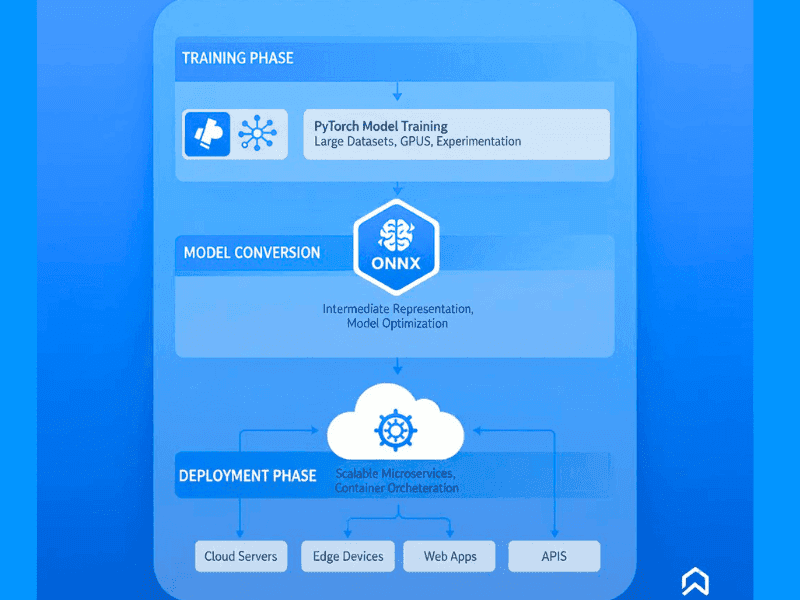
One of the most crucial choices for each startup is creating the appropriate AI stack. Scalability, economical deployment, efficient model serving, and seamless MLOps processes are all guaranteed by a robust stack. Hugging Face, MLflow, Docker, Kubernetes (K8s), PyTorch, ONNX, TensorRT, and OpenVINO are just a few of the crucial tools that are clearly broken down in every Open-Source AI Deployment Guide For Startups. These open-source tools enable quick prototyping, lower technical debt, and provide dependable AI infrastructure for startups.
Why Your AI Stack Matters:
Ensures AI scalability from MVP to enterprise-level
Reduces deployment workflow complexity
Supports model versioning and CI/CD automation
Enhances inference optimization and GPU utilization
Protects you from cloud lock-in with cloud-agnostic architecture
Boosts time-to-market for early-stage founders
The foundation of your engineering process is a carefully chosen stack. In reality, the majority of contemporary entrepreneurs use an Open-Source AI Deployment Guide For Startups to determine which tools boost inference speed across environments, lower costs, and improve performance.
Essential Tools & Frameworks Startups Need
Strategic tool selection is essential for the successful implementation of AI. Every startup should take into account the following crucial open-source elements, each of which has a distinct function:
Core Frameworks:
- PyTorch / TensorFlow → Model experimentation and training
- Hugging Face → Transformers plus pre-trained models
- ONNX Runtime → Faster inference with a cross-platform model format
Deployment Tools:
- Docker → packages the complete environment to ensure runtime consistency.
- Kubernetes (K8s) → coordinates containers and automatically sizes models.
- TensorRT / OpenVINO → Inference optimization at the hardware level.
MLOps Essentials:
MLflow → Model versioning, model registry, and experiment tracking.
These technologies guarantee that entrepreneurs attain cloud agnostic scalability, inference optimization, and model serving reliability—all crucial components highlighted in every Open-Source AI Deployment Guide For Startups.
How These Tools Work Together
These technologies work in a system that resembles a pipeline, with each layer supporting the one before it, resulting in a smooth deployment process.
How the Stack Integrates:
PyTorch/TensorFlow → train the model
Hugging Face → supply pre-trained architectures
ONNX → convert models for lightweight, fast deployment
TensorRT/OpenVINO → accelerate inference speed for GPUs/CPUs
Docker → package everything into reproducible environments
Kubernetes → manage scaling, load balancing, auto-healing
MLflow → track versions, metrics, and push models into deployment
The Result:
Faster MVP deployment
Reduced technical debt
Easier model serving
Consistent performance across clouds
Improved GPU utilization and resource management
Together, these resources offer the full potential of an Open-Source AI Deployment Guide For Startups, assisting entrepreneurs in the confident, economical, and large-scale deployment of AI.
MLOps Concepts You Must Understand
Startups need to grasp the fundamentals of MLOps in order to develop a scalable AI product. This section of the Open-Source AI Deployment Guide For Startups describes how to automate model lifecycles, minimize risks, and optimize workflows. MLOps guarantees that your AI system will continue to function dependably even as data volumes and user needs rise. These ideas are essential for any team using contemporary AI.
Key MLOps Concepts Every Startup Should Know
1. CI/CD Pipeline
- automates model deployment, validation, and training.
- ensures fewer human errors and quicker release cycles.
- maintains the consistency and scalability of your system.
2. Model Serving
- puts the learned model into use.
- Low latency is ensured by programs like TensorRT, TorchServe, and FastAPI.
- allows real-time forecasts for APIs and applications.
3. Scalability
- aids your AI in managing unexpected spikes in user activity.
- Auto-scaling is made possible by serverless frameworks like Kubernetes.
- guarantees steady performance when under a lot of strain.
4. A/B Testing
- allows you to compare various model iterations.
- reduces production risk while progressively increasing performance.
- helps you comprehend user effect prior to a full launch.
5. Drift Monitoring
- identifies shifts in data trends or user behavior.
- Evidently AI and other tools stop long-term accuracy declines.
- guarantees that your model adapts to actual data.
When you grasp these ideas, your Open-Source AI Deployment Guide For Startups becomes comprehensive and useful, providing founders with a clear road map for dependable deployment.
Why MLOps Is Critical for MVP Deployment
Reliability is just as important for an early-stage product as speed. MLOps reduces manual overhead, improves quality, and streamlines operations to help close this gap. This is in accordance with the Open-Source AI Deployment Guide For Startups, which emphasizes the importance of automation and dependability for a successful MVP launch.
Benefits for MVP Development
- Faster iterations: Improvement cycles are accelerated with automated CI/CD.
- Stable performance: Predictable response times are guaranteed by model serving.
- Better decision-making: Early feature validation is aided by A/B testing.
- Reduced deployment risk: Broken releases are avoided by automation.
Your MVP becomes more dependable, scalable, and ready for real-world use with appropriate MLOps procedures.
Reducing Technical Debt Using Proper MLOps
Startups frequently move quickly, which results in brittle deployments, inconsistent data management, and unstructured code. Early technical debt reduction is emphasized in the Open-Source AI Deployment Guide For Startups, and MLOps is essential to this change.
How MLOps Reduces Technical Debt
- Standardized pipelines: CI/CD maintains process reproducibility.
- Clear experiment tracking: Confusion is avoided with MLflow or DVC.
- Containerization: Environment management is made easier with Docker + Kubernetes.
- Continuous monitoring: Silent model failures are prevented with drift detection.
- Version control for data & models: Ensures full traceability.
Startups can avoid patchwork systems and create a clean, scalable AI foundation by integrating MLOps early on, which ultimately saves money, time, and engineering effort.
Step-by-Step Open-Source AI Deployment Workflow
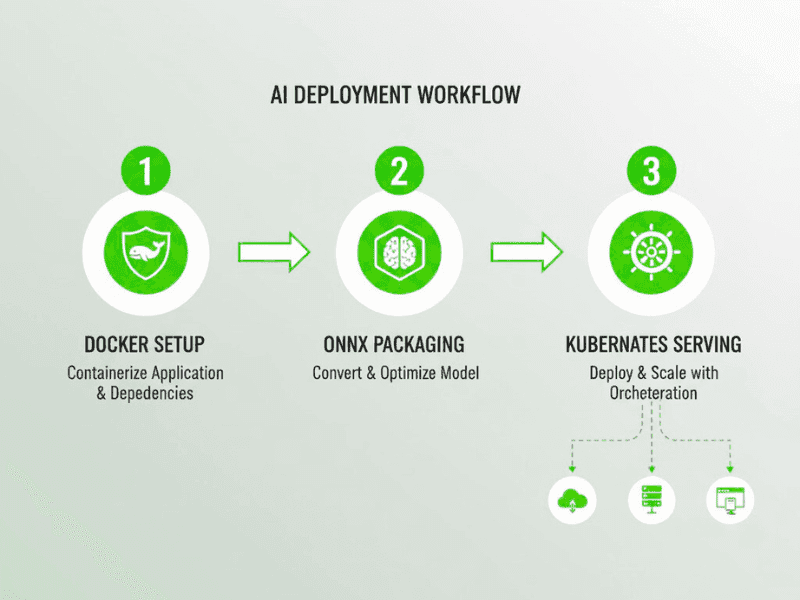
A organized approach that guarantees scalability, repeatability, and effective automation is necessary to build a dependable AI system. This part of the Open-Source AI Deployment Guide For Startups describes a workable, practical deployment pipeline that business teams employ. Helping founders and developers transition from a trained model to a fully functional, production-ready solution without needless complexity is the aim. Teams can increase long-term performance, maintain consistency, and deliver work more quickly by adhering to this procedure.
Key Steps in an Open-Source AI Deployment Workflow
1. Environment Preparation
- For reliable development and production environments, set up Docker containers.
- For scalability and dependability, orchestrate containers using Kubernetes.
- Keep dependencies and configurations under version control.
2. Model Packaging
- Use TensorRT or ONNX to transform models into optimal forms.
- Cut down on computational load, delay, and size.
- Make cross-platform interoperability possible.
- Use TorchServe, BentoML, FastAPI, or custom endpoints to deploy models.
- Assure fast throughput and minimal latency.
- Put autoscaling policies into practice.
4. Continuous Integration & Deployment (CI/CD)
- Automate upgrades, testing, and training.
- To standardize workflows, use Jenkins, GitHub Actions, or GitLab CI.
- Make sure the pipeline runs cleanly after each commit.
5. Monitoring & Optimization
- Monitor drift, GPU consumption, latency, and performance.
- Use Evidently AI, Grafana, or Prometheus.
- Refine and redeploy optimized versions on a regular basis.
By providing teams with a scalable and repeatable deployment blueprint, this organized procedure guarantees that the Open-Source AI Deployment Guide For Startups stays actionable.
Preparing the Environment with Docker & Kubernetes
Since environment setup is the cornerstone of the entire deployment lifecycle, it is one of the most important topics covered in the Open-Source AI Deployment Guide For Startups. During development and production, consistency, repeatability, and stability are guaranteed by the combination of Docker and Kubernetes.
How to Prepare the Environment
Docker Containers:
- Combine runtime, dependencies, and code into small images.
- Assure consistent execution in development, staging, and production.
- Make version management and debugging easier.
Kubernetes Orchestration:
- automatically maintains Docker container clusters.
- permits rolling updates, load balancing, and autoscaling.
- guarantees installations with zero downtime and high availability.
Infrastructure as Code:
- For tidy configuration management, use Helm charts and YAML files.
- ensures fault-tolerant and consistent redeployment.
Startups can create a stable infrastructure that scales easily and fully fits the process described in the Open-Source AI Deployment Guide For Startups by setting up this environment.
Model Packaging Using ONNX / TensorRT
A crucial optimization stage for AI performance in the actual world is model packaging. Because they lower latency, increase efficiency, and guarantee compatibility across hardware platforms, ONNX and TensorRT are suggested in the Open-Source AI Deployment Guide For Startups.
- Why ONNX & TensorRT Matter
- transforms models into a common format from PyTorch, TensorFlow, and other frameworks.
- permits deployment on mobile, edge, CPU, and GPU devices.
- enhances multi-model ecosystems’ interoperability.
TensorRT Optimization:
- offers INT8 and FP16 quantization to increase speed.
- greatly boosts inference throughput.
- Perfect for real-time applications and workloads requiring a lot of GPU power.
2. Packaging Workflow
Export trained model → Convert to ONNX → Optimize with TensorRT → Deploy in serving system.
Validate performance using profiling tools.
Ensure compatibility across nodes in Kubernetes clusters.
This packaging strategy guarantees dependable execution, seamless integration, and reduced resource consumption—all crucial components covered in the Open-Source AI Deployment Guide For Startups.
Inference Optimization & Model Serving
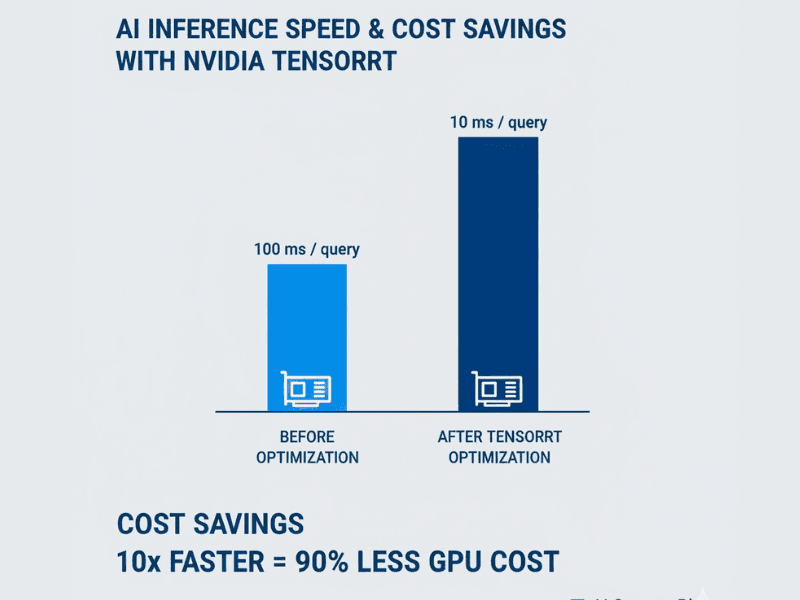
Fast inference and safe, dependable model servicing are critical components of a high-performing AI system. Optimizing inference speed in contemporary deployment pipelines can significantly lower operating costs while enhancing user experience. For this reason, efficient model servicing is emphasized as a fundamental principle in the Open-Source AI Deployment Guide For Startups. Although server load, GPU memory constraints, and performance bottlenecks are common problems for startups, production deployment can be seamless and scalable with the correct optimization strategies.
Key Concepts of Inference Optimization & Serving
1. Model Compression & Quantization
- To make the model smaller, use INT8 or FP16 quantization.
- Faster inference is made possible by programs like TensorRT, OpenVINO, and ONNX Runtime.
- lowers latency for AI products that operate in real time.
2. Hardware Acceleration
- For optimal performance, make use of GPUs, VPUs, and cloud accelerators.
- For increased throughput, use AWS Inferentia, AMD ROCm, or NVIDIA Tensor Cores.
- Perfect for managing a lot of API traffic.
3. Scalable Model Serving
- Scalable endpoints are offered by programs like BentoML, TorchServe, FastAPI, and Triton Inference Server.
- uses Kubernetes to support autoscaling.
- guarantees steady performance even during periods of high traffic.
4. Caching & Batch Inference
- Use clever caching techniques to cut down on unnecessary computation.
- To make better use of the GPU, batch tiny queries.
- reduces expenses for startups that receive a lot of requests.
By optimizing inference, you can make sure that your team takes full advantage of the Open-Source AI Deployment Guide For Startups‘ roadmap and that your AI solution is quick, effective, and ready for production.
Boosting Inference Speed for Startups
For real-time AI solutions, inference speed is essential, particularly for early-stage businesses hoping to provide seamless user experiences. The Open-Source AI Deployment Guide For Startups suggests strategies that aim to lower latency while maintaining reasonable infrastructure expenses.
Effective Techniques to Boost Inference Speed
- Quantization: Model size is reduced and execution is accelerated via INT8/FP16 formats.
- Pruning: eliminates superfluous parameters to make the model architecture leaner.
- Graph Optimization: TensorRT and ONNX Runtime make computation paths easier.
- Parallel Execution: To manage multiple requests at once, use GPU multi-streaming.
- Caching: prevents the processing of repeated inputs.
Without requiring costly hardware upgrades, startups can achieve notable speed benefits by combining compression, GPU optimization, and effective serving technologies.
Best Practices for Secure Model Serving
When exposing AI models via cloud endpoints or APIs, security is crucial. Building strong barriers to safeguard models, customer data, and service integrity is emphasized in the Open-Source AI Deployment Guide For Startups.
Secure Serving Best Practices
Authentication & Authorization:
Use API keys, OAuth, or JWT tokens to control access.
Rate Limiting:
Prevent abusive traffic or DDoS attacks.
Encrypted Communication:
Enforce HTTPS and TLS to secure data in transit.
Container Isolation:
Use Docker security profiles and Kubernetes namespaces.
Input Validation:
Block malicious or malformed requests.
Monitoring & Logging:
Track anomalies, errors, and unauthorized attempts.
Startups may ensure stable and reliable model-serving pipelines while safeguarding their infrastructure by putting these measures in place.
Managing GPU Utilization & Resource Management
One of the main issues early-stage AI teams encounter is efficient GPU utilization. GPUs are powerful yet costly, and companies frequently have to pay for idle or underutilized computation if they don’t manage their resources properly. GPU scheduling, optimization, and cloud-agnostic infrastructure are therefore highlighted as crucial components of contemporary deployment workflows in the Open-Source AI Deployment Guide For Startups.
Key Areas of GPU & Resource Management
1. GPU Sharing & Fractional Usage
- Distribute a single GPU among several lightweight inference tasks.
- Fractional GPU allocation is made possible by programs like NVIDIA MPS and Kubernetes device plugins.
2. Auto-Scaling GPU Nodes
- Depending on the traffic demand, increase or reduce the number of GPU nodes.
- Kubernetes Horizontal Pod Autoscalers (HPA) are smoothly integrated.
3. Spot Instances & Preemptible VMs
- Utilize discounted GPU resources to lower operating costs.
- useful for offline inference and non-essential batch processes.
4. Monitoring Tools for GPU Health
- Make use of DCGM Exporter, Grafana, and Prometheus.
- aids in the diagnosis of abnormal load spikes, overheating, and memory leakage.
Your AI system will continue to be effective, economical, and in line with the tactics discussed in the Open-Source AI Deployment Guide For Startups if GPU utilization is properly managed.
Saving Cost With Smart GPU Scheduling
GPU costs might quickly overtake other monthly expenses for bootstrapped teams. While preserving high inference speed, smart scheduling strategies assist prevent wasteful spending. GPU scheduling is highlighted as a key strategy for improving AI infrastructure without compromising quality in the Open-Source AI Deployment Guide For Startups.
Effective GPU Scheduling Techniques
- Time-Based Scheduling: GPUs should be shut down during periods of low traffic.
- Priority Queues:Prioritize important tasks and group less urgent ones.
- Fractional GPU Allocation: Distribute GPUs among several tasks.
- Dynamic Scaling: GPU nodes are automatically added or removed by Kubernetes.
- Mixed Hardware Strategy: For minor work, use tiny GPUs; for big tasks, use strong GPUs.
These methods usually result in a 30–60% decrease in computation expenses for startups while maintaining inference speed and scalability.
Cloud-Agnostic Deployment Strategy
Your startup may use AI anywhere—AWS, GCP, Azure, on-premises, or hybrid—without completely rewriting your stack by using a cloud-agnostic approach. Particularly for teams looking to avoid vendor lock-in, this flexibility directly complements the scalability concepts described in the Open-Source AI Deployment Guide For Startups.
How to Build a Cloud-Agnostic Deployment
- Use Containers: Any platform can run Docker images in the same way.
- Kubernetes Everywhere: Cloud discrepancies are abstracted away by K8s.
- Model Formats Like ONNX: adaptable to different frameworks and hardware.
- Infrastructure as Code: To standardize configurations, use Pulumi or Terraform.
- Cloud-Agnostic Monitoring: Grafana and Prometheus function in every setting.
These building parts allow firms to operate multi-cloud operations, move clouds, and grow internationally without being dependent on the ecosystem of a single vendor.
Business Impact: Faster Time-to-Market for Startups
For startups, speed is crucial, particularly when introducing an AI solution. Quicker user testing, early feedback, and a greater competitive advantage are all consequences of a faster time-to-market. Because of this, the Open-Source AI Deployment Guide For Startups emphasizes how crucial it is to use open-source solutions in order to reduce operational friction and development time. Teams can get from concept to production in weeks rather than months thanks to pre-made frameworks, scalable MLOps workflows, and cloud-agnostic deployment choices.
How Open-Source Accelerates Time-to-Market
1. Pre-built Tools & Frameworks
- Development time is shortened using tools like Hugging Face, PyTorch, TensorFlow, and ONNX.
- Core infrastructure doesn’t need to be redesigned by teams.
2. Faster Iteration Cycles
- Pipelines for CI/CD aid in the rapid release of updates.
- Continuous improvement without downtime is guaranteed with MLOps.
3. Lower Financial Barrier
- Open-source is ideal for early-stage organizations since it lowers upfront costs.
- Steer clear of relying on expensive business tools.
4. Seamless Scalability
- Scaling is predictable and simple with Kubernetes and Docker.
- During periods of high traffic, auto-scaling guarantees stability.
Using these techniques ensures quick execution from concept to production and gives entrepreneurs a distinct competitive advantage. They also precisely correlate with the roadmap provided in the Open-Source AI Deployment Guide For Startups.
Rapid Prototyping Using Open-Source Tools
In order to validate product-market fit and test ideas fast, rapid prototyping is crucial. Startups can build, test, and deploy without lengthy development cycles thanks to open-source tools.
Best Open-Source Tools for Prototyping
- Hugging Face Models: NLP, vision, and generative AI pretrained models.
- PyTorch & TensorFlow: Adaptable structures for rapid experiments.
- Docker Templates: Permit immediate setup of the environment.
- FastAPI & Streamlit: Create demo apps in a matter of hours.
- MLflow: Instantaneously monitor experiments.
With little financial outlay, these technologies enable founders to quickly build prototypes, get early customer feedback, and iterate with confidence.
Why Bootstrapped Startups Should Choose Open-Source
Because bootstrapped firms have limited resources, cutting expenses without slowing down development is essential. That’s precisely what open-source AI offers: speed, flexibility, and no license costs.
Why Open-Source Is Perfect for Bootstrapped Teams
- No Licensing Fees: saves thousands in the early phases of development.
- Community Support: Tools are continuously improved by thousands of contributors.
- Cloud-Agnostic: Install on local machines, AWS, GCP, or Azure.
- Scalable Infrastructure: Long-term expansion is guaranteed via ONNX and Kubernetes.
- Reduced Technical Debt: Clean, maintainable code is the result of using standard tools.
Bootstrapped companies may stay lean, innovate more quickly, and develop a solid AI foundation without going over budget by using open-source.
Conclusion: Should Startups Choose Open-Source AI?
Open-source is unquestionably the best option for early-stage startups looking to create potent AI solutions without investing a lot of money. It provides unparalleled adaptability, community-driven dependability, and independence from vendor lock-in. The Open-Source AI Deployment Guide For Startups frequently demonstrates how founders can deploy production-grade models more quickly and affordably with the use of open-source solutions like Kubernetes, Docker, Hugging Face, MLflow, ONNX, TensorRT, and OpenVINO.
Why Open-Source Is the Best Fit for Startups
- Cost Benefits: Cloud-agnostic installations, reduced GPU usage, and no licensing costs.
- Startup Fit: Ideal for quick iteration cycles, rapid prototyping, and MVP deployment.
- Reliability:battle-tested frameworks supported by communities of developers around the world.
- Scalability: As your user base expands, open-source MLOps solutions guarantee seamless scaling.
- Low Technical Debt: Standardized, clean workflows minimize long-term maintenance problems.
Faster time-to-market, sustainable infrastructure, and long-term freedom to experiment are some of the competitive advantages that startups can obtain by implementing the tactics outlined in the Open-Source AI Deployment Guide For Startups. Open-source isn’t simply a choice; it’s the winning approach if you want to develop dependable AI systems quickly and efficiently.

FAQ: Common Questions Startups Ask
1. What is the easiest way for a startup to begin with open-source AI deployment?
Because an Open-Source AI Deployment Guide For Startups simplifies the necessary processes, most firms start by following it.
Key points:
- Start with lightweight frameworks such as FastAPI, LangChain, or Hugging Face.
- Make use of container-based, modular configurations to facilitate future scaling.
- Prior to growing, concentrate on a single use case (such as chatbots, automation, or analytics).
2. How can we keep costs low while deploying AI models?
To maintain affordability:
- Select open-source LLMs over pricey APIs.
- For initial testing, use quantized or GPU-free models.
- To cut down on waste, host inference on cloud platforms with autoscaling.
- Rather than starting from scratch, use pre-trained checkpoints.
3. Is open-source AI safe for real business applications?
Yes — if implemented correctly using any Open-Source AI Deployment Guide For Startups as a structured reference.
Security checklist for startups:
Add API authentication and role-based access control.
Use encrypted data pipelines.
Conduct bias tests and ensure responsible AI usage.
Update models frequently to patch vulnerabilities.