Review— The Real Confusion About AI Courses
In 2026, something interesting is happening. People from completely non-technical backgrounds are seriously thinking about an AI career switch.
Teachers, MBA graduates, commerce students, even sales managers.
Why?
Because AI is no longer just for engineers. It’s becoming a business skill. I’ve personally spoken to marketing professionals who feel stuck.
They see automation replacing repetitive tasks. They are concerned about their job security. Naturally, they then begin looking for choices for beginning AI courses.
That’s where the IIT AI Course for Non-Tech grabs attention. Trust is immediately established by the IIT brand.
But confusion begins right after. Is it really AI without coding? Or just another advanced data science program? Many assume AI certification India programs are highly technical.
That fear stops them. But here’s what most people miss. Today’s AI automation career paths focus more on tools, strategy, and implementation than heavy programming.
The modern IIT AI Course for Non-Tech is designed to bridge that gap. Still, doubts remain. Is it worth the investment?
Will it really help in career transition? Let’s break it down honestly.
What is the IIT AI Course for Non-Tech?
The IIT AI Course for Non-Tech is not a hardcore coding bootcamp. Working professionals who wish to comprehend artificial intelligence from a commercial and application standpoint are the target audience.
I discovered something significant as I went over the curriculum. Intricate algorithms are not the main focus.
Instead, it emphasizes AI tools, automation strategy, data interpretation, and real-world case studies. That makes a huge difference.
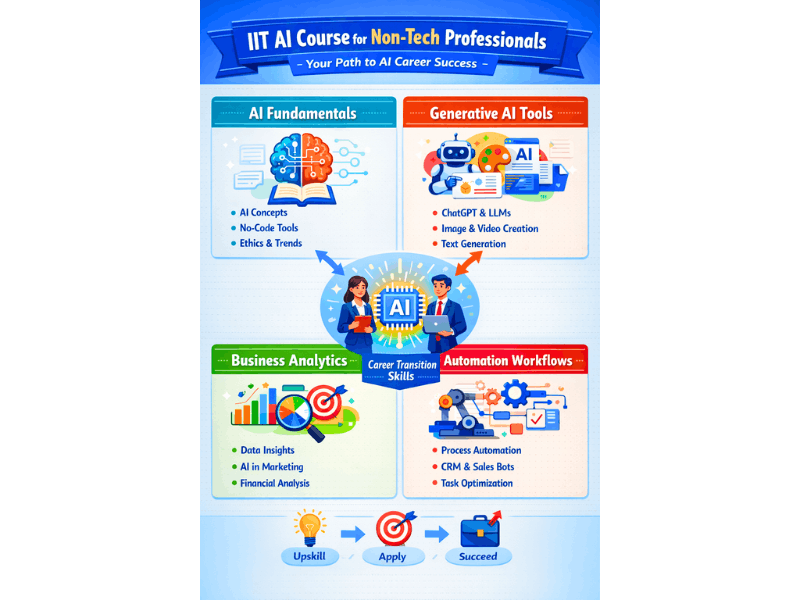
Most non-technical learners are not trying to become data scientists. They want to become AI-enabled professionals. The IIT AI Course for Non-Tech typically covers:
- AI fundamentals in simple language.
- Generative AI applications.
- Business analytics.
- AI-driven decision making.
- Automation workflows.
Think of it like learning how to manage AI systems, not build them from scratch. In my opinion, that’s why this beginner AI course format works well for managers, MBA graduates, and entrepreneurs.
The goal of the IIT AI Course for Non-Tech is skill transformation, not technical overload. It connects the dots between AI-powered careers and conventional roles.
Executive Post Graduate Diploma (ePGD) in AI
The Executive Post Graduate Diploma (ePGD) in AI is among the most well-known forms. Professionals with prior job experience who wish to advance into AI-driven roles are the target audience for this program.
I discovered modules like AI strategy, generative AI tools, business applications, and machine learning fundamentals when I looked into its structure.
It isn’t very mathematical. Rather, it teaches the effects of AI on industries.
Because of this, a lot of non-technical professionals favor this executive road over conventional degrees in data science.
Is IIT AI course valid for non-engineering background
Yes, absolutely.
Most IIT programs clearly state that non-engineering graduates can apply. You don’t need a B.Tech degree.
You don’t need prior coding knowledge. From what I’ve observed, what matters more is your mindset.
If you can understand business problems and are comfortable using digital tools, you can manage AI tools too. Many commerce, MBA, and marketing professionals are already enrolling.
The key is willingness to learn and practice. AI today is about application, not just programming. That’s what makes it accessible.
Can a Non-Tech Person Really Learn AI?
The most common fear I hear from readers is this one. “AI seems complex. Is it really possible for someone who doesn’t know how to code to learn it?”
Honestly, I had the same doubt when I first explored the IIT AI Course for Non-Tech. We’ve been taught that AI is equivalent to engineering math, statistics, and Python.
However, such is out of date thinking. By 2026, AI will be driven by tools rather than code.
The objective of contemporary AI job change programs is problem-solving. They show you how to automate chores, increase productivity, and make better judgments by using AI systems.
That is not the same as creating AI models from the ground up. The IIT AI Course for Non-Tech is structured around application.
It doesn’t aim to turn you into a software developer. Rather, it equips you for jobs in AI strategy, AI consultancy, and AI automation.
From my observation, non-tech professionals often perform better in AI strategy because they understand business pain points.
The key is mindset. If you can learn Excel formulas, CRM software, or marketing tools, you can absolutely learn AI tools.
That’s why the IIT AI Course for Non-Tech feels approachable today. Let’s break it down further.
Prompt Engineering for Non-Coders
Prompt engineering is probably the easiest entry point into AI without coding. You don’t write programs.
You write instructions. That’s it.
In many IIT AI Course for Non-Tech modules, learners practice how to:
- Structure prompts.
- Automate reports.
- Generate insights.
- Create AI-assisted workflows.
It’s like learning how to ask smarter questions. The better your instruction, the better the AI output. This makes AI accessible to beginners.
No programming language required. Just clarity of thinking.
No-Code AI Tools Mastery
Things start to become useful at this point. These days, the majority of AI courses for beginners place a strong emphasis on no-code platforms.
You learn tools like:
- ChatGPT for content and research.
- Automation platforms for workflow management.
- AI workflow builders for task automation.
- Data visualization dashboards.
You incorporate tools rather than creating algorithms. AI can be integrated with marketing platforms, CRM systems, and spreadsheets, for instance.
The learning curve was reasonable when I tested a couple automated procedures.
You’re not feeling overburdened. You have a sense of empowerment. The true change is that.
Coding-free AI is no longer a myth. It’s a set of abilities. And structured programs make it even more accessible.
IIT Madras vs IIT Delhi AI Course (Comparison Table Required)
This comparison can help you cut through the clutter if you’re thinking about switching careers in AI but lack technical expertise.
Many non-technical students are overloaded with options in 2026, particularly when it comes to esteemed programs like these.
Both programs are recognized and reputable, but they serve slightly different purposes for professionals seeking an IIT AI Course for Non-Tech path.
After looking over the course material and talking to former students, I concluded that while both are beneficial, you should decide which one best suits your professional goals.
Here’s a clear breakdown.
| Component | IIT Madras AI Program | IIT Delhi AI ML course for working professionals 2026 |
|---|---|---|
| Fees | ₹1.5–2.3 Lakhs | ₹1.8–2.8 Lakhs |
| Duration | 9–12 Months | 8–10 Months |
| Core Modules | AI Fundamentals, ML Basics, Business Use Cases | AI Strategy, Machine Learning, Applied Projects |
| Difficulty | Beginner–Intermediate | Intermediate (some technical exposure) |
| Certification | Executive Certificate / Diploma | Professional Certification |
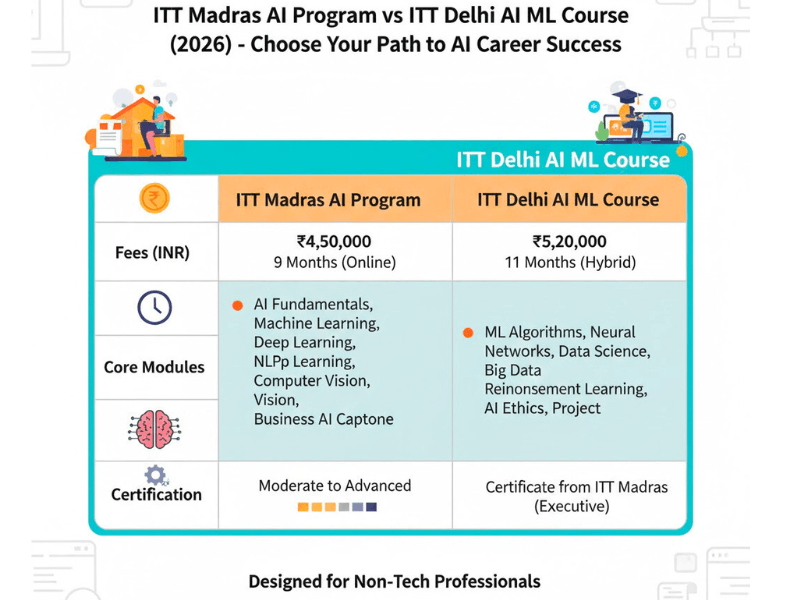
The IIT Madras approach seems more beginner-friendly when I took a closer look at the structure. That’s why many people approaching an IIT AI Course for Non-Tech start here.
Instead of emphasizing coding proficiency, modules are meant to foster confidence and practical application.
The IIT Delhi AI ML course for working professionals 2026, on the other hand, delves farther into applied machine learning.
Although committed non-tech learners can still master it, it might require a little more technical thought. This could be a fantastic fit for you if you’re looking for a little bit more speed and significant project exposure.
Both programs offer opportunity, solid networks, and prestige. But keep in mind that success is not guaranteed by brand alone.
Your consistency, practice, and application will.
New 2026 Trend: Agentic AI & Career Opportunities
I’ll be honest here. When I first heard the term Agentic AI, I ignored it.
It sounded like just another trendy tech term that would go out of style in six months.
However, I came to a realization after watching how businesses are utilizing automation, going to webinars, and going over new IIT modules.
This is not the same.
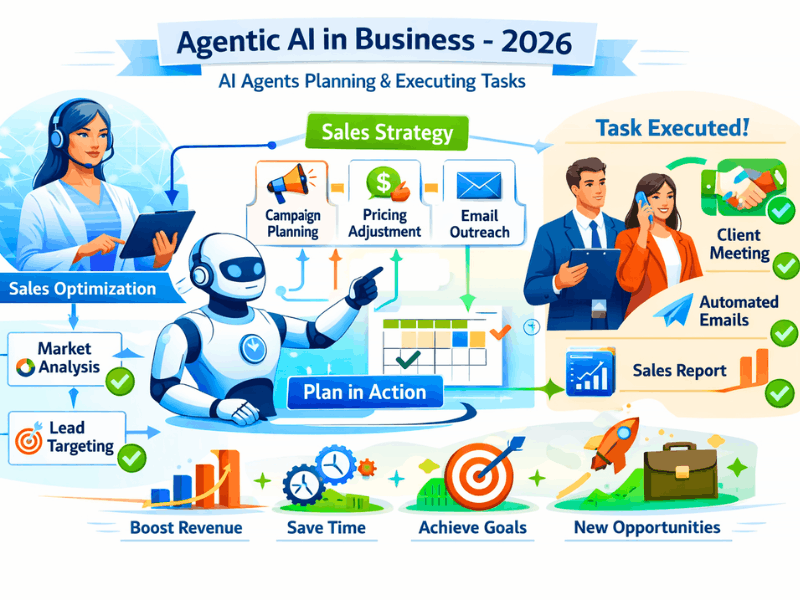
AI systems that act rather than just react are referred to as agentic AI. They evaluate an objective, decompose it into manageable steps, and carry out activities automatically.
Simply said, it’s AI that acts like a virtual worker. For those who are not techies, this is where it becomes interesting.
The modern IIT AI Course for Non-Tech is no longer limited to theory. Since companies are aggressively using agentic AI concepts, many upgraded programs now introduce them.
Additionally, this is giving rise to a new class of AI automation jobs. These systems don’t require coding.
You must learn how to control them. That is a significant change. You manage clever workflows rather than creating algorithms.
Professionals with backgrounds in business, marketing, and operations tend to adjust rapidly, based on my own observations.
Because they already understand processes. They just need to layer AI on top. The latest versions of the IIT AI Course for Non-Tech are preparing learners exactly for this reality.
And yes, Agentic AI is becoming central to that transformation.
Agentic AI for Business Leaders
Let’s make this very simple. Imagine you set a goal: “Increase sales by 20% this quarter.”
An Agentic AI system can analyze customer data, create targeted campaigns, optimize pricing strategies, and even automate follow-ups. It doesn’t wait for step-by-step instructions.
It plans and acts. That’s powerful. For business leaders, this means a new responsibility.
Not coding. But decision-making. In one discussion I had with a program mentor from an IIT AI Course for Non-Tech, he said something practical:
“Future managers will manage AI agents the way they manage teams today.” That stuck with me.
Roles emerging here include:
- AI Strategy Manager.
- Digital Transformation Lead.
- Automation Director.
Agentic AI is less about technology and more about leadership. And that’s why non-tech professionals can thrive here.
Generative AI for Product Management
Now let’s talk about product careers. Generative AI is already changing how products are built.
Instead of spending weeks brainstorming features, product managers now use AI to generate ideas instantly. They test prototypes faster.
They analyze customer feedback in minutes. You don’t need programming skills.
You need clarity of thinking. Inside advanced modules of the IIT AI Course for Non-Tech, generative AI tools are introduced for product ideation, market analysis, and competitive research.
This opens roles like:
- AI Product Manager.
- AI Innovation Consultant.
- AI Implementation Specialist.
Companies want professionals who understand both user needs and AI capabilities.
That combination is rare. And valuable. If you’re coming from MBA, marketing, or operations, this could be your smartest transition in 2026.
Jobs & Salary After IIT AI Course
Let’s talk practically. Before enrolling in any program, I always ask one thing: “Will this actually improve my income?”
When I started researching placement outcomes and speaking with professionals who completed similar programs, one pattern became clear.
The biggest gains don’t come from the certificate alone. They come from how you use it.
The IIT AI Course for Non-Tech is helping many professionals move into hybrid AI roles — especially those who already have 3–8 years of experience.
Based on recent IIT AI course placement statistics for non-tech roles shared in alumni forums and career webinars, demand is rising for applied AI profiles rather than hardcore developers.
Typical roles include:
- AI Business Analyst.
- Automation Consultant.
- Prompt Engineer.
- AI Product Associate.
- Data-Driven Marketing Manager.
- Digital Transformation Lead.
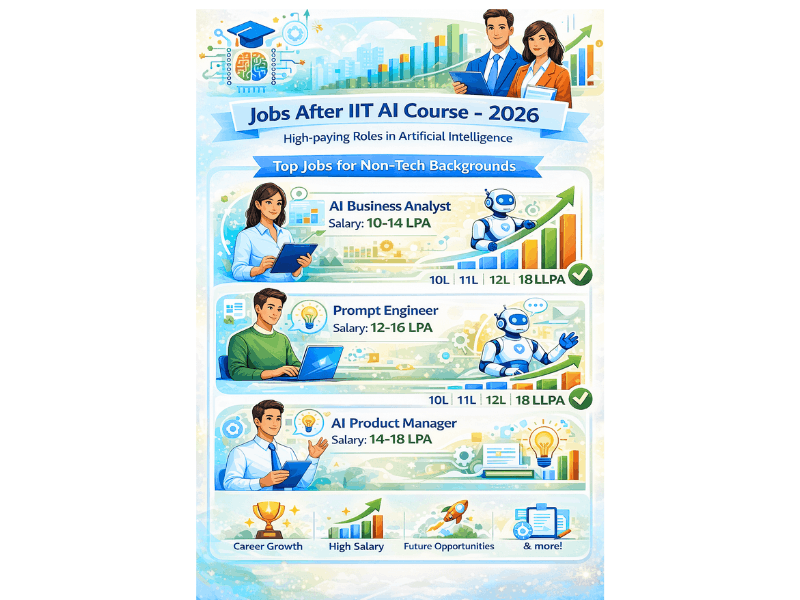
Now about salary.
If you’re switching from a ₹5–7 LPA background, moving into an AI-enabled role can realistically push you toward ₹10–18 LPA within 1–2 years — provided you apply the skills actively.
For mid-level managers, AI-driven ROI for Professionals is often seen internally. Some don’t even change companies.
They use automation to increase performance, reduce costs, and improve results — and that leads to promotions. From what I’ve seen personally, AI doesn’t replace your experience.
It multiplies it. And that’s where the real earning power begins.
Fees, Duration & Cost Worth It?
Let’s face it: money is important. “Is this worth my time and savings?” was the question I asked myself before deciding to look into AI education possibilities.
High-end program fees can differ significantly. For example, the IIT Kanpur Professional Certificate in Generative AI cost typically falls between ₹1.2 lakh and ₹2 lakh (depending on batch and payment plan).
That sounds like a lot — because it is a significant investment. But here’s what I learned from talking to past students.
They didn’t just pay for content. They paid for structure, mentorship, and networking — things most free online resources lack.
Now, when it comes to MBA students and professionals with no coding experience, you’ll want something that teaches tools, strategy, and business application — not deep programming.
That’s why many people prefer certain executive certificates over traditional technical degrees.
The “best IIT AI course for MBA students with no coding” focus is on practical skills you can apply immediately — like automation workflows, prompt strategy, and AI-driven decision making.
If you’re someone who wants useful skills rather than theory, then evaluating the fees against future earning potential is key. Yes, the price tag can be high.
However, the return frequently justifies the expenditure if the curriculum is in line with your professional objectives and you’re serious about advancement.
Career Transition for Non-Tech Professionals
Let’s talk honestly. Most people think switching to AI means starting from zero. That’s not true.
In fact, the smartest career transitions I’ve seen didn’t involve quitting jobs overnight.
They involved adding AI on top of existing skills. Take a school teacher, for example.
They can learn AI tools for personalized learning systems, automated assessments, and content creation rather than quitting school. All of a sudden, they are more than just an educator.
They specialize on AI-enabled education. Now consider a graduate with a B.Com.
With basic knowledge of accounts and finance, they can learn AI-powered financial analysis tools.
They can automate reports, forecast trends, and become more valuable inside finance teams.
Sales professionals? AI-driven CRM systems, predictive lead scoring, and automation workflows can transform them into revenue strategists.
Marketing professionals can shift into performance analytics, AI campaign optimization, and data-driven branding. And MBA students?
They are actually in a strong position.
AI strategy, digital transformation, and product innovation roles need business thinkers — not programmers.
That’s where structured programs like an IIT AI Course for Non-Tech can help. Not because of the certificate alone.
But because it provides direction. From what I’ve personally observed, the safest transition is gradual.
Start applying AI inside your current role. Build confidence. Then shift fully when you’re ready.
That way, you grow without gambling your career.
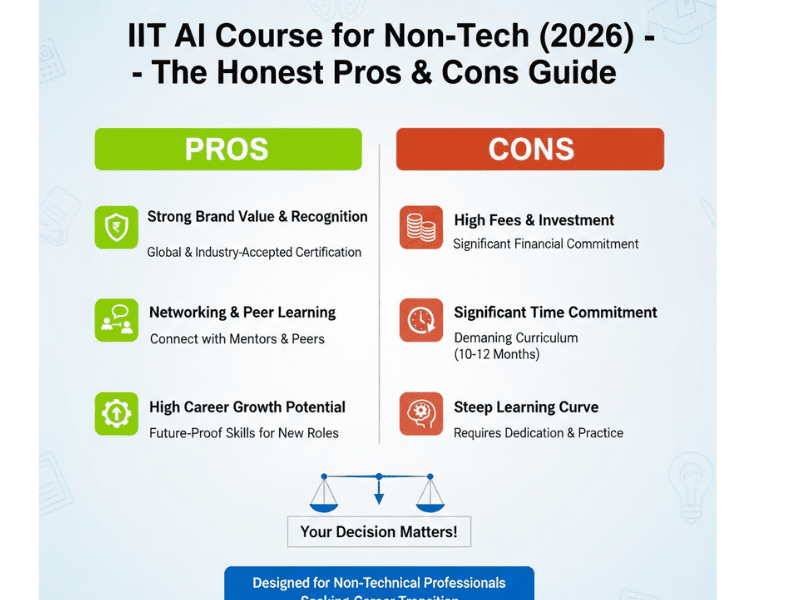
Honest Pros & Cons
Let’s be honest and take the marketing hat off. No course is flawless. Furthermore, no certification ensures success.
As a non-technical professional thinking about enrolling in an IIT-based AI program, here is the fair assessment I would offer a close friend.
Pros
Strong Brand Value – Your CV immediately gains credibility when you use the IIT name.
Structured Learning Path – A well-defined plan as opposed to sporadic YouTube lessons.
Industry-Relevant Curriculum – Pay attention to commercial use cases, automation, and AI applications.
Networking Opportunities – access to industry mentors, alumni, and peer groups.
Career Transition Support – beneficial for people preparing to change careers in AI.
Confidence Boost – Beginners are less afraid when they learn AI in a guided manner.
Cons
High Fees – Depending on the program, investments can range from ₹1 to ₹3 lakhs.
No Guaranteed Placement – While brand is important, performance is more important.
Requires Self-Practice – Lectures alone are insufficient; practical experience is necessary.
Some Technical Concepts – Basic logic or statistics may be included in even non-tech programs.
Time Commitment – It might be difficult to juggle employment and school.
In my opinion, the training is effective if you take initiative. You’ll be let down if you’re expecting shortcuts.
However, it can really speed up your development if you’re willing to study and put it into practice on a regular basis.
Final Verdict — Should You Join in 2026?
I’ll answer this the way I would if you were sitting across from me. Don’t join just because it says “IIT.”
And don’t avoid it just because you’re from a non-tech background. In 2026, AI is quietly becoming part of almost every profession — marketing, finance, operations, even education.
Ignoring it isn’t a smart option anymore. But rushing blindly isn’t smart either. If you’re considering an IIT AI Course for Non-Tech, think about your intention.
Are you trying to escape your current job? Or are you trying to upgrade yourself? The second mindset works.
The first usually leads to disappointment. From what I’ve seen, people who benefit most are those who apply what they learn immediately.
They automate reports. They improve workflows. They test AI tools inside their current role.
Gradually, their confidence grows. Then better opportunities follow. So should you join?
Yes — if you’re ready to put in effort consistently.
No — if you expect the brand name alone to change your career.
AI is powerful. But your discipline matters more.
FAQs
1. Which AI course is best for non-technical?
Don’t dive right into hardcore data science if you don’t have a technical background. Seek out an introductory AI course that emphasizes automation tools, real-world corporate use cases, and AI without coding. For individuals preparing to transition to a practical AI career, executive-style AI certification programs in India are typically superior.
2. Is there any AI course in IIT?
Indeed, a number of IITs provide working professionals with AI and machine learning curricula. The majority of them are executive or certificate programs that cover applied AI, analytics, and generative AI. They are made for managers and career changers in addition to engineers.
3. Can non-tech people learn AI?
Of course. Understanding the fundamentals of AI doesn’t require programming knowledge. Prompt writing, automation platforms, and no-code AI technologies are ways that many professionals learn. AI becomes less about technical coding and more about problem-solving with regular practice.
4. Can a non-technical person become an AI engineer?
Strong arithmetic and coding abilities are typically needed to work as a core AI engineer. Non-technical workers can, however, transition into AI-related positions without becoming complete engineers, such as AI analyst, automation consultant, or AI product specialist.